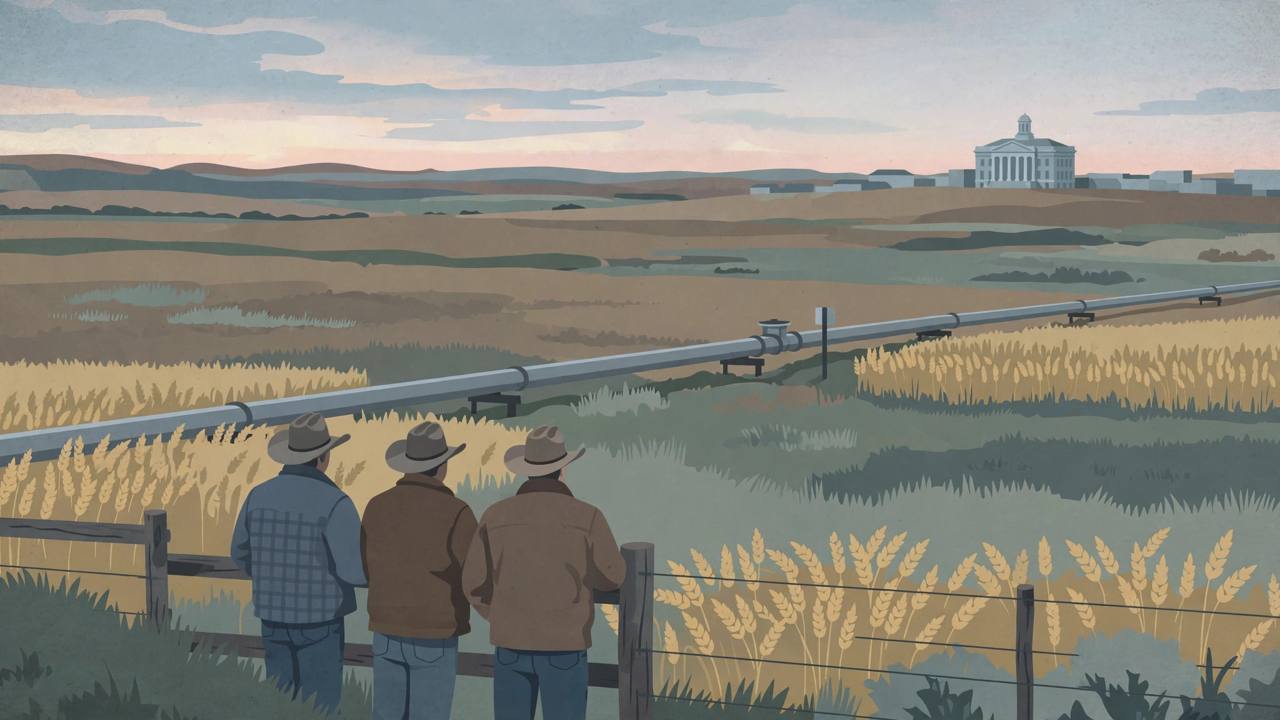
On Monday, November 9, 2026, the United States Supreme Court will hear oral argument in Hoffmann v. WBI Energy Transmission, Inc. (No. 25-159), a property-rights case from North Dakota that asks a deceptively simple question: when a private pipeline company uses federal eminent-domain power to take an easement across your land, who decides what you are owed — your state's law, or the federal Fifth Amendment alone? For the McKenzie County landowners at the centre of the case, the answer is worth exactly $383,375.76 in attorneys' fees and litigation costs that they won in a lower court and then lost on appeal.
The lead petitioner is North Dakota rancher Leonard W. Hoffmann, together with neighbouring landowners. The respondent is WBI Energy Transmission, Inc., the natural gas company that brought a private condemnation action against them under the Natural Gas Act in the United States District Court for the District of North Dakota. The landowners are represented by the Institute for Justice, a public-interest law firm. The United States government has filed a brief supporting the company's position, arguing that the Fifth Amendment's standard for just compensation does not include recovery of attorneys' fees.
How a pipeline crossed the ranch
The dispute began in 2018. In February of that year, according to a detailed case analysis by the Dorsey law firm, WBI Energy Transmission received federal certificate authorization to construct and operate approximately 12 miles of 24-inch-diameter pipeline through ranch land in western North Dakota, in the heart of the oil and gas producing Bakken formation of the Williston Basin. Section 7(c) of the Natural Gas Act requires a certificate of public convenience and necessity from the Federal Energy Regulatory Commission (FERC) before new interstate gas pipelines can be built, and Section 7(h) gives certificate holders the power of eminent domain — the right to take private property for the project, paying just compensation, in federal or state court where the property sits.
Source: Dorsey — case analysis of Hoffmann v. WBI Energy Transmission (Natural Gas Act takings)
WBI obtained its easement across the Hoffmann group's land, but the price took three years of condemnation litigation to settle. The parties eventually agreed on the value of the easement itself. What they could not agree on was the legal bill: the ranchers asked to recover $383,375.76 in attorneys' fees and costs, while WBI argued the amount was unreasonable and should be capped far lower. The district court sided with the landowners, reasoning that because the Natural Gas Act is silent on compensation, North Dakota condemnation law could fill the gap — and North Dakota law provides for attorneys' fees as part of what a landowner receives.
The appeal that wiped out the award
In March 2025, the United States Court of Appeals for the Eighth Circuit vacated the fee award. Because WBI was exercising eminent-domain authority granted by a federal certificate under the Natural Gas Act, the appeals court held, federal law — not state law — dictates the terms of compensation. Under the Fifth Amendment standard, which guarantees just compensation for the property taken, attorneys' fees are not part of the payment. The ranchers' $383,375.76 award disappeared, and they petitioned the Supreme Court, which agreed to hear the case. The formal question before the justices is whether, in private condemnations under the Natural Gas Act, just compensation should be determined by reference to state law.
Source: George Washington Law Review preview, Hoffmann v. WBI Energy Transmission
The Natural Gas Act lets a federally certified pipeline company take land, but it never says how compensation is measured. North Dakota law says a landowner's legal fees count. The Fifth Amendment, as courts have read it, pays for the property only. The Supreme Court must now choose which measure a private company follows.
A split among the federal appeals courts
The case arrives with a genuine circuit split, the kind the Supreme Court exists to resolve. The ranchers point out that four other federal appeals courts — the Third, Fifth, Sixth and Eleventh Circuits — have allowed state law to supply the compensation rules in private Natural Gas Act condemnations, following the approach of United States v. Kimbell Foods, Inc. (1979), under which federal courts borrow state law to fill gaps where no federal programme is frustrated. The Eighth Circuit's contrary ruling in this case is the outlier the landowners want overturned. Their lawyers argue that Congress legislates against a backdrop of state property law, that the Act borrows language from the Federal Power Act that courts read as referring to state law, and that states are the primary source of the rules governing real property.
WBI and the federal government answer that eminent domain is an attribute of federal sovereignty: when Congress delegates that federal power to a private company without expressly adopting state compensation rules, the company stands in the position of the federal government, and the Fifth Amendment measure applies. WBI invokes United States v. Miller (1943) for the proposition that when a statute is silent, the Fifth Amendment defines compensation and only Congress can offer more — so if landowners want fees, they should ask Congress, not the courts. Both sides also claim PennEast Pipeline Co. v. New Jersey (2021), the decision that confirmed the Act delegates federal eminent-domain power to private parties, supports their reading: WBI stresses the word federal, while the landowners say PennEast decided only who may sue, not which compensation law applies.
Source: George Washington Law Review preview — arguments in Hoffmann v. WBI Energy Transmission
Why the case reaches far beyond one ranch
Pipeline easements cross farmland all over the United States, and the fee question shapes every negotiation before a case is ever filed. If a landowner knows the company must also pay reasonable legal costs when state law provides for them, fighting a low valuation is far less risky; if the owner must absorb six figures of legal bills out of the compensation itself, many families will accept the first offer on land their family has ranched for generations. Florida property owners backing the ranchers as friends of the court point to their own experience with the 247-mile Sabal Trail pipeline in Florida, where landowners faced the same fee fight. Energy corridors in the Bakken also sit inside the working world of the region's truckers and haulers, for whom pipeline build-outs mean both jobs and disruption across ranch roads and county highways.
What happens next
The justices will hear argument on Monday, November 9, in Washington, with each side answering questions from the bench. No decision will be announced that day: argued cases are normally decided later in the term, after the justices vote in private conference and opinions are drafted. A ruling for the ranchers would restore the state-law route to fee recovery in Natural Gas Act takings nationwide and vindicate the $383,375.76 award in this case; a ruling for WBI would make the Fifth Amendment the single national measure, and landowners in states like North Dakota would bear their own legal costs even when a company takes their land. Either way, as the Dorsey analysis notes, Congress could still legislate afterwards — the Court is deciding what the current law means, not writing the final word for all time.
For landowners anywhere in America — including immigrant farmers and ranch families who bought land in states like North Dakota, Texas and California — the case is a reminder that the constitutional promise of just compensation is only as strong as the rules that measure it, and that the cost of enforcing a right can decide whether the right is worth enforcing at all. Awaaz Punjab will report the Court's decision when it is handed down.