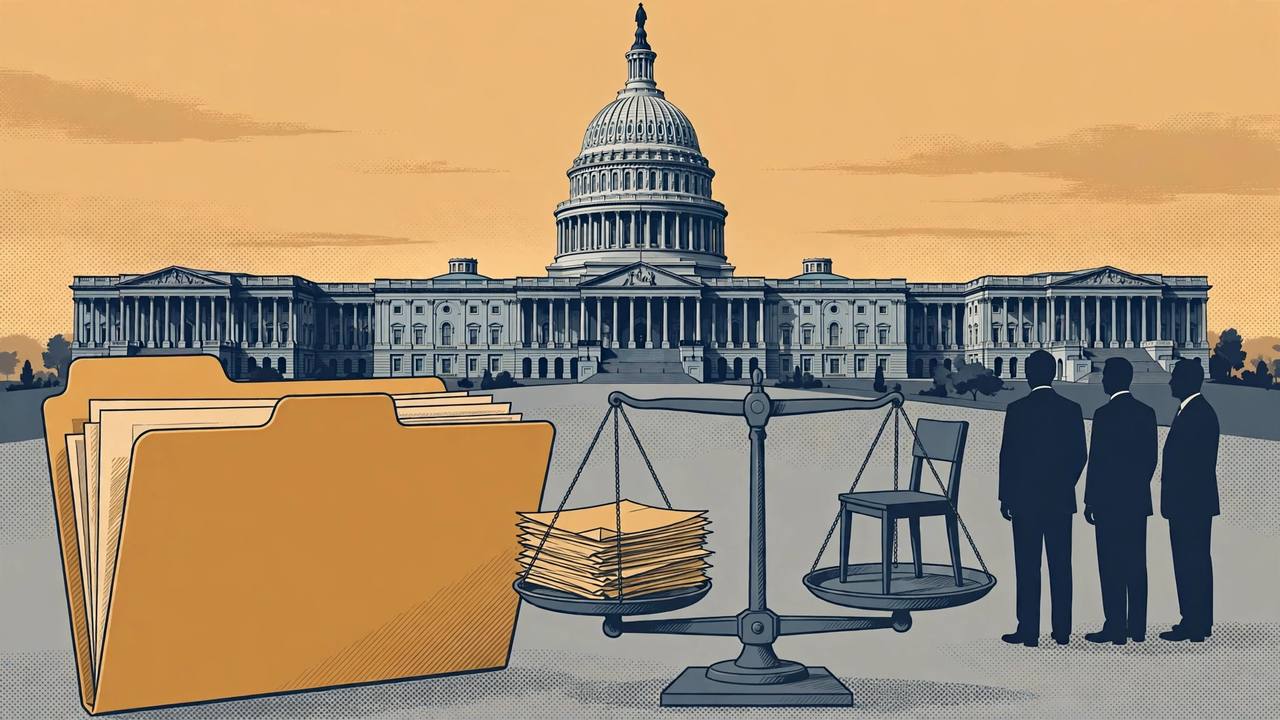
The Republican majority on the Senate Appropriations Committee released its Homeland Security funding bill for fiscal year 2027 on Thursday, November 12 — a $78.2 billion draft for the Department of Homeland Security whose most consequential line is the one that is not there. The bill contains no annual appropriation at all for U.S. Immigration and Customs Enforcement (ICE) or for the Border Patrol, because, the committee says, both agencies have already been paid for years in advance by multiyear laws Congress passed earlier.
Source: Senate Appropriations Committee
For immigrant communities — including the Punjabi diaspora families, students, workers and truck drivers who deal with this department more than almost any other part of the U.S. government — the draft matters less for what it spends than for what it takes off the table. For most of the past two decades, the annual Homeland Security bill was the one place where Congress set ICE's detention budget and bed count, and where fights over enforcement were fought line by line. This draft removes that yearly lever almost entirely, and replaces it with oversight money, reporting requirements and rules for how people in custody must be treated.
Why ICE is not in the bill
The committee's reasoning is written into its own summary. It cites Public Law 119-98 — the Secure America Act, which became law on June 10, 2026 — and the 2025 reconciliation law, Public Law 119-21. According to the committee's statement, the reconciliation law gave Customs and Border Protection more than $64 billion through fiscal 2029, and Public Law 119-98 added more than $26 billion for the Border Patrol on top of roughly $38.5 billion for ICE, money that stays available through September 30, 2029. The statement says the committee does not expect to provide additional annual resources for ICE or the Border Patrol until that money runs out.
The bill is a committee draft prepared for markup, and no markup date has been announced. Bloomberg Law reported that it is unlikely to become law as written, but that it opens the negotiations ahead of a possible government shutdown after December 11, when the current continuing resolution that funds the government expires.
Source: Bloomberg Law
What the bill does fund
The $78.2 billion total is made up of $49.8 billion in regular discretionary spending and $28.4 billion for disaster relief, according to the committee's summary; the fiscal 2026 enacted level was $74.2 billion. Customs and Border Protection receives $11.6 billion — described as $255 million above the fiscal 2026 level — with added money for aircraft and sensors, counter-drug work and trade infrastructure at the ports of entry. U.S. Citizenship and Immigration Services (USCIS) receives $123 million in appropriated funds, in the committee's words, “to sustain the level of FY2026 operations” — a small line, because most of USCIS runs on application fees, but one that covers the E-Verify employment-check system. The DHS Inspector General receives $269 million, including $20 million specifically for oversight of detention facilities.
Rules for people in custody, travellers and employers
Several provisions reach directly into detention and border processing. Section 527 of the draft limits the use of restraints on pregnant women. Section 528 bars the destruction of records about deaths or abuse in custody. Section 210 requires CBP's 2021 policy on pregnant, postpartum and nursing people and infants to stay in effect. The bill's explanatory statement also directs the department to evaluate its 287(g) partnerships with local police — the agreements under which local officers perform immigration-enforcement functions — and to brief the committee within 180 days, and it asks for monthly reports on metering and turnbacks at southwest border ports of entry.
For travellers, Section 207 bars the department from creating a land border crossing fee, or even studying one. For employers — including the trucking companies, warehouses and farms that hire heavily in diaspora communities — the USCIS line keeps E-Verify funded at current levels. One thing the bill does not contain is the immigration courts: the Executive Office for Immigration Review is funded through the Commerce-Justice-Science bill, which the committee released the same day.
The House took the opposite approach
The two chambers are not just apart on numbers; they are apart on whether ICE belongs in this bill at all. The House Appropriations Committee approved its own fiscal 2027 bill, H.R. 9310, on June 11 by a vote of 34-27. That bill provides $64.9 billion in discretionary funding, including $10.1 billion for ICE — of which $3.8 billion is for custody operations — and $18.3 billion for CBP, according to the House committee's Republican summary. House Democrats said in their own summary that the House bill would fund 41,500 detention beds.
The continuing resolution funding the federal government expires on December 11, 2026. Congress can pass another short-term extension, which would keep DHS at fiscal 2026 rates, or negotiate a full-year bill with the outgoing majorities. No Senate markup of the Homeland Security bill has been scheduled yet.
What happens next
The politics around the draft are shaped by the calendar. Democrats take control of both chambers of Congress in January, and senior Democrats have said they want to condition enforcement money on changes in how ICE operates; in June, House Appropriations ranking Democrat Rosa DeLauro said Democrats would not back more money for ICE and the Border Patrol without substantial reforms. Republicans, led in the House by Appropriations Chairman Tom Cole, have framed border and enforcement funding as a core federal duty. With ICE's core funding locked in by statute for years, however, an incoming majority that withheld an annual appropriation would not cut the agency off — the leverage that remains lies in riders, reporting requirements and oversight money, which is exactly where this draft puts some of its weight.
The practical effect reaches the shutdown fight itself. Because the multiyear enforcement money is already law, ICE and the Border Patrol would likely keep operating even through a lapse in annual funding — a change from earlier years, when a Homeland Security shutdown bit into enforcement first. A lapse after December 11 would instead weigh most heavily on the parts of the department that depend on annual funds, from port operations to the services USCIS funds through appropriations. For the communities who watch this department closest, the next fixed points are the unscheduled Senate markup, the December 11 deadline, and the new Congress in January.