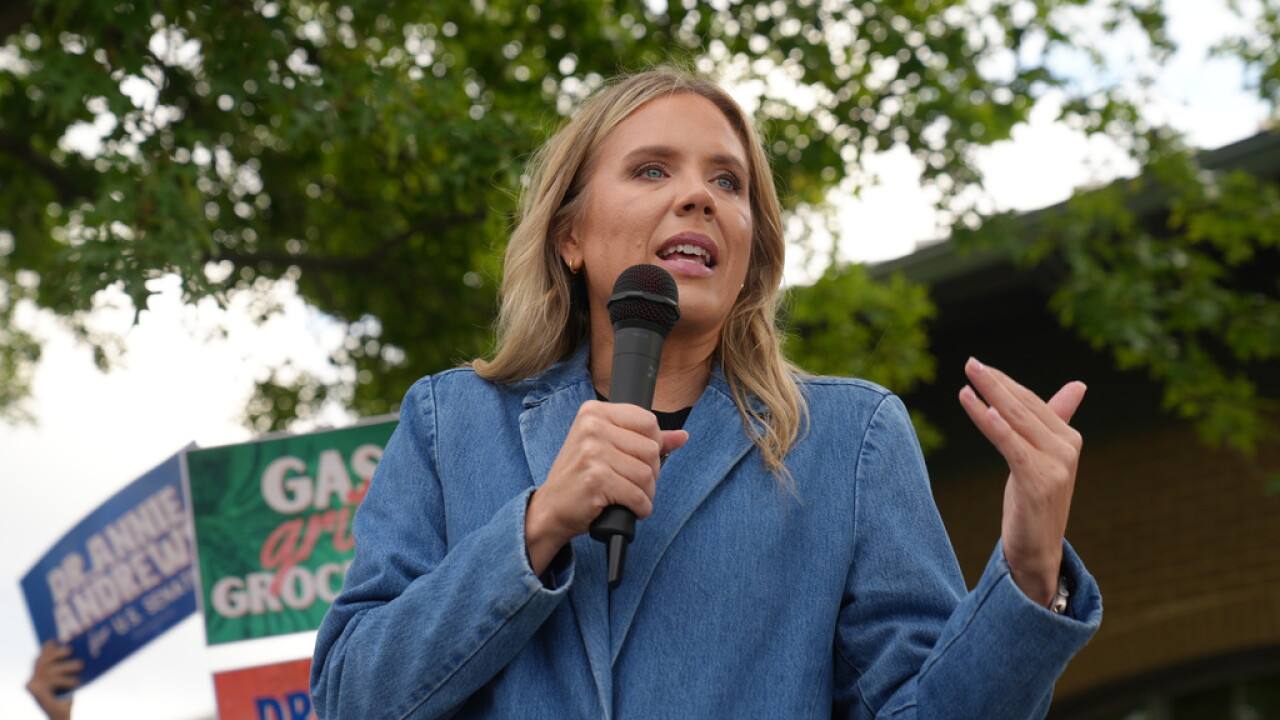
South Carolina has delivered the upset of the 2026 midterm elections. The Associated Press called the state's U.S. Senate race on Tuesday night, November 3, 2026, for Democrat Annie Andrews, a 45-year-old Charleston pediatrician, over Republican Senator Darline Graham — the appointed incumbent who held the seat once occupied by her late brother, five-term Senator Lindsey Graham, and who ran with the full backing of President Donald Trump. NPR, reporting the AP call at 10:39 p.m. Eastern, said Andrews becomes the first woman ever to win a Senate election in South Carolina and the first Democrat elected to the Senate from the state since 1998. All election-night figures are unofficial until South Carolina certifies the result.
The count behind the call was not a squeaker that flipped on a late batch of ballots. In the tally compiled from the state count at about 95 per cent reporting at 10:44 p.m. Eastern, Andrews stood at 984,027 votes, 51.0 per cent, against Graham's 916,267 votes and 47.0 per cent — a lead of 67,760 votes in a state Donald Trump carried by nearly 18 percentage points in the 2024 presidential election. Decision Desk HQ's separate count, at 87 per cent reporting, told the same story: Andrews at 963,293 votes, 51.07 per cent, to Graham's 886,289 and 46.99 per cent, with Libertarian Kasie Whitener at 21,256 votes. Two independent tallies, one conclusion: the Republican stronghold voted Democratic for the Senate for the first time in 28 years.
A seat that reached the ballot through a death in office
No seat on the 2026 ballot carried a stranger history. Lindsey Graham, first elected in 2002 and re-elected in 2008, 2014 and 2020 — when he beat Democrat Jaime Harrison by about 10 points in a race many expected to be close — had won his party's primary again in June and was seeking a fifth term when he died suddenly on July 11, 2026, at 71. Governor Henry McMaster was required to appoint a successor. On July 13, President Trump publicly recommended Lindsey's sister, Darline Graham, calling the appointment, in the words later reported from his statement, a 'fabulous tribute' to her brother; Senate Majority Leader John Thune backed the same choice. McMaster selected Darline Graham on July 13 and she was sworn in on July 14, becoming the first woman to represent South Carolina in the Senate. A week later she announced she would run for a full term.
Getting to November was its own fight. Because Lindsey Graham had already won the June Republican primary, the party held a special primary on August 11; no candidate won a majority, and Darline Graham, 62, a former commissioner of the South Carolina Commission for the Blind, beat Representative Ralph Norman in an August 25 runoff with 52.5 per cent of the vote. In the Senate, she was a reliable Trump vote in her short tenure: NPR noted she fought Democratic efforts to rein in the president's war powers over the Iran war and voted to confirm Todd Blanche as Attorney General. Trump returned the loyalty in person, campaigning for her at rallies in Pendleton on October 21 and in Rock Hill a week later, and urging supporters to vote as if his own name were on the ballot.
The doctor who asked what an inhaler costs
Andrews built her campaign out of her consulting rooms. A pediatrician who spent 14 years at MUSC Children's Hospital in Charleston and is a mother of three, she first ran for office in 2022, losing a U.S. House challenge to Republican Representative Nancy Mace, announced her Senate campaign in 2025 and won the June Democratic primary with 61.5 per cent of the vote over former Paine College administrator Brandon Brown. Her message was affordability, told through her patients. 'I would diagnose kids with common chronic diseases like asthma and diabetes, and I found that while I would explain my treatment plan to the parents so often, they would say, "Well, how much is that inhaler going to cost?" Or "How much is that insulin going to cost?"' she told NPR last month. 'No parent in America should have to be thinking about their pocketbook when they're hearing news that their child has a chronic illness.' Her platform paired that health-care pitch with ending tax breaks for the wealthy, raising wages, affordable child care, and action on housing, energy and grocery costs.
Source: NPR interview with Annie Andrews, reported Nov. 3, 2026; Scripps News candidate profile
The money shows how seriously both parties took a race that was not supposed to be competitive. Reuters reported that Andrews outraised Graham by $22 million. Republican outside groups poured $27 million into holding the seat, while Democratic groups invested $24 million to flip it, and the Senate Leadership Fund, the main Republican super PAC, added a further $5 million in October as the contest tightened. The late polls explained the panic: a Citadel poll had Andrews one point ahead before Trump's Pendleton rally, and a New York Times/Siena poll in the final week put the two candidates level — in a state Republicans have dominated at every level, holding every statewide office bar one, supermajorities in both legislative chambers and, until Tuesday, both Senate seats.
Republicans entered election night holding the Senate 53-47, counting the two independents who caucus with Democrats in the minority figure. Democrats needed a net gain of four seats to take control. South Carolina was not on the early list of likely pickups — it became, in the words of one election-night account, the second Democratic Senate gain of the night after Roy Cooper's flip in North Carolina, and it was won in a state Trump carried by about 18 points two years ago.
One detail in Tuesday's returns underlines that this was a verdict on the candidates, not a partisan tide: ticket-splitting. The Dispatch Times, summarising the night's calls by CBS News, NBC News and Decision Desk HQ, reported that Republican Alan Wilson held a narrow lead in South Carolina's separate governor's race on Tuesday evening, with that contest not yet called — while Graham ran about 10 points behind Wilson on the same ballots. In plain terms, a meaningful slice of voters who backed the Republican for governor chose the Democratic pediatrician for the Senate. Graham's campaign had visible stumbles: in a recent debate she admitted she was 'not that informed on national security' after struggling with a question on Taiwan, a moment her opponents replayed in a state whose politics Lindsey Graham had shaped around defence and foreign policy for two decades.
What happens next
The result is a projection by the Associated Press and other decision desks, not yet a certified outcome: South Carolina counties will complete their counts and the state will certify the result in the coming weeks, after which Andrews is expected to be sworn in for a full six-year term when the new Senate convenes in January. Graham remains in the seat until the term ends. For Washington, the flip tightens the majority arithmetic for everything ahead — war-powers votes on Iran, confirmations and the budget — because a seat the Republican leadership spent $27 million of outside money to defend is now in Democratic hands. For South Carolina, a state whose two Senate seats had been Republican-held for a generation, it ends a 28-year drought: the last Democrat to win a Senate election here was Fritz Hollings, in 1998.
For this site's readers, the South Carolina result lands on familiar ground. The state's Indian-American and Punjabi communities are concentrated around Charleston, Columbia, Greenville and the I-26 corridor, and its highways — I-95 running the coast, I-26 to the Port of Charleston and I-85 through the Upstate — are worked daily by Punjabi truckers hauling port and warehouse freight. The issues that decided this race are the same ones those families price every week: what an inhaler or insulin costs without the right insurance, child-care bills, grocery and energy prices, and a health-care system in which a pediatrician could build a winning Senate campaign simply by repeating what parents asked her in the clinic. Andrews promised to fight on exactly those costs; the record she compiles against those promises, starting in January, is the story this desk will follow.