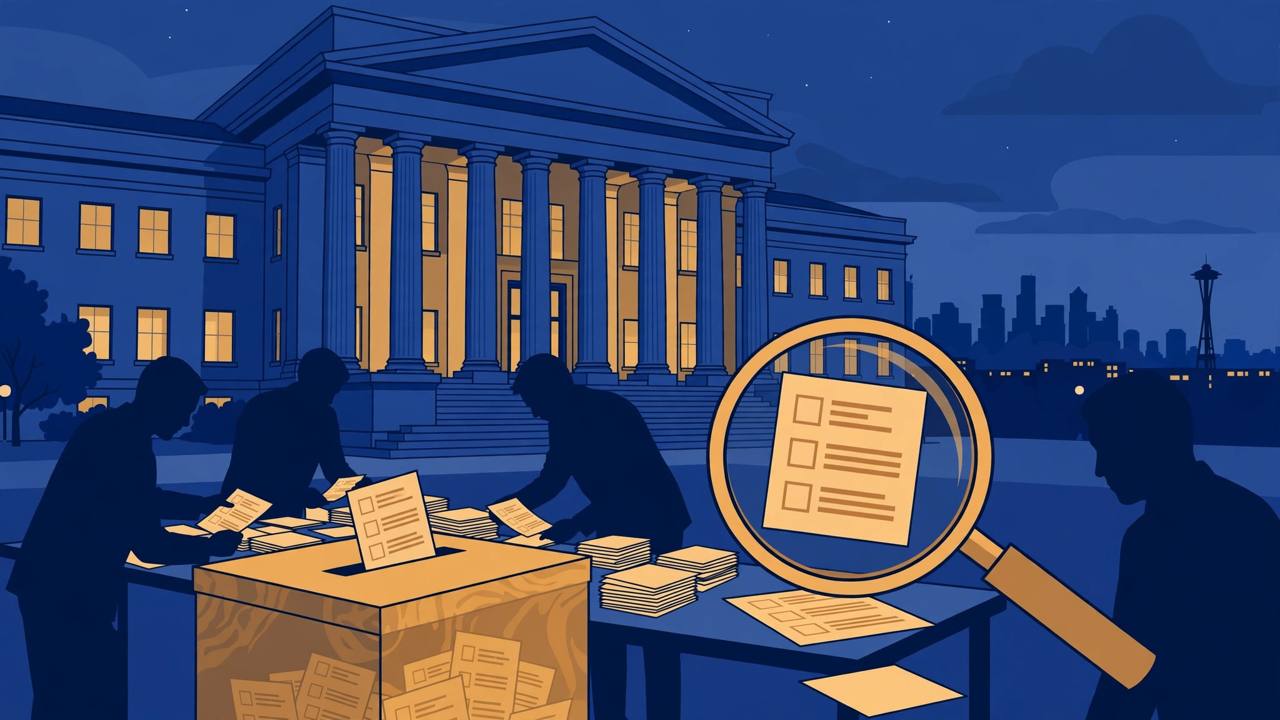
A federal judge in Seattle has barred the Trump administration from pressuring Washington state election officials to set aside the ballots of roughly 400 voters the Justice Department says it suspects are not U.S. citizens — the latest courtroom defeat for a federal push that Washington's own secretary of state had already refused, and a ruling that lands while the state is still counting ballots from Tuesday's midterm election.
Source: Democracy Docket
U.S. District Judge Jamal Whitehead issued the 14-day temporary restraining order on Thursday, November 5, two days after Election Day. The order prohibits the Department of Justice and the Department of Homeland Security from demanding that any Washington election official remove specific voters from the rolls, refuse to issue them ballots, or segregate their ballots and withhold them from the count. It also bars federal officials from threatening election workers with prosecution for refusing to comply.
How the dispute began: a list of about 400 names, sent eight days before the election
On October 26 — just eight days before Election Day — two federal prosecutors, Acting U.S. Attorney Pete Serrano of the Eastern District of Washington and First Assistant U.S. Attorney Neil Floyd of the Western District, sent Washington Secretary of State Steve Hobbs a list of roughly 400 registered voters whom the Justice Department suspected of being noncitizens. The department said the 405 people identified had collectively cast more than 1,500 ballots in previous Washington elections — an allegation the state has not accepted. Prosecutors gave Hobbs a short deadline, reported as 48 hours, to review the names and direct county officials to set the ballots aside until citizenship could be confirmed.
Hobbs refused on October 28. Washington's review of the federal list found it unreliable: it included people who are U.S. citizens, duplicate entries, people who were not currently registered, and people with inactive registrations. Democracy Docket reported that at least 62 people on the list had never even been sent a ballot, because their registrations were cancelled, inactive or could not be located. Hobbs said Washington would not stop processing a registered voter's ballot without individualized proof of ineligibility, and he has noted that the state documented only 15 instances of noncitizen voting between 1982 and 2025.
What the order does — and what it does not do
The temporary order names the Justice Department, the Department of Homeland Security and four officials — Attorney General Todd Blanche, Homeland Security Secretary Markwayne Mullin, Pete Serrano and Neil Floyd. It was granted in part in a lawsuit brought by OneAmerica Votes, the Latino Community Fund of Washington State and the United Food and Commercial Workers International Union, whose members include naturalized citizens. The judge found that federal agencies may request a state's cooperation, but may not compel it. The order does not stop federal officials from investigating unlawful voting, sharing information, or asking election administrators for voluntary cooperation — it stops demands, ballot segregation orders and threats.
This is a follow-up development in a fight this newsroom has covered since October: Washington's refusal was reported when Hobbs rejected the list, and courts elsewhere have ruled the same way in recent days. A federal judge in California rejected a similar Justice Department attempt to force officials there to segregate ballots, and the Supreme Court declined to intervene in that case on November 2. In a separate California case, U.S. District Judge Trina Thompson issued a restraining order on October 30, running through November 16, barring the department from threatening election workers — an order the Justice Department has appealed. A Washington-specific order from Judge Chutkan on November 2 also addressed the practice of sending states lists of voters the administration says may not be citizens.
Washington votes almost entirely by mail and keeps counting for days after Election Day. The voters most exposed to a list-based challenge are naturalized citizens — immigrants who became citizens and registered lawfully — because a flawed list can flag them by mistake. The state's review found exactly that problem: U.S. citizens were on the federal list. For Punjabi and other immigrant communities in the Seattle area and across Washington, the ruling means their ballots are counted on the same terms as everyone else's unless the state itself finds individualized proof that a voter is ineligible.
What happens next
The restraining order took effect immediately on Thursday and runs for 14 days unless a court extends it. A hearing on whether to issue a longer-lasting preliminary injunction is scheduled for November 18. The Justice Department could also appeal, as it did after the California restraining order. No court has ruled on whether any individual voter on the federal list is or is not a citizen, and the order does not change the basic rule that only U.S. citizens may vote in Washington or federal elections. County officials continue processing and counting ballots while the case proceeds.