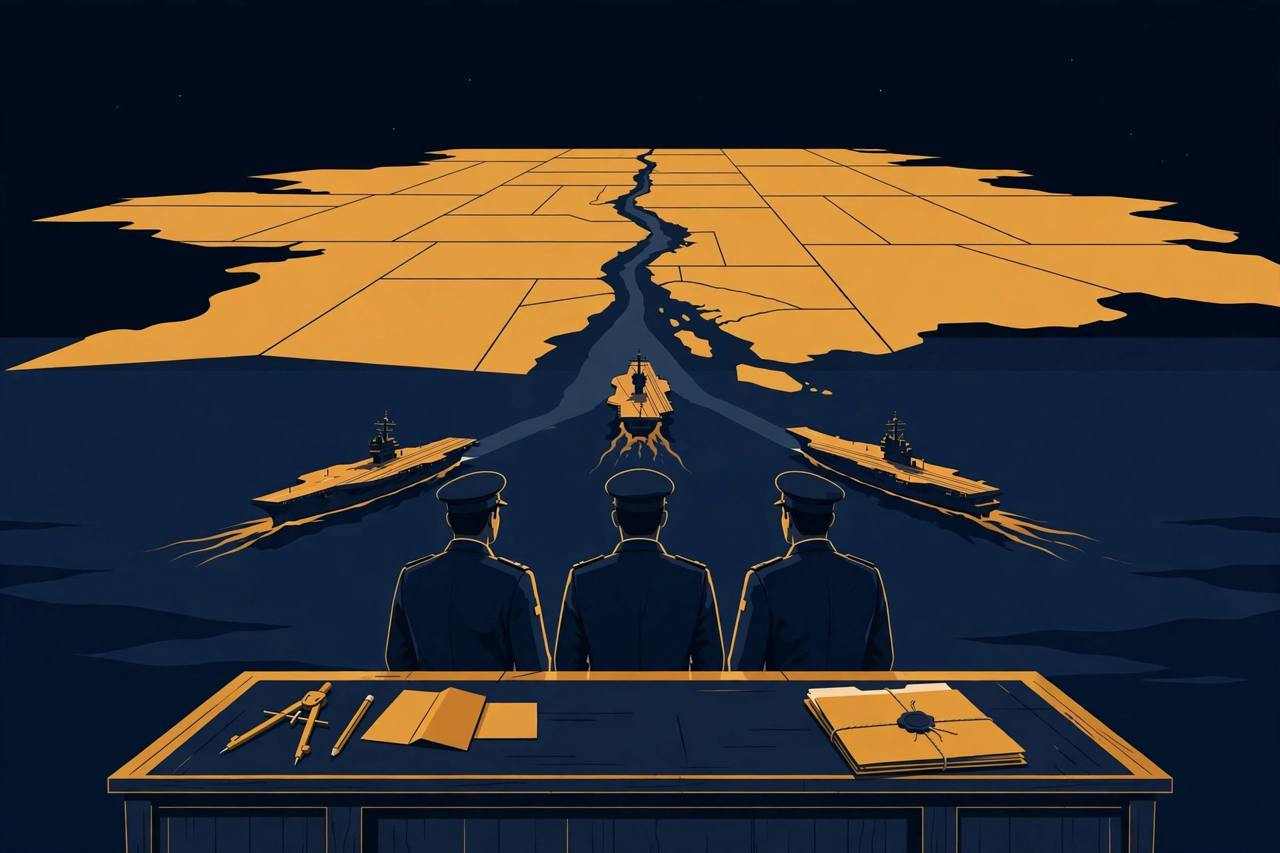
US Central Command has finalised plans for possible strikes on Iran that could begin as early as Wednesday evening, November 4, according to reports by The New York Times and The Jerusalem Post carried on Tuesday by The Media Line. President Donald Trump has not approved military action, the reports stress — but the preparations are complete for a potential three-day campaign against Iranian missile and drone arsenals, Islamic Revolutionary Guard Corps (IRGC) command centres and energy infrastructure.
Source: The Media Line (citing The New York Times and The Jerusalem Post)
The finalised plan follows weeks of preparation Awaaz Punjab has already reported: Washington warned Gulf allies to prepare for a possible short, intense campaign after the midterms, a third US carrier moved into the region, and CENTCOM commander Admiral Brad Cooper briefed Trump on his options. What is new on Tuesday is that the plan is now described as complete, with a named earliest start — Wednesday — and that it arrives alongside a separate Israeli intelligence warning about chemical weapons. Read the Gulf allies warning report
Why the window opens this week: three carriers and moonless nights
The proposed timing follows the November 3 US midterm elections and coincides with a temporary concentration of American naval forces in the region. Three US aircraft carrier strike groups are converging in the area, but one is scheduled to return to its home port after early November — a closing window. Military planners also favour the moonless nights of this period, which offer operational advantages for advanced American aircraft. The existence of a finished plan does not establish that an attack has been authorised, InvestingLive noted in its summary of the Times reporting: the decision rests entirely on Trump's approval, and he has announced none.
Source: InvestingLive (summary of New York Times reporting)
The chemical weapons warning: what Israel told Washington
Israeli officials have spent the past two weeks briefing US intelligence agencies and other officials about Iran's potential chemical weapons capabilities, The New York Times reported. Israel believes Tehran is developing the ability to deliver chemical agents through missiles, drones or covert operations, and Israeli officials consider the potential threat more urgent than Iran's nuclear ambitions. Israel has also presented its findings to Gulf governments.
Source: The Media Line (citing The New York Times)
Washington is openly split over that intelligence. Some American officials regard it as credible, citing recent warnings about Iranian preparations to attack US interests. Others question whether Israel is attempting to encourage Washington to resume military operations against Tehran — viewing the warning, in InvestingLive's summary, as part of a pressure campaign by Prime Minister Benjamin Netanyahu's government to persuade the Trump administration to resume major combat operations. Some Gulf governments, briefed by Israel, also doubt that Iran intends to deploy chemical weapons.
Source: InvestingLive
What is solid
- CENTCOM has a completed strike plan that US officials say could begin as early as Wednesday, November 4, after the midterms — reported by The New York Times and The Jerusalem Post and carried by The Media Line and Clash Report on November 3.
- Trump has not approved any strike; within his administration the sanctions-versus-strikes debate continues, and ILNA-reported sources describe a negotiations camp around Vice President JD Vance and a military-option camp around Defense Secretary Pete Hegseth.
- Unclassified US intelligence assessments have concluded that Iran 'likely aims' to continue chemical weapons research and development.
What is only claimed
- Israel's claim that Iran is preparing to use chemical weapons: it rests on Israeli intelligence shared privately over two weeks, is doubted by some US officials and some Gulf governments, and Tehran denies possessing chemical weapons at all, accusing Netanyahu of promoting the allegations as a ploy. Iran acknowledged in 2003 that it developed chemical capabilities during the 1980s Iran-Iraq war but maintained they were subsequently dismantled.
Tehran's position, and the diplomacy running in parallel
Iran continues to deny possessing chemical weapons and has accused Israeli Prime Minister Benjamin Netanyahu of promoting the allegations as a ploy. The military reporting lands on the same day as the war's other track: Qatar's mediation. Earlier on Tuesday, mediator sources said Washington had approved the draft memorandum Qatar took to Tehran — a preliminary bargain linking an Iranian nuclear concession to the release of part of Iran's frozen assets — while a senior Iranian official told Reuters the two sides remained far from a deal. Trump himself spent election morning holding both tracks open, calling Monday night's strike on Qeshm Island 'just a minor attack' while warning on Fox News: 'I'm not looking to kill lots of people, but if we have to, we'll have to.'
Source: The Media Line
The diplomacy track this plan shadows: Washington's reported approval of Qatar's draft deal with Iran, announced the same day. Read the Qatar draft deal report
Background: a war in its ninth month, at its most dangerous fork since June
The war began on February 28, 2026, when the United States and Israel launched strikes on Iran; a ceasefire and a June memorandum collapsed within weeks, the US naval blockade of Iranian ports has continued, and Iran has effectively closed the Strait of Hormuz, through which about a fifth of the world's oil moved in peacetime. On Monday night, US forces carried out limited strikes on Qeshm Island after Iranian surface-to-air fire at US assets — strikes Trump confirmed as minor. The International Maritime Organization estimates 121 incidents in Hormuz and the wider region since the war began, including 24 confirmed seafarer fatalities, and American drivers just recorded the highest-ever election-day fuel prices — $4.12 a gallon for gasoline and $6.28 for diesel — figures that show exactly why the post-midterm decision carries domestic political weight in Washington as well as military weight in the Gulf.
Source: Transport Topics (IMO estimates and election-day fuel prices)
Monday night's Qeshm Island strikes — the latest actual US attack on Iran, two days before the earliest start in the new plan. Read the Qeshm Island strikes report
Why it matters for Punjabi and Indian workers in the Gulf
Lakhs of Punjabi and Indian workers live in the Gulf states that would sit inside any new campaign's retaliation map — the UAE, Qatar, Saudi Arabia, Kuwait, Bahrain and Oman host US bases, energy plants and the ports and construction sites where those workers earn. Gulf governments have already been warned to prepare for Iranian retaliation on energy facilities and critical infrastructure, and Israel has briefed those same governments on the chemical claim. For workers and their families in Punjab, the practical questions are immediate: whether airspace and flights home stay open, whether worksites near bases and refineries stay safe, whether Hormuz shipping — and the jobs tied to it — holds, and whether remittances and fuel prices at home are hit by another escalation. None of that is decided yet: it turns on a single authorisation that, as of Tuesday night, Trump had not given.
Watch, in order: any Trump statement or order once midterm results are in on Tuesday night; whether the reported Wednesday-evening window passes quietly or with strikes; Iran's formal response both to the Qatar draft and to the chemical allegations; carrier movements, since one group is due to sail home after early November and the moonless-night window is short; and oil prices, which fell on deal hopes on Monday and slid again on Tuesday — a renewed campaign would reverse that in hours.