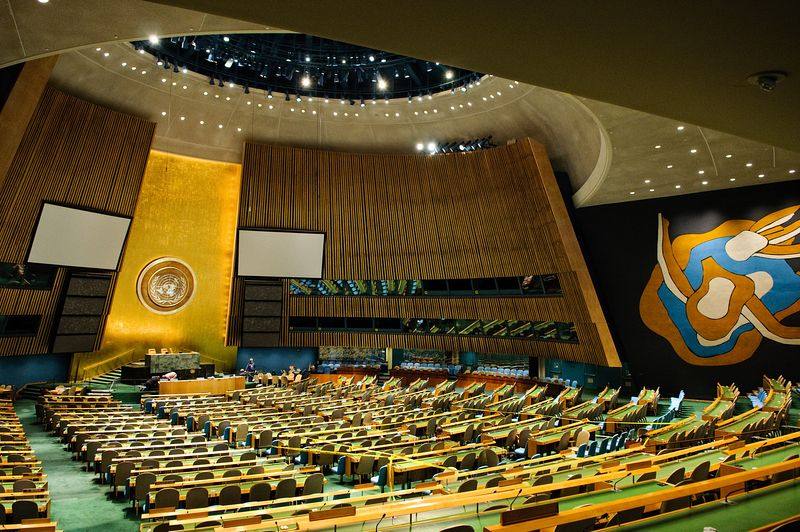
India told the United Nations General Assembly's Third Committee on Thursday that the principle of self-determination cannot be misused to justify secession or to undermine the territorial integrity of sovereign states, in remarks widely seen as aimed at Pakistan.
Source: IANS via New Kerala
Bhavika Mangalanandan, First Secretary at India's Permanent Mission to the UN, was speaking in New York during the committee's consideration of a Pakistan-sponsored resolution titled "Universal Realisation of the Right of Peoples to Self-Determination".
"It is unacceptable that attempts are continuously made at the United Nations and elsewhere to reinvent some of the basic principles of the Charter, such as self-determination, and to apply them selectively for narrow or domestic political ends," Mangalanandan said.
Source: IANS via New Kerala
What India argued
Mangalanandan said the UN has established that self-determination is a vehicle for decolonisation — a principle framed to end colonial rule — and not a justification for secession or for undermining the territorial integrity of any member state.
She added that in states that have now become independent, self-determination is best maintained through the regular exercise of democratic choice — free and fair elections in which people choose their own representatives.
India has consistently maintained that Pakistan's repeated calls for a plebiscite in Jammu and Kashmir hold no ground, pointing out that people in the region have repeatedly affirmed their future with India by taking part in democratic elections and choosing their own leaders. That is India's stated position.
Resolution adopted — without naming any territory
The Pakistan-sponsored resolution, co-sponsored by 62 countries, was adopted by consensus in the Third Committee. It did not mention any country or specific territory — a text drafted to win the widest possible support. It is expected to come before the full 193-member General Assembly for endorsement next month.
Source: APP via TezKhabar
In a departure from Islamabad's usual practice, Pakistan's Permanent Representative, Ambassador Syed Haider Shah, did not raise Kashmir while introducing the resolution. Pakistan has sponsored this resolution every year since 1981, and its text frames self-determination as a right of peoples still under colonial, foreign and alien occupation.
Mangalanandan did not name Pakistan in her intervention. But Indian media and observers noted that Islamabad routinely raises the Kashmir issue at UN forums under the guise of self-determination — and her remarks were unmistakably aimed at that practice.
Why it matters
The exchange is the latest round in a long-running India–Pakistan contest at the UN over what self-determination means. The Third Committee deals with social, humanitarian and cultural affairs; its resolutions are not legally binding, but they carry political weight and set the terms of the debate that reaches the full General Assembly.
What happens next: the resolution goes to the General Assembly for endorsement, and India is expected to keep pressing its position — that democratic participation, not secessionist claims, is the real expression of self-determination in independent states.
What is solid
- Mangalanandan's statement and quotes, as reported by IANS
- The resolution was co-sponsored by 62 countries and adopted by consensus
- Pakistan's envoy Syed Haider Shah did not raise Kashmir while introducing it
- Pakistan has sponsored this resolution since 1981
What is only claimed
- Whether Pakistan's references to Kashmir at the UN amount to a misuse of self-determination — India says yes; Pakistan frames its position as defending the rights of peoples under occupation.