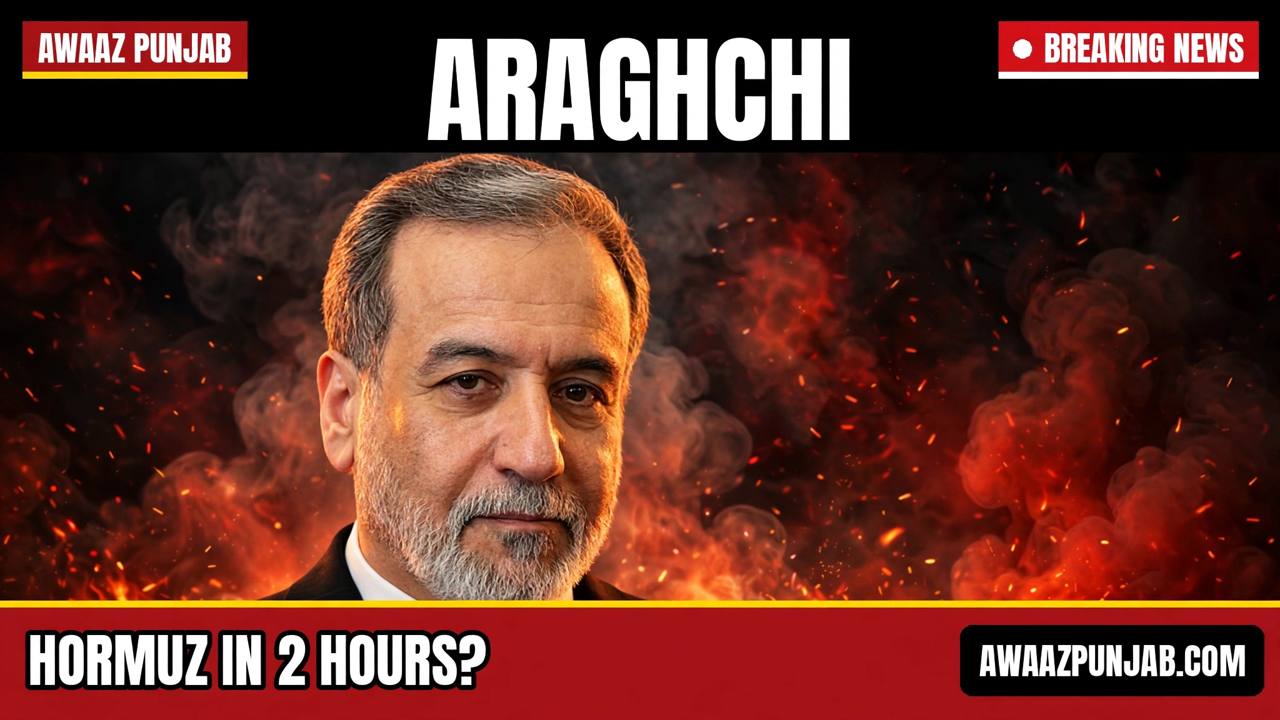
Iran's Foreign Minister Abbas Araghchi has set out Tehran's terms for a deal with the United States in a new interview, saying Iran wants a lasting agreement that guarantees the war will not return — and that the Strait of Hormuz could reopen within two hours if Washington meets Iran's conditions.
Source: Iran Daily
Araghchi first laid out the seven conditions for reopening Hormuz on November 10, when Tehran said the United States must meet its demands to end the war. This interview adds new detail — and declares the earlier Islamabad memorandum dead. Read the earlier report
The two-day plan — and the two-hour offer
Araghchi told the state-run Iran newspaper that Tehran had drawn up a seven-day plan combining US commitments under the Islamabad Memorandum of Understanding with new Iranian demands, including the lifting of additional US sanctions. Under that plan, Washington would have fulfilled its commitments during the first five or six days, Iran would have reopened the Strait on the sixth day, and negotiations on a final agreement would have begun on the seventh.
The plan was sent indirectly to the Americans through Qatari intermediaries during Iran's visit to New York in September, and about two months of exchanges followed. As the US elections approached, the intermediaries proposed shortening the timetable, and Tehran agreed — turning the seven-day plan into a two-day proposal: the United States would act on the first day, and Iran would reopen the Strait on the second day, when final negotiations would begin.
"Even if the timetable is reduced from two days to one day or two hours, we have no problem with that. What matters is that Iran's demands are met," Araghchi said, according to the interview. He added that the two-day plan itself is no longer on the table — but that it could still provide a basis for an agreement if the Americans are serious.
What Iran is demanding
Araghchi said Iran's conditions include lifting the sanctions imposed after the Islamabad memorandum, restoring waivers on Iranian oil sales, releasing all of Iran's frozen funds — including money held in Qatar — reducing the US military presence in the region, and ending the US naval blockade. He said Tehran was seeking "a good, honourable and lasting agreement" rather than remaining in the current state of "neither war nor peace".
He pointed out that fighting had resumed just 15 days after the June ceasefire agreement — which is why, he said, Tehran will not accept an arrangement simply to escape the current situation. "What is the point of reaching an agreement today if it is violated two months later and war resumes?" he asked.
Islamabad memorandum 'no longer on the table'
Araghchi said the Islamabad Memorandum of Understanding between Tehran and Washington was "no longer on the table". According to Al Jazeera's account of the interview, he said the memorandum had been finalised with the signatures of both countries' presidents, but that Washington's violation of an important provision had effectively ended the agreement. That claim is Tehran's account; Washington has not publicly responded to it in this reporting.
Source: ANI
Uranium stays in Iran; nuclear doctrine unchanged
On the nuclear question, Araghchi said Iran was open to a negotiated solution over its stockpile of uranium enriched to 60 percent, but that the material will not be transferred outside the country. The International Atomic Energy Agency has estimated that Iran held 440.9 kilograms of uranium enriched to 60 percent when Israel and the United States attacked Iranian nuclear facilities in June 2025.
He also said Iran's official nuclear doctrine remained unchanged, although experts were continuing discussions on the matter. That contrasts with a suggestion this week by the chief of Iran's Revolutionary Guard Corps, who said Tehran may review its military doctrine, including missile range.
How a deal would be approved — and the diplomacy still running
Araghchi said any proposed agreement would be reviewed by the Supreme National Security Council's negotiations committee before the council issued its final approval. He confirmed that Tehran and Washington were still exchanging messages and proposals through Qatar and Pakistan, and said he had discussed the initiative on his flight back to Tehran after visits to Pakistan and Oman.
"We are people of diplomacy, and we still have hope in diplomacy," he said, adding that Tehran was ready for both defence and diplomacy, depending on Washington's "rationality".
Why it matters for the Gulf — and its workers
The Strait of Hormuz carries a large share of the world's seaborne oil, and its closure has driven up shipping costs and tanker fears for months. Lakhs of Punjabi and Indian workers live and work across the Gulf, and a lasting deal would ease the threat to their safety, their jobs and the flights and remittances their families depend on. A collapse of the talks, by contrast, would keep the region on a war footing.
What happens next
No meeting between US and Iranian officials is planned, and Washington has not yet responded to the interview. US President Donald Trump said on Friday that he was "not rushing" decisions on Iran and might not decide until 2027 — even as his administration weighs a fresh assault alongside Israel.
The same day, Iran's Revolutionary Guard Corps said it had shot down a US MQ-9 drone over the Strait of Hormuz — a claim Washington has not commented on. Read about the drone claim
Mediators in Qatar, Pakistan and Oman are expected to keep carrying proposals between the two sides. But with Tehran insisting its conditions come first and Washington yet to accept them, the standoff that has defined the Gulf for nine months looks set to continue.
What is solid
- Araghchi gave the interview to Iran Daily and set out the two-day and two-hour Hormuz proposals.
- Tehran says the Islamabad memorandum is no longer on the table.
- Araghchi said Iran's 60%-enriched uranium will not be transferred abroad and its nuclear doctrine is unchanged.
- Messages between Tehran and Washington continue through Qatar and Pakistan.
What is only claimed
- Tehran's claim that Washington violated the Islamabad memorandum — the US has not publicly addressed it in this reporting.
- The Revolutionary Guard Corps' claim that it shot down a US MQ-9 drone over Hormuz — unverified, with no US comment.