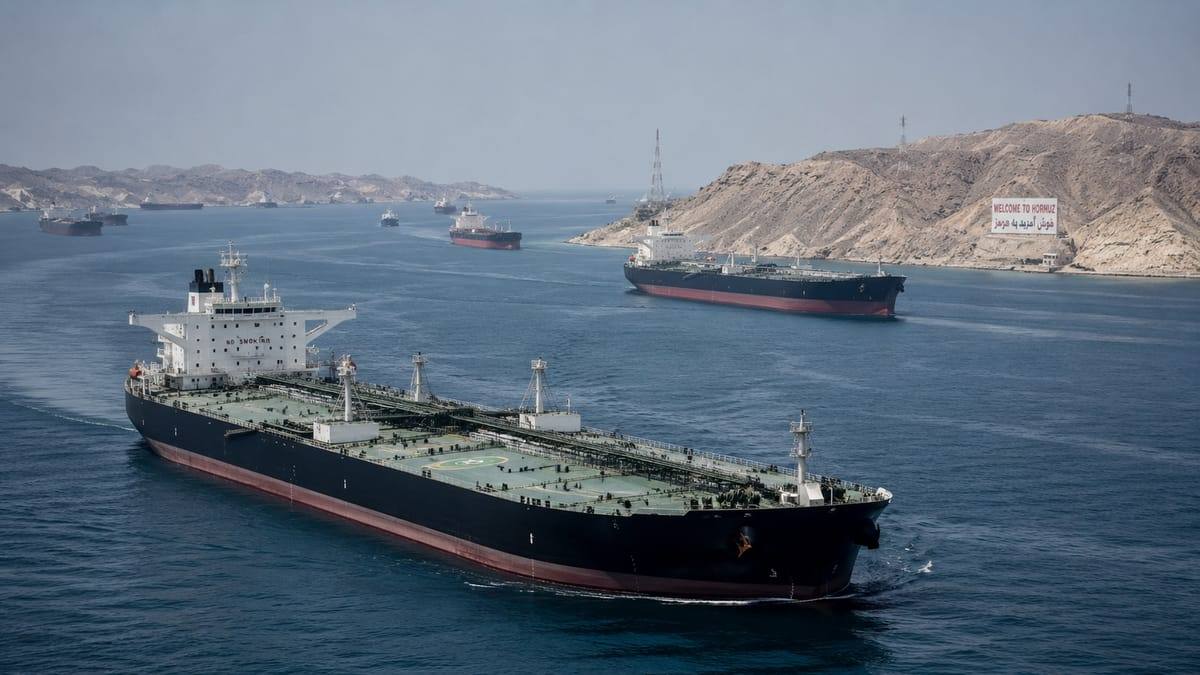
Iran's first vice president said on Wednesday that Tehran is not concerned about the US naval blockade of its ports, pointing to a sharp rise in cargo moving through the country's other borders as his government tries to rein in soaring prices.
Source: Reuters
"The increase in the unloading and clearance of goods through non-southern borders sends the message that we are not concerned about the enemy's naval blockade," Mohammad Reza Aref said, adding that Iran's strategic goods reserves were strong and supplies plentiful, though he gave no figures.
Aref said the government was seeking to prevent increases in the prices of basic goods for at least three months. In a separate meeting, President Masoud Pezeshkian said the government was seeking to direct more budget resources and energy savings towards improving living standards in poorer communities.
Prices soaring as the war drags on
Tehran is facing one of its worst inflation surges in decades, driven by the nearly nine-month-old war with the United States and Israel, with a particularly sharp rise in food prices. Consumer prices in Iran in October were 88.7% higher than a year earlier, while the annual average inflation rate accelerated to 76.8%, according to the Statistical Centre of Iran. Food and beverage prices rose 112.6% year on year.
Source: Reuters
Independent reporting by Al Jazeera paints the same grim picture: food, beverages and tobacco prices rose 113.4% year on year in October, and Iran's economy contracted by 10.1% in the first quarter of the Persian calendar year, from March 21 to June 20. US Treasury Secretary Scott Bessent has predicted a 25% contraction in Iran's economy by the year ending March 2027.
Source: Al Jazeera
The blockade Tehran is defying
The United States reimposed its naval blockade on Iranian ports in July, and earlier this month announced Task Force Iron Gate to restrict the movement of weapons and sanctioned materials across Iran's land borders and the Caspian Sea. Washington says the blockade, together with disruptions to overland trade and sanctions under its maximum pressure campaign, is working, and it has moved a third aircraft carrier into the region.
Iran's leaders have answered with defiance. The country's top security official, Mohsen Rezaei, wrote on X on Tuesday that US President Donald Trump's blockade plans were "delusional and futile", and said Iran was determined to break the blockade and respond with full force to any new aggression. Foreign Minister Abbas Araghchi said on Monday that a land blockade would be almost impossible given Iran's vast territory and extensive ties with its neighbours.
Source: RT
Tehran has also set conditions for any return to talks. Parliament Speaker Mohammad Bagher Ghalibaf said on Tuesday that Iran will not enter negotiations until seven conditions are met, including lifting the naval blockade, sanctions relief and the release of frozen assets. Iran's Foreign Ministry says there are currently no negotiations with Washington.
What it means for workers in the Gulf
The standoff matters far beyond Tehran. Lakhs of Punjabi and Indian workers live and work across the Gulf — in Saudi Arabia, the United Arab Emirates, Qatar, Bahrain and Kuwait — and every escalation in the region touches their safety, their jobs, the cost of living around them and the remittances their families depend on back home. Shipping disruptions through the Strait of Hormuz, through which around a fifth of the world's oil and gas usually travels, have already pushed up transport costs and insurance premiums for Gulf shipping.
Oil eases as diplomacy hopes linger
Brent crude for January delivery settled down $3.20, or 3.46%, at $89.37 a barrel on November 23, its lowest close in about three months, while US WTI crude fell $3.24 to $80.17, as President Trump signalled more time for diplomacy with Iran, Middle East exports recovered and a Libyan pipeline restarted.
Source: Argus
The war itself has been costly. It has cost American taxpayers an estimated $48.3 billion as of November 13, according to the Associated Press and Roll Call — yaani lagbhag ₹4.3 lakh crore — and at least 23 American service members have died and another 865 have been wounded since the war began on February 28, according to Pentagon figures. An open-source tracker puts the conflict's total death toll at more than 8,500 lives, including thousands in Iran and Lebanon.
What happens next
For now, both sides are holding their positions: Washington is tightening enforcement through Task Force Iron Gate and keeping the naval blockade in place until Tehran accepts its terms for peace, while Iran says it will keep routing cargo through its land borders and the Caspian Sea and has ruled out talks until its conditions are met. Any new strike, a tanker incident in the Strait of Hormuz, or a breakthrough in the stalled diplomacy could change the picture quickly.
What is solid
- First Vice President Aref said on November 25 that Iran is not concerned about the US naval blockade and that cargo through non-southern borders has risen sharply.
- Iran's Statistical Centre reported October consumer prices 88.7% higher year on year, with food and beverage prices up 112.6%.
- The US reimposed its naval blockade on Iranian ports in July and announced Task Force Iron Gate earlier this month.
What is only claimed
- Whether Iran can fully withstand the blockade by rerouting cargo — Washington says the pressure is working, Tehran says its reserves are strong.
- Iran's claims about tankers striking mines in the Strait of Hormuz, which have not been independently verified.
Iran's message is defiance: the blockade will not force it to the table. But with inflation near 90% and food prices more than doubled in a year, the pressure on ordinary Iranians — and on Gulf workers caught in the middle — keeps growing.