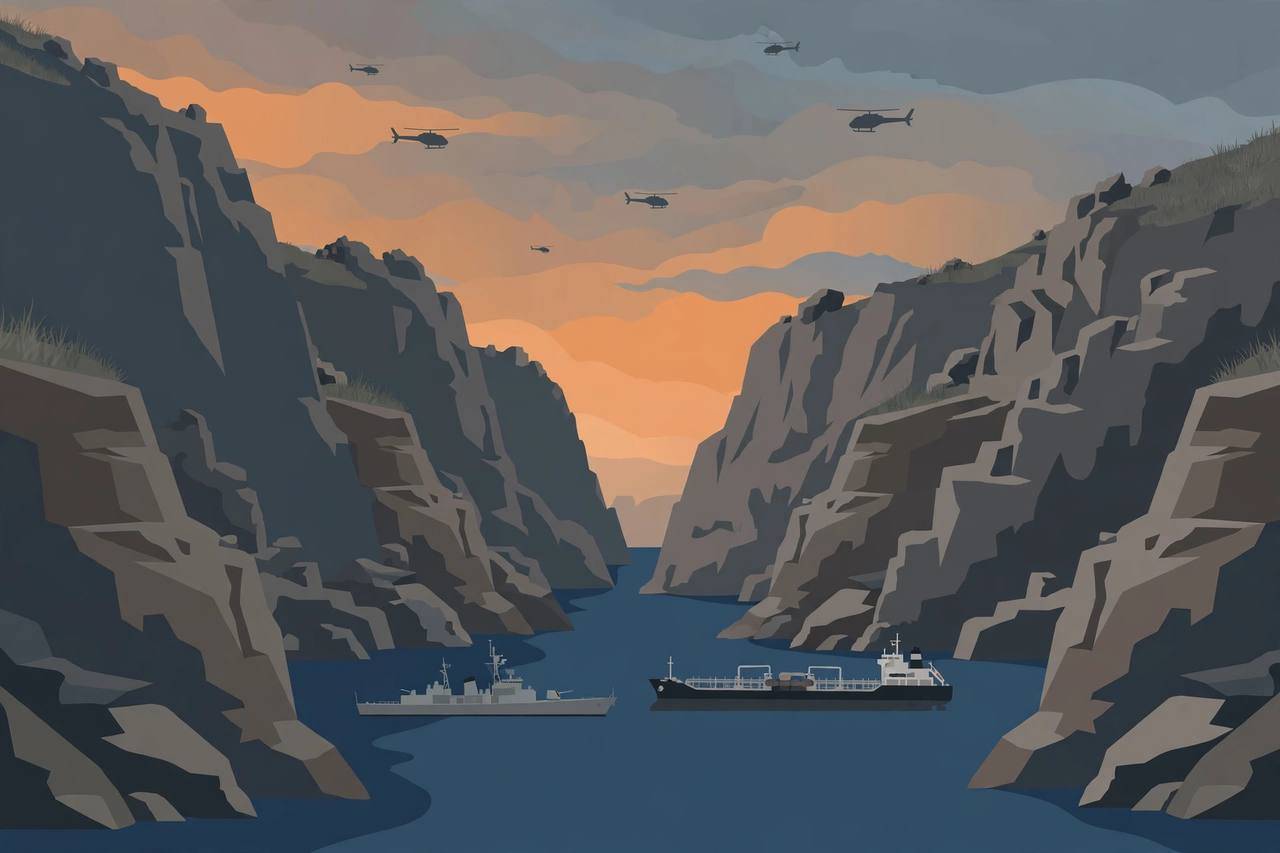
Iran's Revolutionary Guard commanders said on Friday that the "zero hour" for breaking the US naval blockade is imminent, warning Washington to expect action in the air and at sea, in the sharpest escalation of the Gulf standoff since American forces disabled a blockade-running cargo ship this week.
Source: IRNA via Arabian Sea
What the Guard commanders said
Ali Azmaei, commander of the Islamic Revolutionary Guard Corps Navy, said the moment to break the American naval blockade was drawing near. "The enemy should expect movement in the air and sea," he said, adding that "breaking the blockade is an irreversible mission," according to Iran's official IRNA news agency.
Source: IRNA via Sunna Files
The warning was echoed by the Guard's Aerospace Force commander, Majid Mousavi, who wrote on X on Friday: "The enemy should expect action in the air and at sea. Breaking the blockade is Iran's firm mission and unwavering determination." He added that no blockade could withstand Iran's "national will and defensive capabilities."
Source: Times of Israel via Ground News
CENTCOM denies Tehran's claims
US Central Command pushed back on Saturday, posting a "FACT CHECK" graphic denying Iranian claims that its forces had seized tankers, struck the aircraft carrier USS Abraham Lincoln, or imposed a toll on shipping through the Strait of Hormuz. CENTCOM said Iran "no longer has a navy" and called the claims false, according to Anadolu news agency.
Source: Anadolu via Apprised News
Mohammad Mokhber, an adviser to Iran's Supreme Leader Mojtaba Khamenei, told reporters on Friday that "neither will the Strait of Hormuz be opened, nor will we allow a blockade to remain in place." Asked when the standoff would end, he said: "It is happening right now."
Source: Hindustan Times
Iranian Navy Commander Shahram Irani told state television that breaking through the blockade was under way and that Iran's ports were active, with maritime escorts taking place. He also claimed, without giving a date or names, that Iranian navy commandos had retaken two Iranian tankers seized by the Americans — a claim CENTCOM denies and no independent source has verified.
Source: Reuters via The News
On Thursday, US aircraft disabled the Palau-flagged cargo ship Pacific Archer in the Gulf of Oman after it left the Iranian port of Bandar Abbas — the 15th vessel disabled since the blockade began, and the sixth since enforcement resumed in July. The civilian crew was unharmed. Read the earlier story
How the standoff got here
The war began on 28 February 2026, and Friday marked its 273rd day. The United States has enforced a naval blockade of Iranian ports since April — first from 13 April to 18 June, then reimposed on 14 July after talks collapsed — while Iran has kept the Strait of Hormuz, the narrow waterway between Iran and Oman through which Gulf oil reaches the world, closed.
Source: Global Economic Times
President Donald Trump has rejected Iran's proposal to reopen the strait within seven days, and has said he spoke with Israeli Prime Minister Benjamin Netanyahu in the past few days. Trump has also said he will give Iran a chance despite the threats, even as he vows to sink any blockade-running ships.
Source: Al Arabiya via Threads
Oil and the Gulf economy
Brent crude closed at $90.84 a barrel on Friday, down about 4 percent on the day — yaani lagbhag ₹8,440 prati barrel, at $1 = ₹92.93. Prices had jumped earlier in the week after Yemen's Houthis claimed a strike on Saudi Arabia's Ras Tanura refinery, the kingdom's largest at 550,000 barrels a day. OPEC+ meets on Sunday, 29 November, to set production quotas for 2027, with no agreement in place beyond December.
Source: Horizon Markets
What it means for Gulf workers and shipping
Lakhs of Punjabi and Indian workers live and work in the Gulf, and the standoff touches them directly — through shipping delays, rising insurance costs, flight disruption and the safety of sea routes their families depend on for remittances. CENTCOM has urged seafarers in the Gulf of Oman and near the Strait of Hormuz to follow the instructions of military patrols. Iran's navy chief, meanwhile, says maritime escorts are under way and ports remain active, though no routes or vessels have been named.
Source: Reuters via The News
What happens next
All eyes are now on whether Tehran's "zero hour" warning turns into a convoy or a clash. Reports say an Iranian tanker convoy is mobilising to test the blockade, and Iran's foreign minister Abbas Araghchi says negotiators remain in Qatar while messages still pass to Washington through Pakistan and Qatar. But an editorial in Iran's own WANA news agency concluded that breaking the blockade in the short to medium term is practically unfeasible given wide-area US naval surveillance.
Source: Newsy Today
Trump has already rejected Tehran's offer to reopen the Strait of Hormuz within seven days — the proposal is off the table, and the blockade stands. Read the rejection
What is solid
- IRGC Navy commander Ali Azmaei said the "zero hour" for breaking the US naval blockade is imminent (IRNA, BBC Persian).
- IRGC Aerospace Force commander Majid Mousavi warned on X that the enemy should expect action in the air and at sea (Times of Israel, Reuters).
- US Central Command disabled the Palau-flagged M/V Pacific Archer in the Gulf of Oman on 26 November, the 15th vessel disabled since April (AP, Reuters, CENTCOM).
- CENTCOM denied Iranian claims about seized tankers and a strike on the USS Abraham Lincoln on 28 November (CENTCOM, Anadolu).
- Brent crude closed at $90.84 a barrel on 28 November, down about 4 percent (market data).
What is only claimed
- Iran's claim that its navy commandos retook two tankers seized by the Americans — CENTCOM denies it and no independent source has verified it.
- Iran's claim of a strike on the aircraft carrier USS Abraham Lincoln — CENTCOM calls it false.
- The Houthi claim that their strike caused fires at Saudi Arabia's Ras Tanura refinery on 25 November — the Saudi-led coalition says four drones were intercepted and has not confirmed damage.
- How soon Iran could actually break the blockade — Tehran says the hour is near; Iran's own WANA news agency calls it practically unfeasible in the short to medium term.