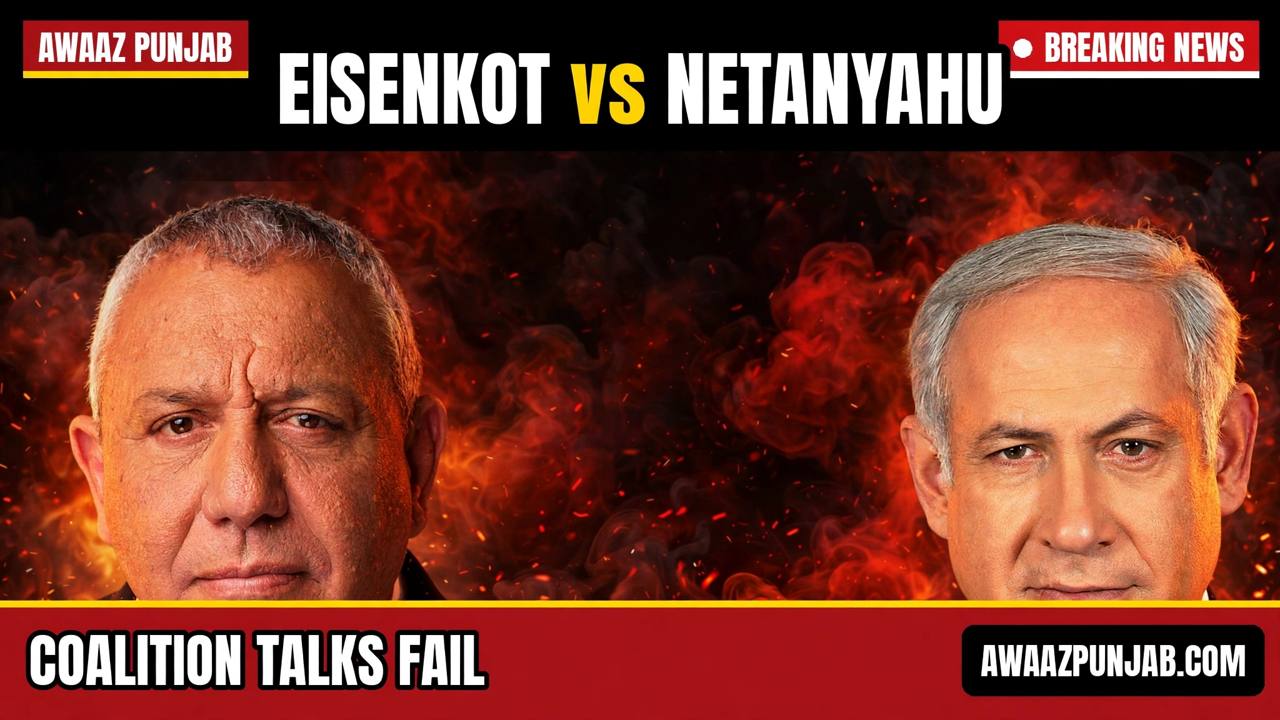
Talks between the parties of caretaker Israeli Prime Minister Benjamin Netanyahu and his rival Gadi Eisenkot ended without a deal on Sunday, leaving Israel no closer to a new government nearly a month after an inconclusive election.
Source: Al Jazeera
Eisenkot had invited Netanyahu's Likud back to the table for a new round of coalition talks on Sunday, after the first round ended without a deal. Read the earlier story
Delegations from Eisenkot's Yashar party and Netanyahu's Likud met for four hours at a hotel in Herzliya, near Tel Aviv, in the second round of negotiations in a week. In a joint statement, the two parties said they had outlined their positions on a range of substantive issues and discussed them in detail, and that a follow-up meeting would be held. Neither side gave a date.
According to Israeli media reports, the sharpest dispute concerned National Security Minister Itamar Ben-Gvir. Likud wants him inside the government, while Yashar insists on his exclusion. Channel 12 and the Yedioth Ahronoth newspaper both reported the Ben-Gvir standoff as the main sticking point.
The two sides also remained split over who should lead the next government and who should sit in it. Eisenkot opposes any rotating premiership with Netanyahu, while Netanyahu is reported to insist on taking the premiership first.
What happens next
If the unity track fails, Yashar intends to move within days toward a confidence vote on a minority government, relying on outside support from Arab parties in the Knesset. Eisenkot announced the plan on Friday, saying he would set up a 'national emergency government' and try to broaden it before or after it is sworn in. 'This is not a negotiating threat, it is a decision I have taken,' he wrote.
The arithmetic is tight. The anti-Netanyahu camp holds 67 of the 120 Knesset seats, counting the 19 seats of the Arab parties, while Netanyahu's bloc has 53. But opposition from Avigdor Lieberman's Yisrael Beiteinu and possible abstentions by Arab lawmakers could deprive a minority government of its confidence vote. A minority government would rely on outside support from Ra'am and the Joint List, without ministries and without seats in the security cabinet.
Former prime minister Naftali Bennett has proposed a broad coalition of his Together list with Yashar, Likud and Yisrael Beiteinu, under which Eisenkot would serve first as prime minister and Netanyahu would follow him. The rotation idea has found no takers so far, and Lieberman has ruled out joining any government that includes Netanyahu at all.
Eisenkot, a former army chief of staff, was tasked by President Isaac Herzog with forming a government after the October 27 election gave his bloc 48 seats, thirteen short of a majority in the 120-seat Knesset. His mandate runs until December 6, with a possible extension of fourteen days. Netanyahu remains in office as caretaker prime minister in the meantime, and his party is the largest single party in the chamber, with 27 seats to 21 for Yashar.
What is solid
- Likud-Yashar talks ended without a deal on Sunday, November 22
- The sharpest dispute was over National Security Minister Itamar Ben-Gvir
- Eisenkot's mandate to form a government runs until December 6
- Eisenkot has said he will seek a minority government confidence vote if unity talks fail
What is only claimed
- Whether Arab parties will back a minority government in a confidence vote
- Whether a follow-up Likud-Yashar meeting will be scheduled, and when
The parties said a follow-up meeting would be held, without revealing a date or further details. With the December 6 deadline approaching, Eisenkot must now choose between one more attempt at a broad coalition, a minority government confidence vote, or returning the mandate — a step that could send Israel back to elections with Netanyahu still serving as caretaker prime minister.