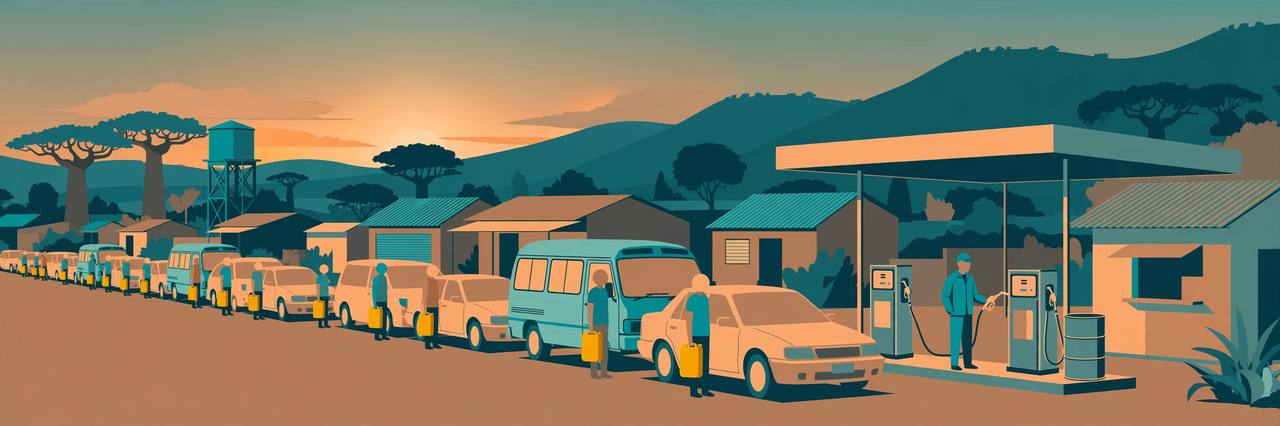
Finding fuel in Malawi has become a daily struggle, with motorists spending hours — sometimes entire nights — waiting at filling stations for tankers that may never arrive, as a foreign-currency shortage chokes the country's petrol imports.
Source: Al Jazeera
In Blantyre, the commercial capital, car dealer Ken Mhango, 40, drove to a filling station after a friend told him a fuel tanker was on its way. He had gone several days without fuel. Twelve people were already waiting when he arrived, but the situation soon turned chaotic as minibus drivers and motorcycle taxi operators arrived and jumped the queue. “They were so reckless they didn't care if they bumped your vehicle. A scuffle erupted,” he told Al Jazeera. It took him four hours to get 20 litres — others spent the night in the queue. Queues have increasingly turned violent: the mayor of Blantyre has been sued for assault following an incident at a fuel queue, and an attendant was killed after being struck by a vehicle during a commotion at a filling station, according to local media reports.
Rationing and the black market
Purchases are reportedly rationed to 20 litres a day, while motorists sometimes pay attendants for an additional five litres. The Malawi Energy Regulatory Authority publishes daily schedules showing which filling stations are expected to receive fuel, but motorists say deliveries are so unpredictable that planning a journey is nearly impossible.
Unable to find enough fuel at the pumps, many people are turning to the black market, even though selling fuel without a permit is illegal. Mhango said he paid 30,000 Malawian kwacha — about $17.31 — for two litres of petrol for his father. Unsafe storage of black-market fuel has caused deadly fires and explosions, and Malawi's Nation newspaper has recorded at least six deaths from such blasts this year, according to Al Jazeera.
Why there is no fuel
At the heart of the emergency lies a persistent shortage of foreign exchange. Malawi is landlocked and does not produce a single litre of fuel — every litre of petrol and diesel is imported and must be paid for in dollars. The country consumes about two million litres a day and needs an estimated $49 million in foreign exchange every month to pay for petroleum imports. The National Oil Company of Malawi has acknowledged the seriousness of the problem, and the Ministry of Energy has said difficulties honouring letters of credit have disrupted supplies.
In a statement this week, the ministry said the crisis was “largely attributable to a combination of financial, foreign exchange and logistical constraints” and rejected claims that the government was doing nothing. The Transporters Association of Malawi has argued that locally owned tankers are sitting idle and could help with distribution if the government brought them in.
The shortages are disrupting daily life far beyond the pumps. Minibus fares have soared — one Blantyre journey that previously cost 1,500 kwacha now costs 4,000, Reuters reported — businesses are losing customers, and students at Mzuzu University's Dunduzu Campus have been hitching rides to lectures because only a handful of filling stations in Mzuzu have fuel. Mhango said customers have stopped bringing their cars to his garage: “The crisis has completely changed and messed up everything.”
The Human Rights Defenders Coalition had planned nationwide protests on November 17 to demand the energy minister's resignation over fuel shortages and power cuts, but postponed them after police said they could not guarantee security because officers were needed for a ruling party parade that day.
What is solid
- Motorists queue for hours and sometimes overnight, with purchases rationed to 20 litres a day.
- Malawi needs about $49 million in foreign exchange every month for fuel imports, and the Ministry of Energy blames forex and logistical constraints.
- At least six people have died this year in blasts linked to black-market fuel storage, according to The Nation.
- A planned nationwide protest on November 17 was postponed.
What is only claimed
- Whether the government is doing enough — the ministry says the crisis comes from forex and logistical constraints and that it is acting; critics say the government has been slow and has no plan to restore supplies.
There is no date yet for supplies returning to normal. The ministry says it is working through the financial and logistical constraints, while motorists keep sleeping in their cars at filling stations and the black market keeps filling the gap the pumps cannot.