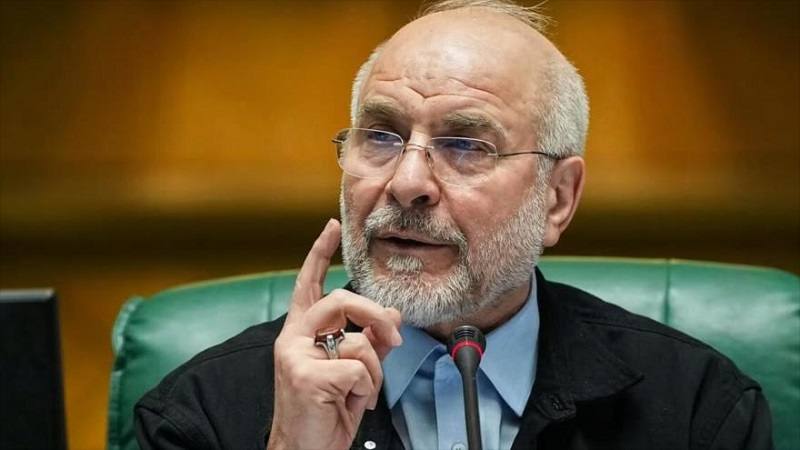
TEHRAN — Iran's parliament speaker and chief negotiator with Washington, Mohammad Baqer Qalibaf, told the United States on Wednesday, November 4, that American voters had rejected the war on Iran in Tuesday's midterm elections — and warned that if the US government ignores that verdict and attacks Iran again, Tehran's answer will be a “nightmare”. Qalibaf posted the message on X the morning after Democrats routed President Donald Trump's Republicans in the midterms, a result Iranian officials are reading, publicly and immediately, as a vote against the war that began with US and Israeli strikes on Iran on February 28.
Source: Reuters via Business Day, Nov 4, 2026
“Conscience or the cost of living, Americans said NO TO WAR, and we endorse this message,” Qalibaf wrote. “If the US govt betrays their public will to serve international paymasters and blackmailers, it will learn our NO comes with a Nightmare.” The wording was identical across the Reuters report, Iran's Press TV and Azerbaijan's AzerNews, all citing the same X post on Wednesday. Qalibaf is not a commentator on the talks — he is Tehran's chief negotiator in them — which makes his reading of the American vote a negotiating position as much as a political comment: Iran is telling Washington that it believes the American public has removed any mandate for a renewed bombing campaign.
Source: Reuters via Business Day, Nov 4, 2026; Press TV, Nov 4, 2026
President Trump himself has conceded the war hurt his party at the ballot box: Read: Trump admits Iran war contributed to midterm losses
What happened, and when
The sequence Qalibaf was answering runs through the last three days. On Monday night, US forces struck an Iranian air-defence facility on Qeshm Island in the Strait of Hormuz — an operation US officials described as defensive, after Iran's Islamic Revolutionary Guard Corps (IRGC) fired on a US aircraft on November 2. Trump confirmed the strike to Fox News on Tuesday, calling it a “minor attack” on a facility Washington had watched being built for about two months: “As soon as it was completed, we hit it very effectively last night.” Iran's IRGC said its air defences had downed US drones near the strait, including an MQ-9 east of Hormuz. On Tuesday, Americans voted; on Wednesday morning, Qalibaf claimed the result.
Source: Reuters, CBS and AP reporting via UrduPro summary, Nov 3–4, 2026
The Qeshm Island strike itself, and Trump's confirmation of it, were reported in full earlier: Read: Trump confirms US strikes on Iran's Qeshm Island
Tehran's military leadership spoke in the same hours. Major General Ali Abdollahi, commander of Iran's Khatam al-Anbiya Central Headquarters and head of the armed forces general staff, warned on Tuesday that Iran's forces were updating target lists covering US and Israeli assets and would respond immediately, “without geographical limitations”, to any threat. Those warnings are the context for Qalibaf's word “nightmare”: it is the political wing's version of a threat the military wing had already issued in operational language.
Source: Reuters via The Edge Malaysia, Nov 3–4, 2026
The talks: still far apart, Qatar still shuttling
Qalibaf's post landed while the diplomacy he leads remains deadlocked. A senior Iranian official told Reuters on Tuesday that Iran and the United States were still far from a deal to end the war. Qatar, the mediator, stepped up its efforts this week precisely because of fears the conflict could flare again after the midterms: a Qatari delegation travelled to Tehran on Monday and held an extensive meeting of about three hours with Iranian counterparts, exchanging proposals to bridge the differences, Qatar's Foreign Ministry spokesman Majed al-Ansari said. “A mediator cannot lose hope. There are developments in communication between the parties, but it is not possible to speak about any particular development at this stage,” al-Ansari said, adding that both sides were reviewing the mediators' proposals and that Qatar was coordinating with Gulf Cooperation Council partners.
Source: Reuters, Nov 3, 2026; Madhyamam (Qatar Foreign Ministry briefing), Nov 4, 2026
The core bargain has not moved. Iran's seven conditions for reopening the Strait of Hormuz include lifting the US naval blockade of Iranian ports, waiving sanctions on Iranian oil sales, releasing frozen Iranian funds and observing a ceasefire that includes Lebanon. Mohsen Rezaei, secretary of Iran's Supreme National Security Council, said Washington's reply to those conditions was “not convincing” and that the strait would stay shut to the United States until they were addressed. Qatar condemned the attack on the Qatari LNG tanker Al Maayda and said freedom of navigation in Hormuz and the Gulf was non-negotiable — a reminder that the mediator is also a shipping victim of the closure.
Source: AnewZ, Nov 4, 2026; Madhyamam, Nov 4, 2026
Oil, Hormuz and the Gulf workers in the middle
Markets are pricing the same uncertainty Qalibaf is exploiting. Crude rebounded on Wednesday from four-week lows after falling sharply on Tuesday on reports Iran might discuss previously non-negotiable issues; Brent traded at $103.60 a barrel and West Texas Intermediate at $95.98, OilPrice reported. Two consultancies warned against optimism: Rystad Energy said Gulf crude flows are unlikely to return to normal soon even if a deal is reached, and Vortexa's data showed combined crude, condensate and fuel exports through Hormuz averaged 17.1 million barrels a day in October, down from 18.9 million in September — yaani, roughly 18 lakh barrels a day less oil moving through the strait than a month earlier. For the lakhs of Punjabi and Indian workers across the Gulf states, every week the strait stays shut and the strike threats continue is a week of dearer fuel, disrupted shipping and flight schedules, and employers exposed to an energy shock — which is why a negotiator's post on X in Tehran is a kitchen-table story in Brampton and Ludhiana alike.
Source: OilPrice, Nov 4, 2026 (Rystad Energy and Vortexa data)
What is solid
- Qalibaf posted on X on Wednesday, November 4: 'Americans said NO TO WAR, and we endorse this message', warning of a 'nightmare' if Washington betrays that will — Reuters; Press TV; AzerNews, all citing the same post
- Qalibaf is Iran's parliament speaker and its chief negotiator in talks with the United States — Reuters; Press TV
- A senior Iranian official told Reuters on Tuesday the two sides remain far from a deal; a Qatari delegation held a roughly three-hour meeting in Tehran on Monday — Reuters; Qatar Foreign Ministry via Madhyamam
- Trump confirmed to Fox News on Tuesday that US forces struck an air-defence facility on Qeshm Island, calling it a 'minor attack' — Fox News via multiple wires
What is only claimed
- Qalibaf's claim that the midterm result was a vote against the Iran war is Tehran's interpretation of the American election — US reporting attributes the Republican losses to several factors, and Trump himself has cited the war among them; no exit-poll verdict on Iran alone is established here
- Reports in US media, citing unnamed officials, that Central Command has prepared strike options that could begin as early as Wednesday after the midterms are unattributed preparations, not an announced decision — Trump, asked whether he would resume attacks after the midterms, answered 'No', and told the Financial Times he saw no immediate strike; both signals are on the record and point in opposite directions
Background: a war on pause, not ended
The war began on February 28, when the United States and Israel attacked Iran; it has since settled into a pattern of limited strikes, a closed or restricted Strait of Hormuz — the waterway that carried about one-fifth of the world's oil in peacetime — a US naval blockade of Iranian ports, and indirect talks through Qatar and other mediators that have produced drafts but no agreement. The midterm elections were the deadline both sides talked around for weeks: Washington was reported to be holding larger strike options until after Tuesday's vote, and Tehran was reported to be waiting to see whether the vote weakened Trump. Qalibaf's post is Tehran's answer to that wait — an attempt to convert the election result into a public constraint on whatever Trump decides next.
Source: Awaaz Punjab analysis of Reuters, AP and Al Jazeera reporting, Nov 4, 2026
What happens next
Three things decide whether Qalibaf's reading holds. First, Trump's own next move: whether the reported post-midterm strike options are used, shelved, or traded away in the Qatar channel — his public signals this week have pointed both ways. Second, the Hormuz bargain: whether Washington's next reply to Iran's seven conditions moves on the blockade, oil sanctions or frozen funds, the three items Tehran calls non-negotiable. Third, the new Congress: a Democratic-controlled Congress can investigate, fund or restrict a renewed campaign, which is exactly the leverage Tehran is claiming the voters handed it. Watch for a formal US response to Qalibaf, any CENTCOM announcement, and Qatar's next briefing — and for oil, which at $103.60 is still pricing a war that neither side has ended.