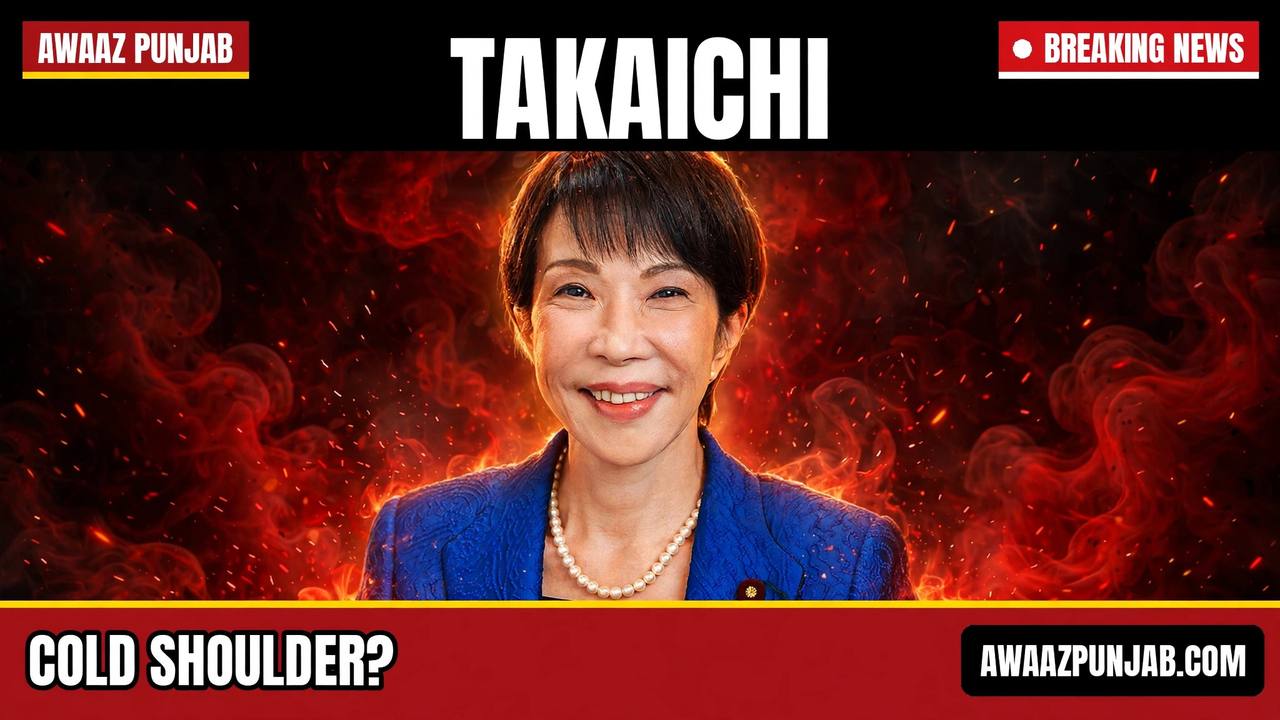
Japanese Prime Minister Sanae Takaichi cut an isolated figure at the two-day APEC gathering in Shenzhen, China, arriving without the fanfare that greeted other world leaders and sitting near the end of the summit table, Reuters reported on Thursday.
Source: Reuters
Takaichi landed at Shenzhen airport on Wednesday for her first visit to China as prime minister — the first by a Japanese leader since 2019. She was met on the tarmac by Zhang Qiyue, a retired diplomat who served as ambassador to Greece, and Japan's ambassador to China, Kenji Kanasugi, with only a small honour guard. Kyodo News noted the young people who waved red bouquets for other leaders were nowhere in sight when her plane landed.
The contrast with other arrivals was stark. US President Donald Trump was greeted personally by Chinese President Xi Jinping, with music, cheers and pompoms. Russian President Vladimir Putin was met by Cai Qi, the Communist Party's fifth-ranked official. South Korean President Lee Jae Myung was welcomed by dancers and young people waving red flowers, Australian Prime Minister Anthony Albanese received a bouquet, and Philippine President Ferdinand Marcos Jr was welcomed by dancers.
The cool response continued on Thursday. At the leaders' group photo, Takaichi stood near one end of the back row while Trump, Xi and Putin exchanged handshakes up front. In the meeting room, Xi sat beside Trump and opposite Lee — with Takaichi seven seats away near the end of the table.
Xi and Takaichi shook hands at Wednesday's welcome dinner and again on Thursday, but held no one-on-one talks to resolve the diplomatic row looming over Japan's economy. At Thursday morning's greeting line, Takaichi spent several minutes trying to talk to the Chinese leader without an interpreter present, while most leaders exchanged handshakes and kept walking, the South China Morning Post reported.
Source: South China Morning Post
Her only bilateral meeting at APEC was a 30-minute exchange with Putin, in which she sought the release of a detained Japanese journalist and protections for Japanese companies after Moscow seized assets of Japan Tobacco International. Read the earlier story
Why Beijing is cold
The row dates to November 2025, when Takaichi said a crisis in the Taiwan Strait could constitute a situation threatening Japan's survival and warrant a self-defence response. Beijing has since curbed exports of critical minerals — used in everything from cars and computer chips to jet engines — to Japan, its biggest trading partner.
At a press conference on Thursday, asked whether Japan would intervene in a conflict over Taiwan, Takaichi declined to answer what she called a hypothetical question. 'There has been no change whatsoever' to the position Japan set out on Taiwan in 1972, she said — when Tokyo said it 'fully understands and respects' Beijing's position that Taiwan is a part of China.
'Beijing sought to downgrade her official status to that of a head of government rather than a head of state,' said Jeremy Chan, a senior analyst at Eurasia Group. 'China's frosty reception of Takaichi shows quite clearly that Beijing is not yet ready to forgive her over her remarks about Taiwan,' he said, expecting the relationship to remain strained until Takaichi leaves office.
Beijing and Tokyo both pushed back on the snub reading. A Chinese foreign ministry spokesperson said China made appropriate protocol arrangements for all participants. Japanese Chief Cabinet Secretary Minoru Kihara said Tokyo's understanding was that the host extended 'the customary courtesies to her, just as it did to the leaders of the other economies.'
What happens next
The rare-earth curbs continue to grip Japanese industry, and there was no sign of a thaw in Shenzhen: at her press conference at the end of the APEC meeting, Takaichi listed fourteen national leaders she had exchanged views with during her overseas trip. Xi was not among them.
What is solid
- Takaichi was met at Shenzhen airport by retired diplomat Zhang Qiyue, not a serving senior official (Reuters, South China Morning Post).
- She held no one-on-one meeting with Xi at APEC; her only bilateral was a 30-minute exchange with Putin (Reuters).
- China has curbed critical-mineral exports to Japan since her November 2025 Taiwan remarks.
What is only claimed
- Whether the reception was a deliberate snub: Beijing and Japan's cabinet secretary say protocol was normal; analysts and Japanese media call it a cold shoulder.