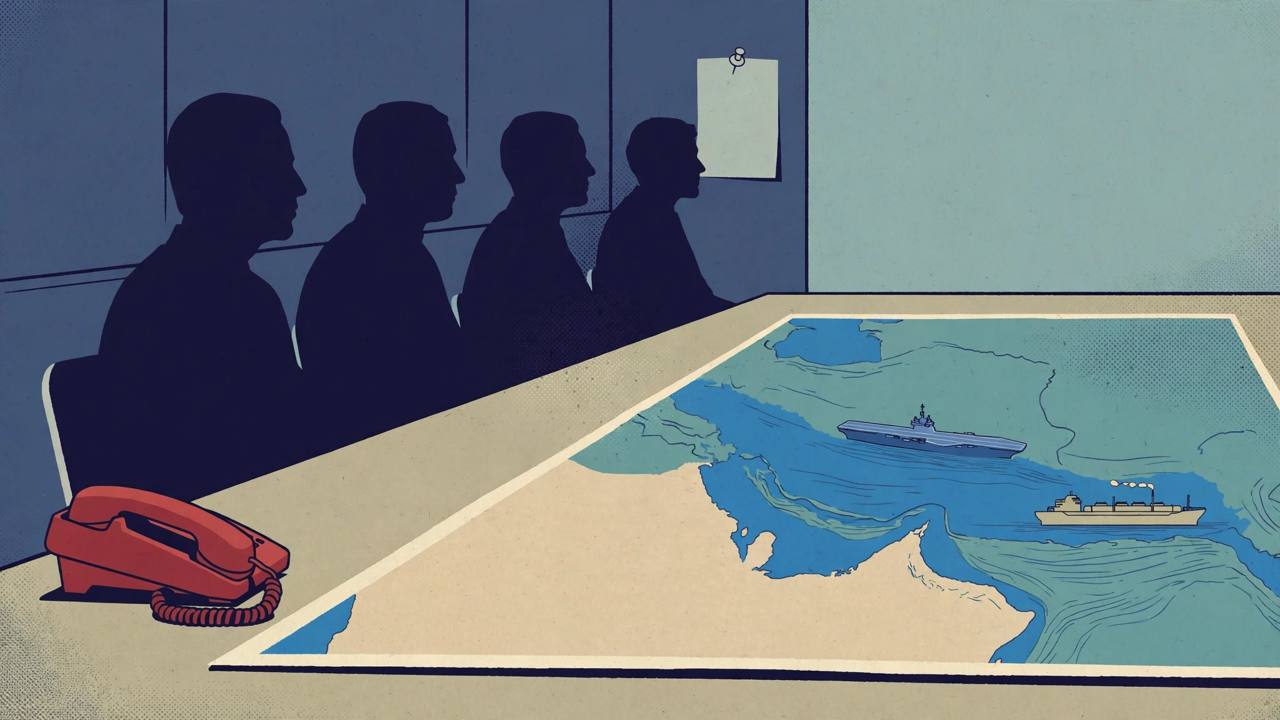
WASHINGTON / RIYADH — President Donald Trump has told senior advisers in recent days that he may hold off on attacking Iran if the United States faces no new provocations from Tehran or from the Iran-backed Houthis in Yemen, according to three people familiar with the matter, Reuters reported on Saturday, November 14.
Source: Reuters
The private comments are a new development beyond what Trump has said in public. Current and former officials told Reuters that Trump does not appear to have made up his mind about how to resolve the unpopular conflict, which the United States and Israel launched in February. But in meetings with his national security advisers, and after a series of intelligence briefings, Trump said he was considering holding off on strikes, the people said. They spoke on condition of anonymity. Trump has also indicated sympathy for allies in the region who have asked him not to return to a full-fledged war.
"I could end it immediately, but at the request of the nations that I am looking to protect, we are doing it a little bit longer way, a bit more civilly," Trump told sports broadcaster Stephen A. Smith on Thursday — the public version of the same position, which Awaaz Punjab reported on November 13.
The earlier development — Trump's public claim that Saudi Arabia and four other Gulf states asked him to hold off strikes — is covered here: Trump Says Gulf States Asked Him to Hold Off Strikes on Iran
Saudi crown prince and Erdogan both urged him not to resume attacks
In phone calls over the past two weeks, Trump asked for the opinions of Saudi Crown Prince Mohammed bin Salman and Turkish President Tayyip Erdogan, and both urged him not to resume attacks on Iran, according to a senior US official and another person familiar with the matter. They said Trump made no commitment either way.
Source: Reuters
Trump told bin Salman on October 31 that he was planning to attack Iran after the US elections, but the crown prince pleaded for him to hold off, arguing that economic sanctions against Iran were working, according to two more people familiar with the discussion. Saudi Arabia's Foreign Ministry did not respond to a request for comment. Trump has spoken with Erdogan three times since October 28, according to Turkey's presidency; an official readout of the November 7 call stressed that tensions between Iran and the US need to end.
What US intelligence told him
US intelligence agencies have assessed that the US naval blockade and economic sanctions are hurting the Iranian economy and would continue to put pressure on Tehran, two US officials briefed on the intelligence said. The same agencies have assessed that renewed strikes would not significantly shift Iran's demands in negotiations, the officials said. Building on its months-long blockade of Iranian sea traffic, the US military is also seeking to prevent weapons and other sanctioned material from entering Iran by land or through the Caspian Sea, Reuters first reported last week.
Trump was also briefed on US weapon stockpiles, some of which have drawn down to worrying levels, the two people familiar with the intelligence briefings said. Reuters reported in August that the US had used "virtually all" of its long-range precision munitions, and another person briefed on the matter said they have not been replenished. A White House official disputed that picture, saying: "The United States Military has enough munitions and ammo to serve all of the Commander-in-Chief's strategic goals and beyond." The CIA and the Office of the Director of National Intelligence did not respond to requests for comment.
Military options stay ready — and Israel is still lobbying for strikes
At the same time, the US military is ready to escalate if needed, three more people familiar with US planning said. A third aircraft carrier is moving into the Middle East in the coming days to replace one of the two currently operating in the region, but all three carriers could stay if needed. Trump could opt to bomb Iran's underground nuclear facilities, one of the people familiar with his calls with the Saudi and Turkish leaders said — but the US has already struck those facilities, and it is unclear whether further strikes would be successful. Israeli officials have continued to lobby the administration to engage in another military campaign, according to a US official.
A White House official said in a statement: "As Commander-in-Chief, President Trump is the architect and sole decision-maker who holds all the cards and will always ensure that America's interests are protected. The United States is in a very strong position with control of the Strait of Hormuz and the Iranian economy collapsing. Only President Trump knows what he will do, and when." On Thursday, Trump had signalled that the US has already achieved what it could from negotiations, without saying whether he would resume strikes: "We don't need a deal with Iran. We've got their money, Hundreds of Billions of Dollars, and we've got their Strait!"
Rubio makes the same argument in public; Tehran warns of a decisive response
Secretary of State Marco Rubio made the administration's economic argument publicly on Friday evening, telling the Federalist Society: "The economic pain that we are inflicting on that regime is so great that there's no need for military action because we've weakened them so much." The Washington Post, citing a US official, reported that the administration has settled for now on an approach of no renewed war, no negotiations and no lasting peace, and that Trump has received several intelligence briefings daily since the midterm elections.
Source: Associated Press
Iran's deputy ambassador to the United Nations, Gholamhossein Darzi, told the UN Security Council on Friday that Iran "has never closed the door to diplomacy," but warned that if the US or Israel returned to bombing, Iran would offer "an immediate and decisive response." Chief mediator Qatar continues to try to negotiate an interim agreement that would restore traffic through the Strait of Hormuz, the Associated Press reported, but two Middle East diplomats familiar with the process described the push for peace as in a holding pattern while they await clarification of Trump's intentions. The United Nations reports that October had the highest number of incidents against commercial ships in the strait since February, even as oil shipments through it have reached near-prewar levels.
Source: Associated Press
The war has raised global fuel prices and proven unpopular with US voters, who handed control of Congress to the Democrats in last week's midterm elections. In a Reuters/Ipsos poll taken shortly before the November 3 elections, 55 percent of Americans said the war was not worth the cost, and Vice President JD Vance cited it as the reason Trump's Republicans lost Congress. For the lakhs of Punjabi and Indian workers living across the Gulf, a decision to hold off on new strikes lowers the immediate risk to their cities, jobs and flights home — but with the Hormuz shipping lanes still contested and a third US carrier on its way, their safety still depends on whether Tehran and the Houthis avoid the provocations Trump has named as his trigger.
Trump's position is conditional, not a settlement: no new strikes unless Iran or the Houthis provoke the US, while the naval blockade and sanctions continue. His ambiguous positioning is expected to loom over next week's Asia trip, where at the APEC meetings in Shenzhen he is due to hold an unprecedented three-way summit with China's Xi Jinping and Russia's Vladimir Putin, with Iran and nuclear stockpiles expected on the agenda, the Associated Press reported.