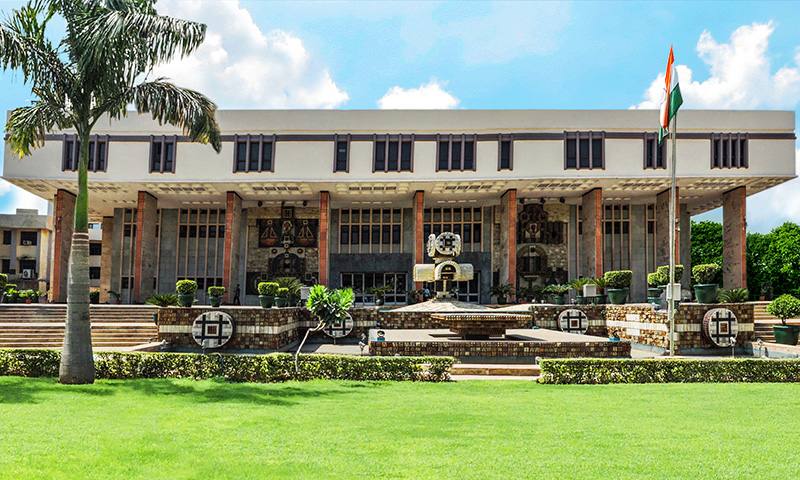
The Delhi High Court has held that marrying an Indian citizen does not by itself give a foreign national an automatic or enforceable right to stay in India or to claim a spouse visa.
Source: Live Law
Justice Amit Mahajan made the observation while dismissing a petition filed by a US citizen, Lisa Hall Srivastava, who had sought conversion of her e-Tourist Visa into an Entry (X-1) or spouse visa on the basis of her marriage to an Indian citizen.
Srivastava had married Mohd. Wasim Akram on December 7, 2025, in accordance with Muslim rites and customs, and the marriage was later solemnised before a Marriage Officer under the Special Marriage Act, 1954, on March 18. She approached the court alleging that the Foreigners Regional Registration Office (FRRO) had not favourably processed her application for conversion, and that she and her husband had been subjected to repeated enquiries over the age difference between them.
Why the authorities objected
The Centre told the court that the woman's immigration history and surrounding circumstances had been examined by the competent authority. It pointed out that she had previously been married twice and had sought immigration benefits on the basis of those earlier marriages. Her first marriage ended in July 2021, after which her Overseas Citizen of India (OCI) status was cancelled in November 2023; her second marriage, solemnised in December 2022, ended in November 2025.
The authorities also noted that she had been living as a tenant in premises owned by her present husband even before their marriage, and that he had accompanied her while she pursued immigration benefits based on her previous marriage. On that basis, the competent authority had formed a prima facie opinion that the marriage was one of convenience and that the possibility of financial or contractual arrangements to facilitate immigration benefits could not be ruled out.
What the court held
"The mere fact that the Petitioner has entered into a marriage with an Indian citizen does not, by itself, confer an automatic or indefeasible right to conversion of her existing visa into an Entry (X-1) Visa," Justice Mahajan observed, accepting the Centre's explanation as satisfactory.
Source: Live Law
The court referred to the Supreme Court's decision in Louis De Raedt v. Union of India, which held that the fundamental rights of a foreign national are confined to Article 21 of the Constitution and do not include the right to reside and settle in India under Article 19(1)(e), which is available only to citizens. It also relied on its earlier decision in Randa Chehab v. Union of India, which held that the entry or stay of a foreign national is a matter of sovereign discretion.
The court further held that a marriage certificate issued under the Special Marriage Act does not prevent immigration authorities from examining the circumstances of the marriage and the applicant's eligibility for the visa sought. It noted that the husband had not filed an affidavit corroborating the woman's claims about their relationship and cohabitation — a relevant circumstance, the court said, though not determinative by itself.
What is solid
- The Delhi High Court dismissed the plea for conversion of an e-Tourist Visa into an Entry (X-1) spouse visa.
- The court held marriage to an Indian citizen confers no automatic right to a visa or to stay in India.
- The court relied on the Supreme Court's Louis De Raedt ruling and its own Randa Chehab decision.
What is only claimed
- Whether the marriage was one of convenience — the authorities' prima facie view, which the court accepted as a satisfactory explanation but did not itself decide.
- The genuineness or validity of the marriage — the court expressly said it had not adjudicated on this.
The court clarified that it had not adjudicated upon the validity or genuineness of the marriage, and that its observations were confined to the petitioner's claim for immigration benefits. Any representation pending before the authorities, or filed in future, must be decided in accordance with law, the court said.
The ruling matters for foreign spouses of Indian citizens and for the wider diaspora: it restates that a spouse visa is granted at the discretion of the competent authorities, and that applicants must satisfy them about the genuineness of their case, including through the prescribed verification process.