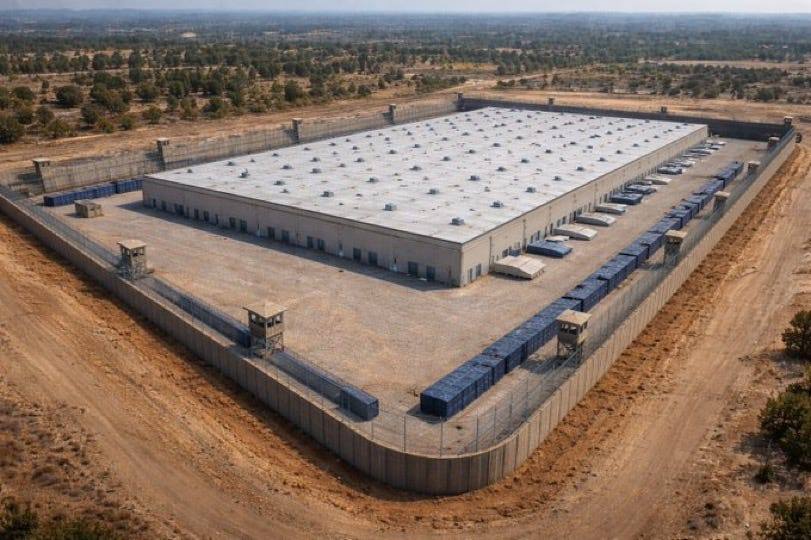
The American Civil Liberties Union is warning Congress that the bipartisan Senate energy-permitting bill — written to speed up power lines, factories and energy projects — could unintentionally fast-track something else entirely: the Trump administration's expansion of immigration detention. In a memorandum obtained by POLITICO and reported on November 5, the ACLU argues that the bill's proposed changes to federal environmental review could also apply to major detention projects, narrowing the circumstances in which reviews are required and reducing the opportunities to challenge a warehouse conversion or a new facility before construction proceeds.
Source: POLITICO, via JRL Charts
The ACLU is not alone. The Detention Watch Network, a national coalition that campaigns against immigration detention, warned this week that the bill — the BAAJA Act, S. 5653, whose Title IV is called "Project Certainty" — would hamper, if not altogether thwart, the legal work that has slowed ICE's detention buildout, and would let the agency proceed with "massive, irreversible projects like the warehouse detention expansion project with little oversight and no meaningful legal recourse." A first vote on the bill is scheduled for Monday, November 9, in the lame-duck session.
Source: Detention Watch Network, via Hill Heat
Why an environmental law is the battlefield
The fight runs through the National Environmental Policy Act (NEPA), the 1970 federal statute that requires agencies to evaluate the environmental consequences of major federal actions before they proceed — examining water use, wastewater, air quality, traffic and effects on surrounding communities. For detention expansion, NEPA has turned out to be the one law with real stopping power. The Detention Watch Network notes that the lack of environmental review provided the essential legal basis for challenges across the country: NEPA lawsuits have been filed by the states of Arizona, Maryland, Michigan and New Jersey, and by cities in Texas, Georgia and Utah.
Those challenges have already bitten. In April 2026, Maryland won a preliminary injunction blocking ICE from proceeding with construction on a warehouse conversion in Williamsport because the government had not complied with NEPA; in Arizona, federal authorities agreed to pause conversion work at a proposed detention facility while additional environmental review proceeded. In other words, the review process the Senate bill would streamline is the same process that has repeatedly forced ICE to stop, study and defend its warehouse plans in court — which is precisely why civil-liberties groups are reading an energy bill as an immigration bill.
Veteran climate attorney David Bookbinder — former chief counsel of the Sierra Club and of the centre-right Niskanen Center — summarised the bill's reach for critics in a recent letter: on the one hand, he wrote, it makes renewable-energy permitting easier and improves transmission policy; on the other, it makes fossil-fuel permitting easier still, binds future administrations to this administration's permitting policies, weakens the Clean Water Act, and, in his assessment, "effectively repeals" NEPA and the Endangered Species Act. That is a critic's characterisation, not a court's finding — but it shows how far beyond wind farms and power lines lawyers believe the text reaches.
The negotiators' answer: detention centres are not exempt
The Democratic senators who negotiated the deal reject the ACLU's reading outright. A spokesperson for Senator Sheldon Whitehouse told POLITICO that the proposed NEPA provisions do not exempt detention centres housing federal detainees from environmental review, and Whitehouse's office rejected the suggestion that the legislation would remove review requirements for immigration facilities. Whitehouse and fellow Democratic negotiator Senator Martin Heinrich continue to advocate the reform as a way to accelerate energy infrastructure and address electricity costs — the purpose the bill was written for.
Politically, the warning lands at an awkward moment for the deal's supporters. House Democratic Leader Hakeem Jeffries opposes the Senate permitting deal and has demanded more House input; a spokesperson for Jeffries told POLITICO the legislation remains insufficient in several areas. Incoming House Natural Resources Committee chair Jared Huffman is among the progressive lawmakers resisting the current framework. Democrats, strengthened by Tuesday's midterm results, are divided between those who see permitting reform as essential to building renewable energy and cutting household power bills, and those who refuse to hand the administration a broadly written fast-track that could also serve its enforcement agenda.
Environmental review is often the only formal moment when residents of a town chosen for a detention warehouse get public notice, a comment process and a route into court. Warehouse detention sites have been proposed or bought in states with large Punjabi and South Asian communities — including New Jersey, Michigan and California — and ICE's own watchdog reports describe a detained population that passed 61,817 people a day in April 2026. If review narrows, neighbours of the next warehouse may learn about it when the fencing goes up. (The GAO reports give no breakdown of detainees by nationality, and none is claimed here.)
The money trail: what GAO already found in the warehouse programme
The warning also rests on a documented record. The Government Accountability Office reported on September 24, 2026 that ICE had purchased 11 warehouses for approximately $1.07 billion to expand detention capacity; seven of the facilities were planned for sale, and auditors documented more than $20 million in nonrecoverable costs — property assessments, security and other expenses on buildings the agency bought and then decided not to keep. Federal auditors concluded ICE had pursued the expansion without sufficient strategic planning or consistent evaluation of financial risk. A second GAO report, released November 5, found inspections of detention facilities were cut even as the detained population grew by more than 50 percent in a year — context Awaaz Punjab reported separately.
Read our earlier report on the GAO's detention-inspection findings: ICE inspections fall as detention expands: GAO
What happens next
The Senate is expected to take its first vote on the bill on Monday, November 9, with further lame-duck action to follow; House passage is not assured, given Leader Jeffries' opposition and demands for changes. Three outcomes are in play: the bill advances as written, in which case the NEPA question will be tested the first time ICE cites the new procedures for a detention project; it is amended with an explicit carve-out stating the fast-track does not apply to detention facilities, as critics are demanding; or it stalls, leaving NEPA — and the state and city lawsuits built on it — as the standing obstacle to the warehouse buildout. Meanwhile the underlying buildout itself continues under existing law, and the Maryland and Arizona cases remain the template for how communities fight it.
What is solid
- The ACLU sent lawmakers a memorandum, obtained by POLITICO, warning the Senate permitting bill could accelerate ICE detention projects by narrowing environmental review.
- The Detention Watch Network issued a parallel warning about the bill (BAAJA, S. 5653); a first Senate vote is scheduled for November 9.
- Senator Whitehouse's office states the bill does not exempt detention facilities from environmental review.
- GAO (September 24, 2026) documented about $1.07 billion spent on 11 ICE warehouses, seven later planned for sale, with over $20 million in nonrecoverable costs.
- NEPA litigation has already slowed the buildout, including a Maryland preliminary injunction in April 2026 and a paused Arizona conversion.
What is only claimed
- Whether the bill's NEPA changes would legally apply to immigration detention facilities at all — the ACLU and Detention Watch Network say the text is broad enough; the bill's negotiators say it is not.
- How large the detention buildout figures are: the Detention Watch Network cites a $45 billion buildout; that is the group's figure, not an audited total.