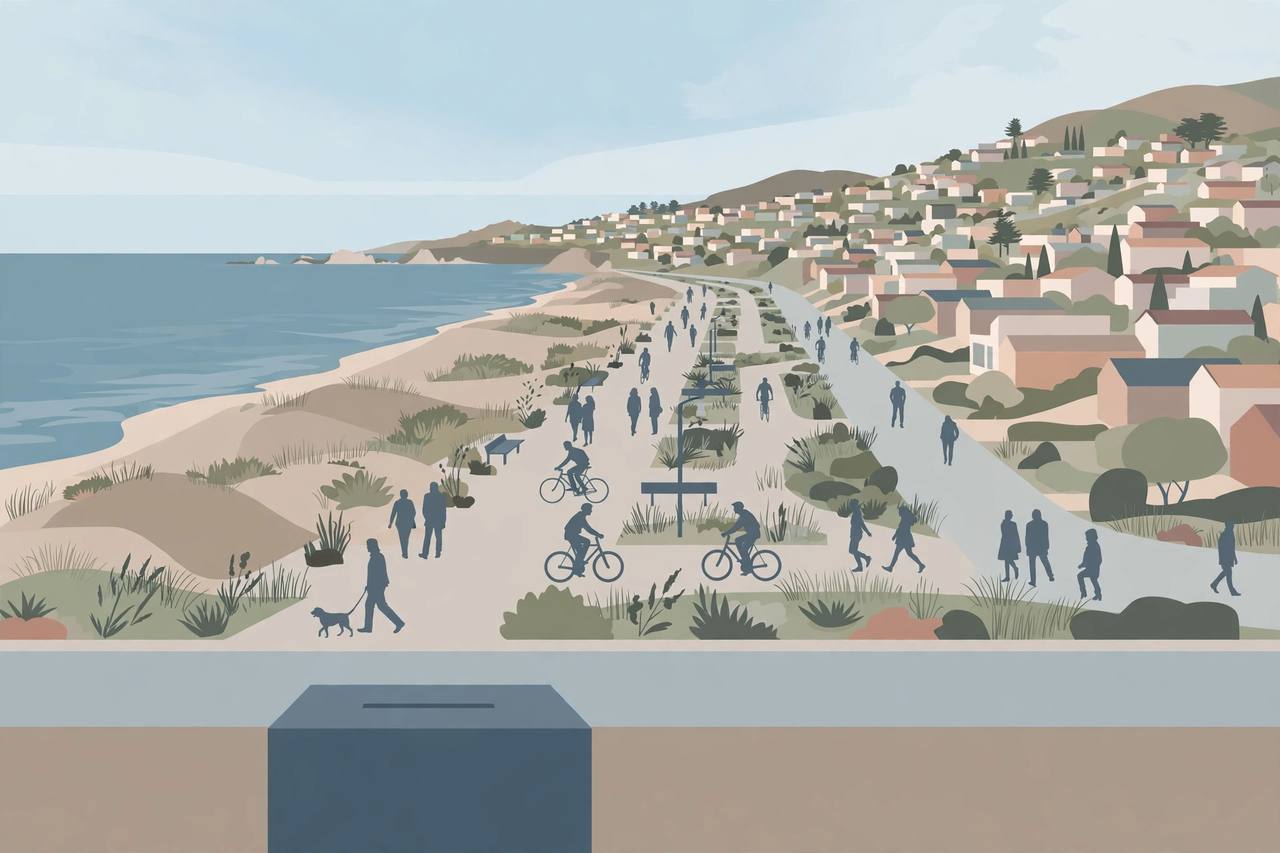
San Francisco voters have defeated Proposition G, the ballot measure that would have reversed the closure of the Great Highway to motor vehicles, keeping the oceanfront road on the city's western edge closed to cars and preserving the Sunset Dunes park created on it. According to preliminary results with 100 per cent of precincts reporting, voters rejected the measure 62.65 per cent to 37.35 per cent, the Richmond Review/Sunset Beacon reported. The Associated Press count for the measure recorded 109,319 votes against and 64,776 in favour. CBS News, through KION Central Coast, reported the same outcome in early returns, with 62.79 per cent voting no. The results are preliminary and remain unofficial until certified.
Source: Richmond Review / Sunset Beacon, November 4, 2026
Proposition G, titled the 'Great Highway for Everyone Act', would have reopened the two-mile Upper Great Highway between Lincoln Way and Sloat Boulevard to cars and trucks on weekdays, while keeping it closed to motor vehicles from Fridays at 6 p.m. to Mondays at 4 a.m. and on holidays, when Sunset Dunes would continue as a park. It needed only a simple majority to pass — and fell well short of one.
Source: KION Central Coast (CBS News), November 4, 2026
What the winners said — and what the measure's backers said
The defeat was celebrated by Friends of Sunset Dunes, which ran the 'No on G' campaign. 'We're so grateful that San Franciscans rejected Prop. G, making it clear after a six year debate that Sunset Dunes is here to stay,' said Lucas Lux, the campaign manager for 'No on G'. 'Thank you to every volunteer and neighbor who powered our campaign by knocking doors and talking to their communities about Sunset Dunes.' Otto Pippenger of the 'Yes on G' campaign pointed to campaign funding as a reason for the loss: according to the San Francisco Ethics Commission, the 'No on G' campaign had raised $1,612,220 — nearly ten times the $166,475 raised by 'Yes on G'. 'Money is the greatest predictor,' Pippenger said. 'Anytime you go up against four or five times your budget, the odds are against you.' Pippenger shared no plans for a further effort to reopen the highway as of Tuesday evening.
District 4 Supervisor Alan Wong, who backed the measure and won a full term in the same election, accepted the result. 'While Proposition G did not pass as I had hoped, I respect the decision of San Francisco voters and remain proud to have supported a compromise that reflected concerns raised by many Sunset residents,' Wong said. 'My focus moving forward will be on addressing the neighborhood impacts of the permanent closure. Whether a resident supported Proposition G or opposed it, I will continue working with all residents and City departments to ensure the Sunset residents' concerns are heard and that practical improvements are made on the surrounding streets.' Joel Engardio, the former supervisor recalled by Sunset District voters after he supported the 2024 closure, posted after the election: 'Sunset Dunes forever! Thank you San Francisco for voting to save our magnificent coastal park... Now that we've voted on this issue three times in four years, it's time to accept that Sunset Dunes is here to stay. There's no reason to keep fighting over one of San Francisco's most popular parks.'
The third vote in four years on the same two miles of road
Tuesday's vote was the third citywide decision on the Great Highway since 2022. That year, residents voted 65.11 per cent to 34.89 per cent to reject Proposition I, which would have restored full-time car access. In 2024, voters approved Proposition K by 54.73 per cent to 45.27 per cent, closing the road to cars permanently and clearing the way for the park — a result that passed citywide but caused a backlash in the Sunset District, where voters later recalled Supervisor Engardio. Sunset Dunes opened on April 12, 2025, and the Recreation and Parks Department's sensors counted more than 1.7 million visits in the park's first full year. The fight is older than the ballots: the Great Highway was fully closed to vehicles during the stay-at-home orders at the start of the COVID-19 pandemic, then reopened to traffic on weekdays before Proposition K settled its status — until this year's challenge.
How Proposition G reached the ballot
Prop. G arrived by citizen petition, after a first attempt inside City Hall failed. In January, Supervisor Wong tried to place a reopening measure on the June ballot but fell one signature short of the four supervisors required — only Supervisors Connie Chan and Chyanne Chen signed. Organizers then launched a signature drive and submitted 15,924 signatures against the 10,615 required; the Department of Elections certified the measure on July 23. Friends of Sunset Dunes sued to remove it from the ballot, alleging false statements in the petition; the challenge was denied in August. The 'Yes on G' campaign, led by Pippenger and spokesperson Jamie Hughes, was backed by Supervisor Wong, District 4 candidate Albert Chow, the Chinese American Democratic Club, the Richmond District Democratic Club and the San Francisco Taxpayers Association. The 'No' campaign was supported by the San Francisco Democratic Party, state Senator Scott Wiener, GrowSF, SPUR, the Sierra Club, the San Francisco Chronicle's editorial board and District 4 supervisor candidate Jeremy Greco.
The San Francisco Controller's analysis of August 10 found that if Proposition G had won, reopening the road would have cost the city $9.8 million in one-time capital costs and approximately $500,000 to $1.9 million a year in ongoing costs — figures both campaigns used in the final weeks.
Why a two-mile road fight matters beyond the Sunset
The Great Highway runs along Ocean Beach at the city's Pacific edge, and the argument over it has become San Francisco's proxy war over cars, public space and who the coast belongs to. Drivers in the Sunset and Richmond districts said the closure pushed traffic onto surrounding residential streets; park supporters answered that the city gained a coastal park used more than 1.7 million times in a year, at a fraction of the cost of building one. For the Bay Area's large Punjabi and South Asian communities — families spread from San Francisco and Daly City to Fremont, San Jose and the East Bay, many of whom drive across the city for work, school runs and weekend trips to Ocean Beach — the practical meaning is simple: the direct coastal drive stays closed, weekday traffic patterns around the Sunset stay as they are, and the park their children use on weekends is permanent.
What happens next
The results are preliminary; San Francisco's Department of Elections will continue updating counts before certification, but a margin of roughly 25 points with all precincts reporting is not expected to change. The closure therefore remains in force and Sunset Dunes continues as a full-time park. The open questions are now the ones Supervisor Wong named: traffic, pedestrian safety and mobility on the surrounding Sunset streets that absorbed the highway's cars. The 'Yes' campaign has announced no new reopening effort, and with three citywide votes in four years all going the same way, both campaigns publicly treated Tuesday's result as the end of the six-year debate.