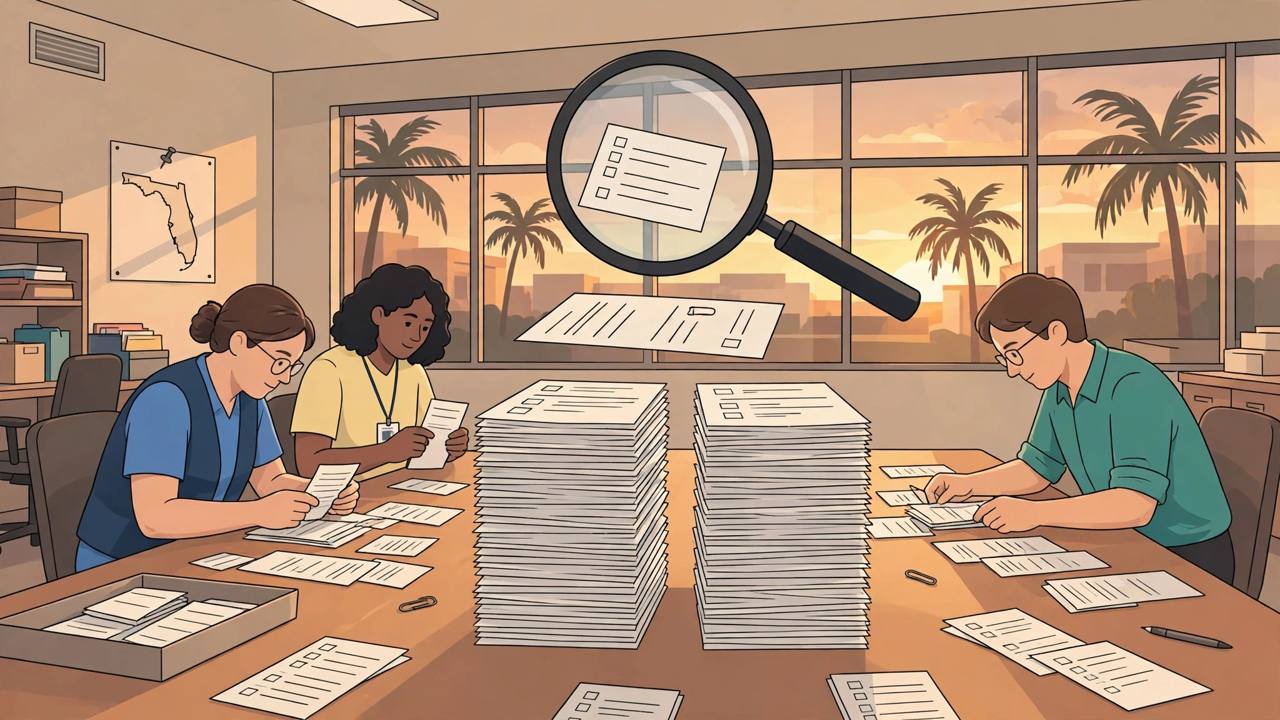
Two Central Florida congressional races were still balanced close enough on Wednesday afternoon, November 4, that a few dozen ballots could force recounts in both of them — even though election officials say flipping either result would take far more. Central Florida Public Media reported at 4:57 p.m. Eastern on Wednesday that hundreds of uncounted ballots could send the undecided midterm races in Florida's 7th and 9th congressional districts to recounts this week, because both leaders sit just outside the margin that triggers one automatically under Florida law.
Source: Central Florida Public Media (Nov. 4, 2026)
Under Florida law, a mandatory recount is triggered if the second-place candidate finishes within 0.5 percent of the leader. In District 7, Republican Ryan Elijah leads Democrat Bale Dalton by 0.53 percent — and just 80 more votes for Dalton would pull the margin inside the recount line. In District 9, incumbent Democratic Representative Darren Soto leads Republican Dan Green by 0.52 percent — 53 votes shy of the threshold for an automatic recount, the station reported.
Source: Central Florida Public Media (Nov. 4, 2026)
Osceola County elections official Kari Ewalt told Central Florida Public Media a recount is genuinely possible in District 9, but warned that changing the leader is a different matter: Green needs to make up nearly 1,500 votes to win, and Dalton needs even more in District 7. 'In a race this big, 0.5% is a lot of votes,' Ewalt said, adding she has never seen a large local race flip against a deficit that size, and: 'If we end [up with] a recount at 0.5% difference, I do not believe that the outcome overall would change after a recount.'
District 7: Seminole and Volusia, and a 1,701-vote gap
District 7 covers all of Seminole County and the southern part of Volusia County. The Associated Press count on Wednesday put Elijah at 161,189 votes to Dalton's 159,488, with 156 of 158 precincts reporting and the race rated too early to call. Central Florida Public Media reported earlier that all precincts had reported in Seminole County, where Dalton took 54 percent of the vote, and that voters were still in line at Oviedo precincts as late as 9 p.m. on election night, according to Elijah — one reason the count ran late. Dalton's campaign said in a press release that he is willing to wait as long as it takes for an accurate count.
District 9: a redrawn seat Soto is fighting to keep
District 9 is one of the seats Florida's Republican-led legislature redrew this year. The Lakeland Ledger reported the new district stretches across some 5,500 square miles — all or parts of Orange, Osceola, Indian River, Highlands, Okeechobee and Glades counties, plus a section of southeast Polk — remade to favour Republicans. Soto, of Kissimmee, was first elected in 2016 and was the first person of Puerto Rican descent elected to Congress from Florida; Green, of Vero Beach, won an August Republican primary against six rivals with about 25.5 percent of the vote. Late Tuesday returns compiled by Creative Loafing Tampa put Soto ahead 50.26 percent to 49.74 percent.
Where the uncounted ballots come from
The outstanding ballots come from three streams, Central Florida Public Media reported. Some were cast provisionally, by voters who knew their ballots would be reviewed and could be disqualified. Others are mail-in ballots whose signatures did not match the signatures on file — those voters can still save their ballots by submitting an affidavit to county election officials by 5 p.m. on Thursday. And military and overseas voters can request a 10-day extension on mailing in their ballots. Together, the streams amount to potentially thousands of outstanding votes across the two districts, and county election supervisors will be tallying the final batches at the end of the week.
The map behind the photo-finishes
Both races are tight partly by design. The new congressional maps pushed by President Donald Trump and Governor Ron DeSantis redrew 20 of Florida's 28 House districts, and when the legislature passed the map in April, four Democratic-held districts looked set to flip Republican, Creative Loafing Tampa reported. Instead, Democrats held all four on Tuesday: Kathy Castor in District 14, first-time candidate Pia Dandiya in District 22, Jared Moskowitz in District 25 and — if his lead holds — Soto in District 9. Two Miami-area races were nearly as tight but sat outside recount range in late returns: María Elvira Salazar led Eliott Rodriguez 50.27 to 49.73 percent in District 27, and Mario Díaz-Balart led Nicole Locklin 49.9 to 49.08 percent in District 26. If the close results hold, Florida's House delegation stays exactly where it was before the election: 20 Republicans and 8 Democrats.
Why two uncalled seats still matter in Washington
The Associated Press has already called control of the U.S. House for the Democrats, so Districts 7 and 9 will not decide who runs the chamber in January — they will decide how large the majority is, and how much room the new speaker has on close votes. A recount in either district would also be the first statewide test of Florida's election machinery under the new maps, watched closely by both parties' legal teams after a midterm in which control of Congress changed hands.
What it means for Central Florida's Punjabi and South Asian readers
District 9 runs through the Orlando–Kissimmee corridor of Orange and Osceola counties, one of the fastest-growing South Asian settlement areas in Florida, and District 7 covers Seminole County suburbs such as Oviedo and Sanford with growing Punjabi families and businesses. For any reader who voted by mail in these counties, the practical point is the cure deadline: if your ballot's signature was flagged as not matching, an affidavit filed with your county supervisor of elections by 5 p.m. Thursday can still make that vote count — in races where 53 and 80 votes decide whether there is a recount at all.
What happens next
County supervisors tally the final batches at the end of the week. If either margin closes to 0.5 percent or less once those ballots are in, Florida law requires a recount before the result is certified; if the margins stay where they are, both races can be certified without one. All figures are unofficial until certification, and the campaigns' next moves — legal challenges over provisional and cured ballots are the usual route — will be decided by those final county numbers, expected within days.