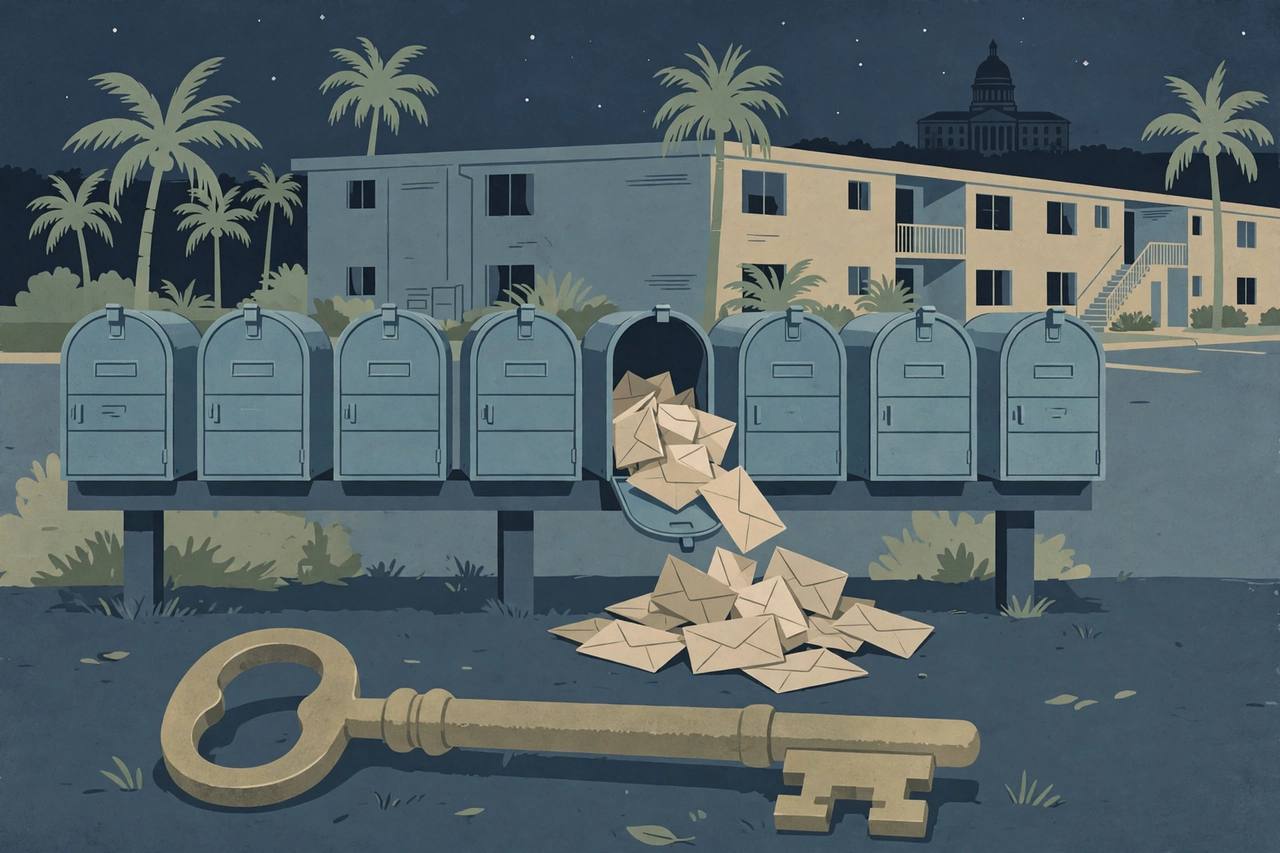
Two Tallahassee residents who prosecutors say used a stolen-grade Postal Service key to raid apartment-complex mailboxes across the city have been sentenced to federal prison. Christy Cody Holgate, 49, was sentenced to more than three and a half years in federal prison, and Kim Demetrius Benson, 53, was sentenced to two years' imprisonment, after both pleaded guilty to conspiracy to commit mail theft and multiple counts of mail theft, according to the U.S. Attorney's Office for the Northern District of Florida. The sentences were announced on Wednesday, November 4, 2026, by John P. Heekin, the U.S. Attorney for the Northern District of Florida, and reported the same day by FOX 49 in Tallahassee.
Source: FOX 49 Tallahassee (WTLH), November 4, 2026
"These defendants sought to enrich themselves by stealing the mail, but now they'll see the inside of a federal prison cell," Heekin said. "My office is committed to aggressively prosecuting anyone who tampers with, steals, or diverts the U.S. Mail to ensure our citizens can continue to rely upon the U.S. Postal Service to quickly, safely, and securely deliver the mail."
How the scheme worked, according to court documents
Court documents say that between August 5, 2025, and December 5, 2025, Holgate and Benson broke into multiple apartment-complex mailboxes using a U.S. Postal Service mail key that allowed access to residents' mail. Apartment buildings typically collect residents' letters in locked cluster boxes that a carrier opens with a single master key, which is why one key can expose an entire building's mail at once. Investigators with the U.S. Postal Inspection Service and the Tallahassee Police Department documented multiple thefts involving hundreds of pieces of mail and obtained video surveillance that captured the break-ins, prosecutors said.
Arrested with bags of mail — and the key
When the two were arrested in December 2025, authorities said they were found in a vehicle containing bags of stolen mail items, along with stolen debit and credit cards and a USPS mail key. Prosecutors said the two conspired to steal U.S. mail that, according to a confession by Holgate, was then sold to another individual for money to purchase illegal drugs. Both later pleaded guilty — Holgate and Benson each to the conspiracy charge and to multiple counts of mail theft — which is why the case ended in negotiated guilty pleas and Wednesday's sentencings rather than a trial.
Why mail theft is a federal case
Stealing mail is prosecuted federally because the mail is a federal system: the U.S. Postal Inspection Service, the law-enforcement arm of the Postal Service, investigates thefts alongside local police — here, the Tallahassee Police Department — and cases are charged in U.S. District Court by the local U.S. Attorney's Office. Assistant U.S. Attorney Eric K. Mountin prosecuted this case. The pattern in Tallahassee fits the one postal inspectors describe nationally: stolen letters are rarely the end goal. Mail carries bank and credit cards, replacement cards, benefit and tax documents and personal details that can be turned into identity theft and check fraud, which is why a bag of stolen letters — and the stolen debit and credit cards found with these defendants — is treated as the raw material of financial crime, not petty theft.
December 2025: bags of stolen mail, stolen debit and credit cards, and the USPS mail key itself, in the vehicle with Holgate and Benson, authorities said. Investigators had already documented multiple thefts of hundreds of mail pieces and had surveillance video of the break-ins, prosecutors said.
The local impact in Tallahassee
Tallahassee, Florida's capital, is a city of state workers, two universities and large apartment complexes — exactly the housing pattern cluster-box theft targets, because one compromised mailbox bank can mean dozens of households missing pay documents, cards and official letters at once, often without knowing anything was taken until a bill, a bank alert or a missing delivery gives it away. Prosecutors did not publish a victim count or a dollar loss in Wednesday's announcement, and the announcement did not say how the pair obtained the postal key — a detail postal inspectors treat as one of the most sensitive in mail-theft cases, because master keys are supposed to be tightly controlled.
Why this matters to readers far beyond Florida
For immigrant families — including Punjabi families across the United States — the mailbox is not a minor thing: green cards, work permits, notices from immigration courts and tax authorities, and replacement bank cards all arrive by U.S. Mail, and a stolen or missed official letter can mean a missed deadline with consequences far larger than the letter itself. The Tallahassee case is a reminder of the practical defences postal inspectors recommend: collect mail daily, use USPS Informed Delivery alerts, put mail on hold when travelling, and report a cluster box that looks forced or a neighbourhood pattern of missing mail to the Postal Inspection Service and local police — the two agencies whose joint work produced this case.
What happens next
With guilty pleas entered and sentences imposed, Holgate and Benson will serve their terms in the federal prison system; the U.S. Attorney's announcement did not name the facilities or a surrender date, and it listed no further court dates in the case. Any remaining questions — including how the postal key was obtained and whether the individual who, on Holgate's account, bought the stolen mail faces charges — were not addressed in Wednesday's announcement.