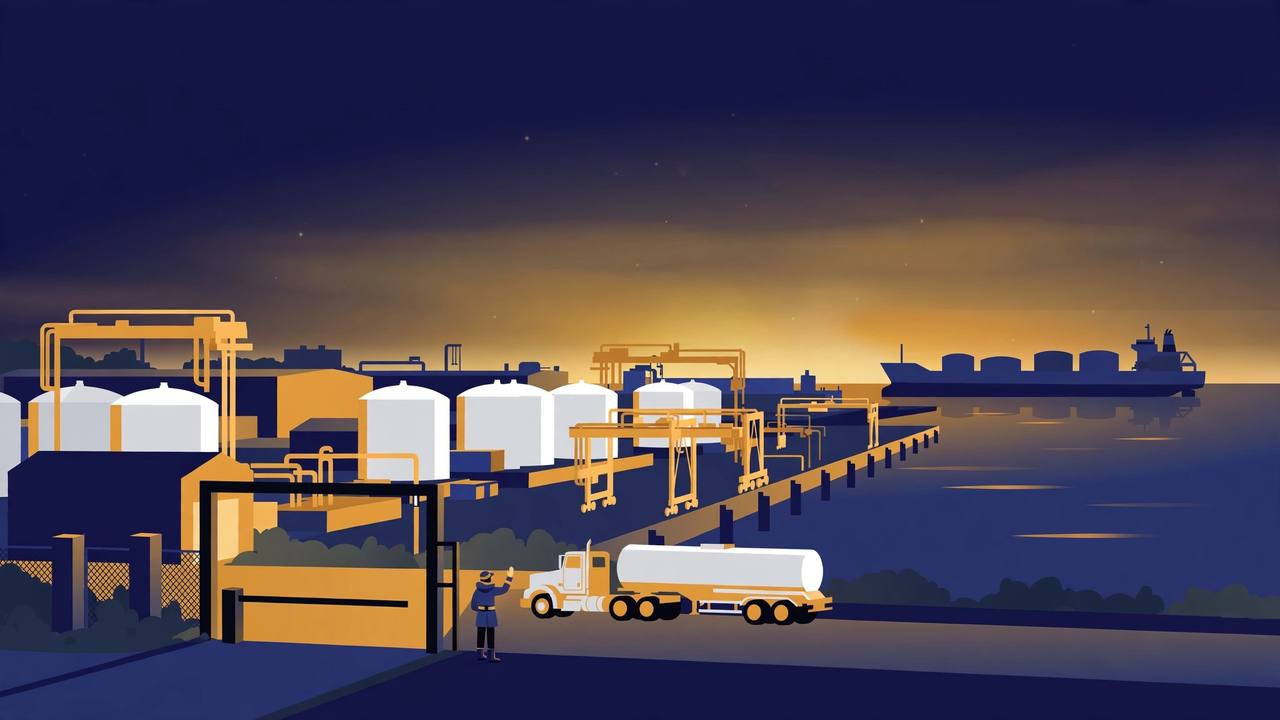
TRENTON — New Jersey's governor has drawn a legal line at her state's docks. In a letter dated Monday, November 2, Governor Mikie Sherrill warned the state's port and terminal operators against accepting shipments of Russian diesel, saying those shipments break federal law and could expose businesses and individuals to 'harsh' civil and criminal penalties, Reuters reported on November 3. 'Every port and terminal operator, intermediary, and buyer is on notice: do not help bring illegal Russian diesel into New Jersey,' Sherrill said. The warning is a new development in a story Awaaz Punjab has followed since the first Russian diesel tanker was dispatched to the United States under the Trump administration's license last month: a state governor is now telling the private companies that would physically unload that fuel that doing so is, in her reading, illegal — whatever Washington's license says.
Source: Reuters — New Jersey governor warns ports against accepting Russian diesel (Nov 3)
What the governor's letter actually says
Sherrill's letter, published by her office, puts operators on notice that 'purchasing or unloading the illegal Russian fuel currently bound for the east coast of the United States at the urging of the Trump Administration would likely subject businesses and individuals to harsh penalties, both civil and criminal.' Her legal argument rests on the Ending Importation of Russian Oil Act, which Congress passed in April 2022 after Russia's invasion of Ukraine and which bans imports of Russian energy products; the governor says diesel falls inside the banned tariff classification. She argues that a Treasury license cannot override an act of Congress, and that no presidential certification that could lift the ban has been made. The letter cites penalties that include a fine set at the value of the merchandise introduced or attempted to be introduced, and a five-year statute of limitations — exposure she described as running to millions of dollars for participants.
Source: Office of Governor Mikie Sherrill — letter to port and terminal operators (Nov 2)
The license she is challenging: General License No. 135
The other side of the clash is a document issued on October 9, 2026 by the Treasury Department's Office of Foreign Assets Control (OFAC). General License No. 135 authorizes transactions 'related to the sale, delivery, offloading, or importation, including importation into the United States, of diesel fuel of Russian Federation' origin, and it runs until 12:01 a.m. Eastern time on April 7, 2027. The administration granted the license amid tight global diesel inventories and near-record U.S. prices ahead of the November 3 midterm elections, Reuters reported. Russia has since dispatched multiple diesel tankers to the United States. Sherrill's position — that a general license issued by an agency cannot legalize what a statute forbids — has not been tested in court; it is the governor's stated legal reading, and no court ruling on the dispute exists yet.
Source: Reuters / Governor Sherrill's letter (OFAC General License 135, Oct 9)
The tanker at the centre of it: Agioi Fanendes
One ship turned the legal argument into a deadline. Reuters reported on October 23 that a tanker carrying approximately 40,000 metric tons of Russian diesel had departed the Russian Baltic port of Primorsk. The Malta-flagged vessel, Agioi Fanendes, initially listed the Port of New York and New Jersey as its destination, with an expected arrival of November 7; U.S. Senator Richard Blumenthal of Connecticut cited the same tracking data on October 24. The ship's manager, Eastern Mediterranean Maritime, subsequently told Reuters that no discharge port or country had been finalized, and on November 3 The New York Times reported the tanker was in the North Atlantic and had changed its listed destination to indicate it was awaiting instructions. If it does unload in the United States, it would be the first shipment of Russian diesel to reach the country since July 2023.
Source: Reuters shipping reporting, via Morristown Minute
Who got the letter — and what they said
The Times reported that Sherrill sent the warning to a dozen operators, including Kinder Morgan, IMTT and Phillips 66, and that the facilities receiving it were outside the Port Authority of New York and New Jersey's own port system — private terminals along the New Jersey waterfront that handle much of the region's fuel. Kinder Morgan said it had received no notice of a Russian diesel shipment to its terminal. Sherrill has not announced a formal port closure, and her office has not confirmed that any Russian diesel shipment has been blocked. Transport Topics reported that she said New Jersey would use its legal and regulatory authority to prevent the shipments from entering through the state — a warning of state action layered on top of the federal penalties she cites.
Source: The New York Times via Morristown Minute; Transport Topics
Washington: OFAC General License 135 (Oct 9) authorizes the sale, delivery, offloading and importation of Russian-origin diesel until April 7, 2027. Trenton: the Ending Importation of Russian Oil Act (2022) bans exactly those imports by statute, and a license cannot repeal a law. No court has ruled between them — operators at New Jersey terminals are the ones who must decide whose reading to risk money on.
Why diesel prices make this a trucking story
The license exists because diesel is expensive, and that is why a ports dispute in New Jersey lands directly on the Punjabi trucking community concentrated in the state and across the Northeast corridor. The U.S. Energy Information Administration put the average price of on-highway diesel in the Central Atlantic region, which includes New Jersey, at $6.49 a gallon on November 2 — up $2.58 from a year earlier. At those prices, every load a tanker can legally land matters to pump prices, freight rates and the margins of owner-operators running the I-95, I-78 and New Jersey Turnpike corridors. The governor's warning cuts the other way: if New Jersey terminals refuse the cargo, the fuel the administration licensed to ease prices may have to discharge elsewhere — or not at all — while the legal fight plays out.
Source: EIA data reported by Morristown Minute (Nov 3)
Background: from invasion ban to election-eve license
Congress banned Russian energy imports in April 2022, weeks after Russia's full-scale invasion of Ukraine, as part of the Western effort to cut the Kremlin's oil revenue. For more than three years the ban held, and no Russian diesel reached the United States after July 2023. That changed in the autumn of 2026, when tight inventories and diesel prices near records — a direct cost-of-living pressure on truckers and freight — led the Trump administration to issue the October 9 license and invite Russian supply back to U.S. and global markets, a move Awaaz Punjab covered when the first tanker sailed. Sherrill, a Democrat governing a state whose ports serve the New York metropolitan fuel market, is the first governor to formally warn her own state's operators off the trade — turning an argument about sanctions policy into a practical question for a dozen terminal companies with a ship a few days out.
Source: Reuters; Governor Sherrill's letter
What happens next
The immediate test arrives with the Agioi Fanendes, previously expected on November 7 and now listed as awaiting instructions in the North Atlantic: where it finally discharges — a New Jersey-area terminal, another U.S. port, or nowhere in the United States — will show whether the governor's warning changed behaviour. Beyond the ship, three things will decide the dispute: whether any operator tests the license at a New Jersey terminal and draws a state or federal response; whether the administration defends General License 135 against the governor's statutory argument, in public or in court; and whether other port-state governors follow Sherrill's lead. The license itself runs until April 7, 2027, so the legal question will outlast this one tanker. Awaaz Punjab will follow the tanker's arrival and any response from the terminal operators and the Treasury Department.
Source: Morristown Minute / Reuters