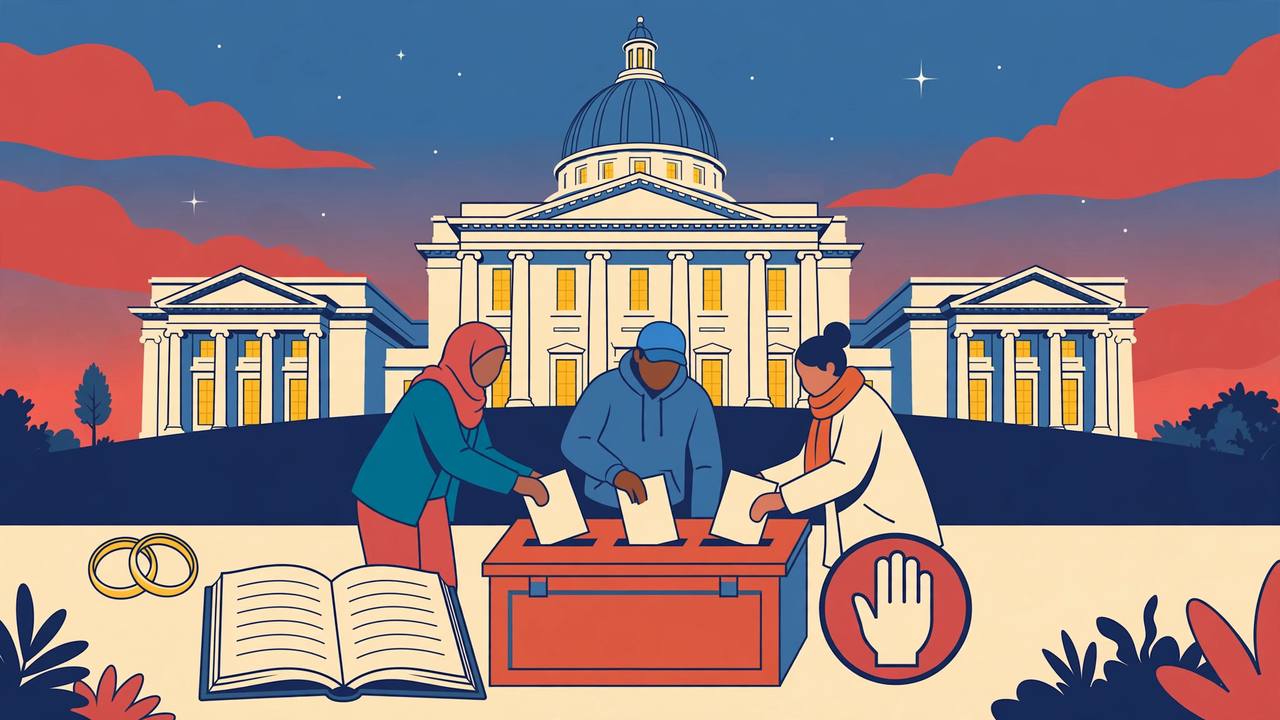
Virginia voters have rewritten their state constitution in a single night. On Tuesday, November 3, voters approved all three constitutional amendments on the ballot — Question 1, which writes a fundamental right to reproductive freedom, including abortion care, into the Constitution of Virginia; Question 2, which deletes the constitution's 2006 ban on same-sex marriage and replaces it with a guarantee that marriage cannot be denied on the basis of sex, gender or race; and Question 3, which restores the vote automatically to people convicted of felonies once they are released from incarceration, ending the governor-by-governor petition system. The Associated Press called Question 1 shortly after 9 p.m. Eastern, and called Questions 2 and 3 just after 9:30 p.m., as returns from across the Commonwealth came in. Awaaz Punjab previewed all three questions before the polls closed; this report carries the verdicts, the counts, and what changes now.
Source: WHRO / VPM — Virginia voters sign off on all 3 constitutional amendments (Nov. 3, 2026)
Before voting ended, Awaaz Punjab explained the three questions, how they reached the ballot and the court fight already hanging over Question 1. Voters have now answered: all three passed. The earlier explainer is here. Read the pre-vote explainer
The counts behind those calls, as tabulated by the Associated Press late on election night, show three clear but not identical verdicts. On Question 1, with 2,235 of Virginia's 2,529 precincts reporting — an estimated 93.73% of the vote in — 'Yes' stood at 2,126,448 votes to 1,304,519 for 'No'. On Question 2, with 2,264 precincts reporting and an estimated 94.08% of the vote counted, 'Yes' had 1,972,670 votes to 1,486,493. On Question 3, called by AP at 9:34 p.m., with 2,230 precincts reporting and an estimated 94.02% counted, 'Yes' had 1,937,478 votes to 1,517,020. All results remain unofficial until the State Board of Elections certifies them, and provisional and remaining absentee ballots are still being counted.
Source: Associated Press — 2026 election results, Virginia Questions 1, 2 and 3
Question 1 — a constitutional right to reproductive freedom
Question 1 was the most contested and the most heavily funded of the three. After certification, the Virginia Constitution will state that “every individual has the fundamental right to reproductive freedom, including the ability to make and carry out decisions relating to one's own prenatal care, childbirth, postpartum care, contraception, abortion care, miscarriage management, and fertility care.” In practical terms, WHRO reported, the amendment allows abortion through the second trimester and lowers barriers in the third trimester — where the state may still restrict it, except when a physician determines it is medically indicated to protect the patient's life or physical or mental health, or when the fetus is not viable — and it shields health-care providers from criminal prosecution for that care. Because the protection now sits in the constitution itself, a future legislature and governor opposed to abortion cannot remove it by ordinary law; barring federal legislation restricting abortion nationwide, the right is durable. Virginians for Reproductive Freedom, the 'Yes' campaign, spent $3.7 million through October 26, dwarfing roughly $850,000 spent by the coalition campaigning for 'No', according to campaign-finance figures cited by WHRO. Virginia has also become a destination for patients from states with bans: the Guttmacher Institute estimates nearly 9,000 people travelled to Virginia seeking abortion care in 2025.
Source: WHRO / VPM — Virginia voters sign off on all 3 constitutional amendments (Nov. 3, 2026)
Democrats in the General Assembly had pursued this amendment since the U.S. Supreme Court overturned Roe v. Wade in June 2022. Virginia's process requires an amendment to pass the legislature twice, with a House of Delegates election in between: House Republicans defeated it in 2023, and Democratic majorities then passed it in 2025 and 2026 to send it to voters. Governor Abigail Spanberger welcomed the result on Tuesday night; FFXnow reported her saying that because Virginians used their voices at the ballot box, these rights will now be enshrined in the constitution. One fight is not finished: the amendment faces a legal challenge from the Founding Freedoms Law Center, the legal arm of the Family Foundation, which argues the ballot language was misleading and asks the Tazewell County Circuit Court to block certification of the results. A hearing is scheduled for November 13. “The fight's not over,” said Jessi Blakely, state director for Family Foundation Action. “We're not necessarily surprised, just based on how the process has been run and what the ballot language was, but we're hopeful that we'll get a good look at it in court.”
Source: WHRO / VPM; FFXnow — Va. constitutional amendments pass (Nov. 3, 2026)
Question 2 — the marriage ban comes out of the constitution
Question 2 changes nothing about who can marry in Virginia tomorrow — same-sex marriage has been legal nationwide since the Supreme Court's 2015 Obergefell v. Hodges decision — but it removes the text that marriage advocates spent two decades trying to erase. In 2006, while other states were moving the opposite way, Virginia voters approved the Marshall-Newman Amendment, named for its patrons, writing into the constitution that “only a union between one man and one woman may be a marriage valid in or recognized by this Commonwealth.” Obergefell made that sentence unenforceable in 2015, but it stayed on the page. Once these results are certified, it comes out, replaced by language stating that “marriage is one of the vital personal rights essential to the orderly pursuit of happiness” and that officials cannot deny a marriage on the basis of sex, gender or race. The amendment also writes the principle of Loving v. Virginia — the 1967 Supreme Court case, itself from Virginia, that struck down bans on interracial marriage — into the state's own constitution. Supporters argued the change is insurance: the Supreme Court's Dobbs decision weakened the due-process reasoning on which Obergefell rests, and advocates did not want Virginia's constitutional ban waiting to revive if Obergefell ever falls. FFXnow noted the vote makes Virginia the only Southern state to enshrine such marriage protections in its constitution. Virginians for Marriage Equality spent nearly $700,000 campaigning for 'Yes', against a comparatively negligible amount raised by 'No' campaigns. At the polls, the change felt personal to some voters: “I am a lesbian, married 21 years,” Chesterfield voter Dina Persico told WHRO. “But it was simple to me because it really wasn't changing much. It's just protecting the language.”
Source: WHRO / VPM — Virginia voters sign off on all 3 constitutional amendments (Nov. 3, 2026)
Question 3 — the vote comes back automatically on release
Question 3, called by AP at 9:34 p.m., rewrites one of the oldest rules in Virginia politics. When the amendment was first written into the state's governing documents, Virginia stripped the vote from anyone convicted of a felony — a framework that, in the words of the 1902 constitutional convention's own leaders, was built to disenfranchise Black Virginians — and gave the governor alone the power to give it back. That petition system survived into the 1971 constitution and, according to The Sentencing Project, left about 250,000 Virginians unable to vote after leaving prison as of 2024. The amendment does four things: it creates a fundamental right to vote in the constitution; it confirms that people who are incarcerated cannot vote; it restores the vote automatically on release — expressly including people convicted of murder, voluntary manslaughter and involuntary manslaughter, the three offences to which a federal court ruling in January had already narrowed disenfranchisement, after which the state notified about 235,000 Virginians in September that they should never have lost the vote; and it replaces the old disqualification for 'mental incompetence' with a narrower test based on whether a person has the capacity to understand the act of voting. State Senator Mamie Locke of Hampton first carried a version of this amendment in 2009, following the late Senator Yvonne Miller, and legislators pushed versions of it for decades. Governor Spanberger backed taking the decision out of the governor's hands entirely, because a discretionary system changes with every administration. Opponents questioned whether people convicted of crimes should elect lawmakers and whether automatic restoration on release lets people vote before paying restitution, fines and fees; supporters answered that tying the vote to payments is a barrier akin to a poll tax.
Source: WHRO / VPM — Virginia voters sign off on all 3 constitutional amendments (Nov. 3, 2026)
Locally, the three verdicts held up in the Northern Virginia suburbs that many Awaaz Punjab readers call home. Potomac Local reported that majorities in Prince William County, Stafford County, the City of Manassas and the City of Fredericksburg voted 'Yes' on each of the three questions, in line with the statewide result, on unofficial local totals from the Virginia Department of Elections; statewide, with the large majority of precincts reporting, Question 1 was running at roughly 61–62% 'Yes', Question 2 at roughly 56–57% and Question 3 at roughly 55–56%.
Source: Potomac Local — How local voters decided the constitutional amendments (Nov. 4, 2026)
Northern Virginia — Fairfax, Loudoun and Prince William counties — and the Richmond suburbs hold one of the East Coast's largest Punjabi and South Asian communities, and these three amendments now sit above every state law their families live under. Question 1 decides what reproductive and fertility decisions a family can make with its own doctors, protected from a future legislature. Question 2 guarantees that a lawful marriage cannot be denied or de-recognised by the state on grounds of sex, gender or race. Question 3 means a family member, employee or neighbour who has served a sentence gets the vote back automatically on release, instead of petitioning a governor and waiting. None of the three asks anyone's background — that is the point of a constitutional right — but all three were decided by the voters of the same counties where the community lives, works and runs its businesses, and all three passed there.
What happens next
Three steps remain. First, the count finishes: provisional ballots and the remaining absentee ballots are still being added, and the State Board of Elections must certify the results before anything is final — every figure in this report is unofficial until then. Second, the courts: the Tazewell County challenge to Question 1, seeking to block certification over the ballot language, is heard on November 13, and its outcome will decide whether the reproductive-freedom amendment proceeds on schedule or enters a longer legal fight. Third, the calendar: the amendments are scheduled to take effect on January 1, 2027. From that date, reproductive freedom and marriage equality stand in the text of Virginia's constitution rather than in statutes and court rulings alone, and voting-rights restoration becomes automatic on release from incarceration. Awaaz Punjab will report the certification and the November 13 hearing as they happen.