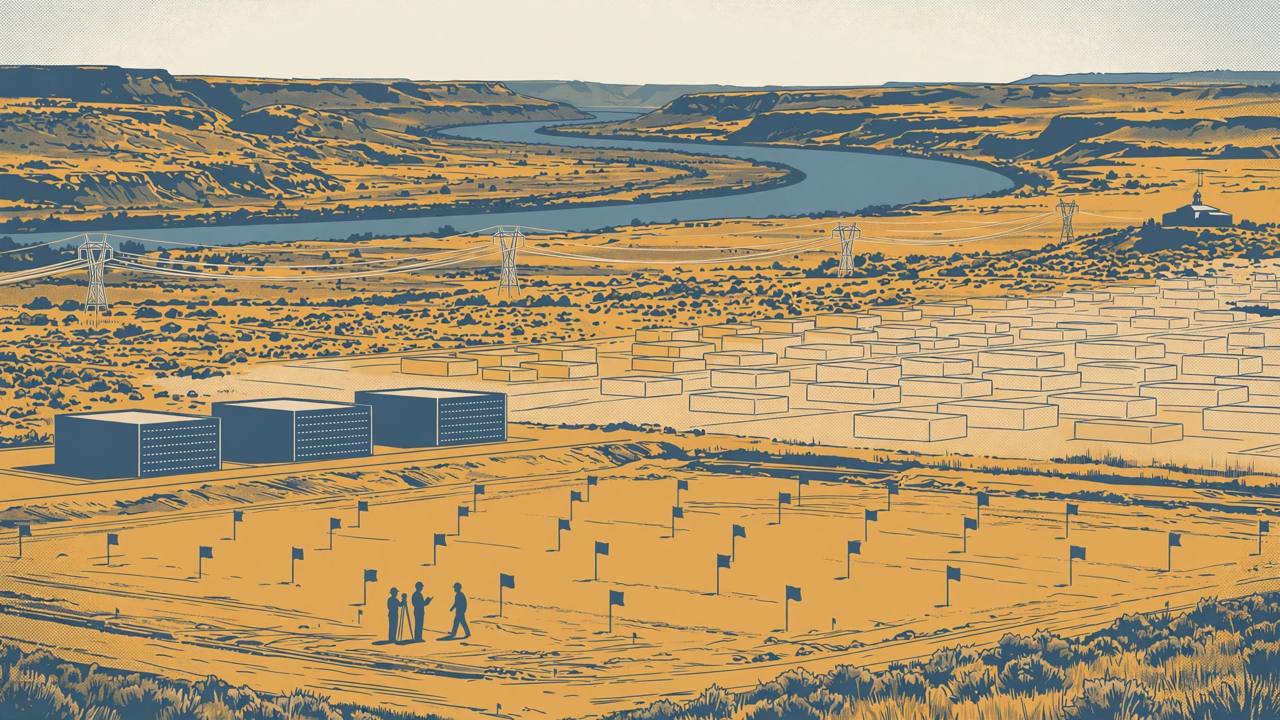
WEST RICHLAND, Washington — Amazon confirmed on Monday, November 2, that it is the company behind the purchase of roughly 1,000 acres at Lewis & Clark Ranch in West Richland, in Benton County, where it is weighing a data-centre campus that would start with three buildings and could grow to 21. The confirmation lands the same week the West Richland City Council takes up interim rules for data centres — tonight, Tuesday, November 3, at 6 p.m. at City Hall, 3100 Belmont Boulevard — with city staff recommending approval and an organised group of local opponents urging residents to show up and demand a stronger moratorium instead.
The site sits in the Lewis & Clark Ranch area, north of Ruppert Road, in a city across the Yakima River from Richland in Washington's Tri-Cities. Amazon told the city it has completed initial due diligence on the land, but it has filed no permit applications, and the state's environmental review under the State Environmental Policy Act (SEPA) — which examines impacts on water, air, land use, wildlife, energy and environmental health — has not begun. Amazon says it bought the property from a development company that had acquired the land intending to market it for data-centre development and sell it to an end user; local reporting identified that earlier buyer as the developer Trammell Crow.
Source: Tri-Cities Area Journal of Business / Tri-Yak News
The $264 million headline — and what the records actually show
Local headlines have put a $264 million price on Amazon's land, but that figure comes from Benton County property records, not from Amazon, which has not disclosed what it paid. The Tri-Cities Area Journal of Business reported that the parcels, formerly held by Frank Tiegs LLC, changed hands twice in July: a sale on July 10 to TC West Richland 1 LLC for $82.7 million, and a sale on July 16 to WKC31 Development LLC for $263.7 million. No published source ties WKC31 Development LLC to Amazon, and Amazon says only that it bought from a development company. Readers should treat the $263.7 million county-record sale as the reported market context for the ranch — not as a confirmed Amazon purchase price.
Source: VoltGrid News, reviewing Journal of Business county-records reporting
Water, power and the questions Amazon has — and has not — answered
Amazon has put numbers on water. It says outside air would carry the campus's cooling load about 93% of the year, with water-based cooling in the hottest 7%; the first three buildings would use about 10 million gallons of water a year for cooling — roughly 3.3 million gallons per building — and a full 21-building campus would stay below 70 million gallons a year. The permanent supply would be treated surface water, not local wells, the company says, its operations are not expected to strain community drinking water, and it is pursuing replenishment projects intended to return more water to the watershed than the campus withdraws. A supply plan is still being finalised with local partners.
On electricity, Amazon has given no megawatt figure and has not named its power supplier. The company says it works with utilities, regulators and grid operators so that data centres pay for the electricity and infrastructure improvements they require, and maintains those costs should not be passed to local residents and businesses. The Tri-City Herald has reported that Benton Rural Electric Association said earlier this year it was in early due diligence with an unnamed prospective data centre in its service area, with a cost-recovery agreement in place and no decisions made; whether that unnamed project is this one has not been stated by either side.
Tonight's council vote: rules, a “fake moratorium” row, and what is actually proposed
The interim ordinance before the council tonight would set temporary data-centre rules for up to six months while staff, the Planning Commission and the council study impacts and draft permanent regulations. As drafted, data centres would be prohibited in the Light Industrial zoning district but allowed in the Mixed-Use/Light Industrial district under development standards; cryptocurrency mining would be prohibited in every zoning district; and an existing noise exemption would be removed. City staff recommend approval; the Journal of Business has described the measure as a six-month moratorium.
Source: 98.3 KEYW / City of West Richland council agenda reporting
Opponents in the group Tri-Cities Data Center Watch call the proposal a “fake moratorium.” They argue its provisions on prospective application and vested rights could protect developers while failing to protect residents living near the site — local reporting has noted homes close to the proposed campus — and they are urging residents to attend tonight's 6 p.m. meeting to demand what they call a real moratorium and to oppose any developer agreement. The precise legal effect of the draft's vested-rights provisions has not been clarified by city officials, and it is one of the points residents are expected to press tonight.
Three buildings first: 120–150 full-time jobs, plus hundreds of construction jobs — electricians, technicians, network specialists, engineers, security and HVAC staff. At full build-out: 21 buildings and more than 1,000 full-time jobs. On taxes, Amazon estimates the first phase would generate millions of dollars a year for West Richland, Benton County, fire and police services, school districts and the Port of Kennewick — rising to tens of millions a year at full build-out — against about $6,400 in estimated local property taxes from the same parcels in 2026.
Background: a ranch, a 2025 zoning change, and a region filling with data centres
The Lewis & Clark Ranch site is part of a larger subarea of about 7,600 acres of Columbia Basin farmland and rangeland, in a region known for wheat, apples, cherries, hops and wine grapes. West Richland changed its zoning in 2025 to allow data centres in certain areas, before Amazon's role was public, and the wider Tri-Cities area is seeing several data-centre proposals at once. Amazon is also pursuing a campus at the Wallula Gap Business Park in Walla Walla County, where it faces local opposition as well, and it already operates data centres south of the Tri-Cities in Oregon. Amazon says it has invested more than $400 billion in Washington since 2010, including infrastructure and employee compensation, and employs more than 95,000 people in the state — context for why a single campus decision in a small city now draws state-level attention.
For the Punjabi trucking community that runs Interstate 82 and US-395 through the Tri-Cities, the campus is a freight-and-jobs story as much as a technology one: a multi-year construction programme of this size means sustained work for hauliers, electricians and contractors across Benton County, and a permanent change to the land and power market their routes pass through every day.
What happens next
Tonight's council decision comes first: if the interim rules pass, they govern data-centre applications for up to six months while permanent rules are drafted. Amazon's own next public checkpoint is a community open house on November 19, from 5 p.m. to 8 p.m. in the cafeteria at Enterprise Middle School, where residents can question company representatives at information booths on water, energy, noise, jobs and environmental impacts. Beyond that, nothing about the campus is approved: no permit application is on file, the SEPA environmental review has not started, and Amazon has not disclosed its purchase price, its power source or a construction timetable. “We're committed to growing responsibly and we want the community to leave the Open House with a better understanding of this project and what it could mean for the area,” an Amazon spokesperson said.