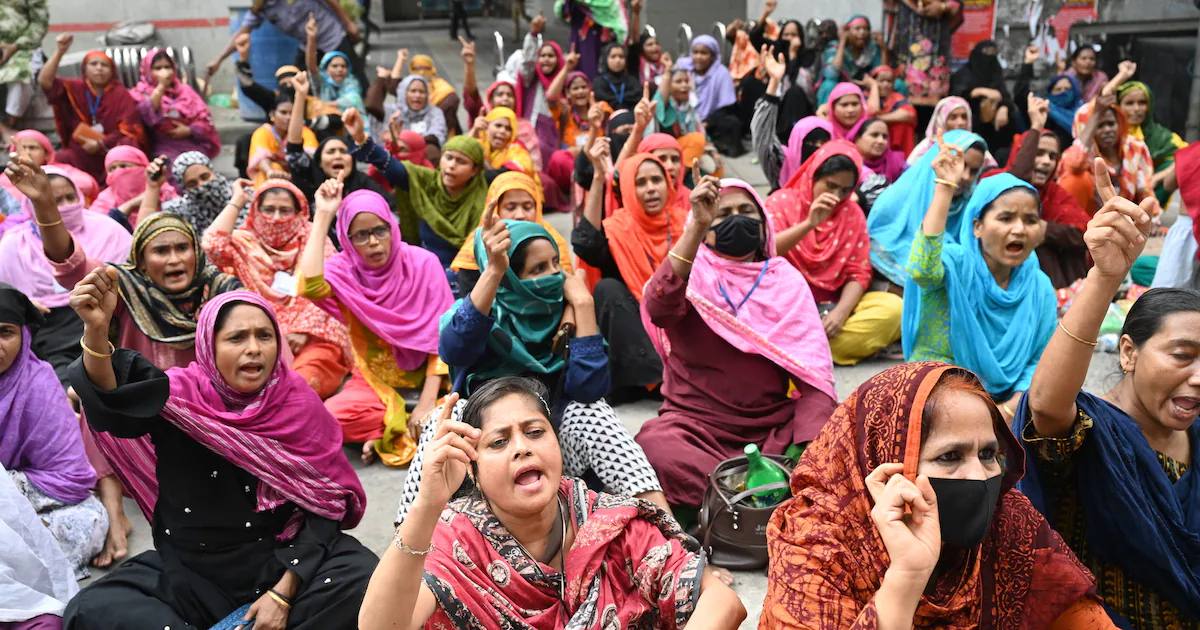
Bangladesh has raised the minimum monthly wage for its garment workers by 36 percent to Tk17,000 — about $136 — after weeks of violent protests that shut hundreds of factories and disrupted production across the country's industrial belts. The decision was announced early on Wednesday, November 25, after a marathon meeting of the government-appointed Minimum Wage Board that ran for nearly 12 hours and stretched past midnight.
Source: Reuters
The six-member board settled the new rate through a vote after workers' and employers' representatives failed to reach a consensus. Four members backed the employers' proposal of Tk17,000, while two backed the workers' side, which had lowered its demand to Tk18,000 in the final round of talks. Board chairman Syed Azad Subhani announced the decision to reporters after the meeting ended in the early hours of Wednesday.
Source: The Business Standard
Under the revised four-grade structure, the minimum wage for Grade 1 workers has been set at Tk21,500, up 43 percent from the current rate. Grade 2 workers will receive Tk20,000, an increase of about 40 percent, and Grade 3 workers Tk19,200, an increase of about 42 percent. The lowest grade — Grade 4, which covers entry-level workers and operators — gets Tk17,000, up from Tk12,500. The new rates are expected to take effect from December 1, subject to approval by the labour and employment ministry, with workers receiving their revised salaries from January.
Source: The Business Standard
Workers' representative Babul Akter said the workers' side was not satisfied with the announced wages but had to accept the board's decision. The 36 percent rise is the smallest percentage increase in the garment sector's minimum wage since the first wage structure was introduced in 1986 — and far below the Tk30,000 a month, about $240, that workers had been demanding since the protests began in late October, citing the rising costs of food, housing, transport and healthcare.
Source: Associated Press
Workers reject the deal; fresh protests and tear gas on Wednesday
The announcement did little to calm the unrest. Workers who had demanded Tk30,000 rejected the new rate and took to the streets again on Wednesday in Gazipur, Savar, Tongi and Sreepur. Police fired tear gas and sound grenades to disperse workers who blocked the Dhaka-Tangail and Dhaka-Mymensingh highways in Gazipur, and workers clashed with police at Bhogra Bypass and Naojor from around 8:30 in the morning. In Savar, workers blocked roads near Padmar Mor in Hemayetpur. By noon, authorities at 60 garment factories in Savar and Ashulia had declared general holidays amid the unrest.
Source: The Business Standard
Production had already been badly hit before the announcement. The Bangladesh Garment Manufacturers and Exporters Association said 481 factories suspended production on Tuesday — 397 were unable to operate and another 84 remained closed under the labour law's 'no work, no pay' provision. At the peak of the unrest, around 500 of the country's roughly 4,500 garment factories had shut down, and hundreds of factories closed on earlier protest days in Savar, Ashulia and Gazipur.
Source: Reuters
Home Minister Salahuddin Ahmed told reporters on Wednesday that a wage deal had been reached but alleged that a 'political conspiracy' was fuelling the continued unrest in Gazipur, claiming genuine workers were not involved in the protests. He said the wage board had held several meetings, inspected factories and consulted stakeholders before deciding, and that all sides had agreed to the decision in the morning. The claim of a political conspiracy has not been independently verified.
Source: The Business Standard
Why this wage decision matters far beyond Bangladesh
Bangladesh is the world's second-largest garment exporter after China. The ready-made garment industry employs more than four million workers — most of them women — supplies global retailers including H&M, Zara, Walmart, Target and Gap, and generates more than 80 percent of Bangladesh's export earnings, worth about $55 billion a year, yaani 55 arab dollar. A prolonged shutdown ripples through global clothing supply chains and the livelihoods of millions of families.
Source: Reuters
The unrest has been building since late October, when workers began demanding the minimum wage be raised from Tk12,500 to Tk30,000. A wage board was formed on November 1, but protests, highway blockades and clashes with police continued through the month, and factories were repeatedly shut. Labour groups say a worker, Toufiq Hossain, died during the unrest, and two union leaders, Sultana Begum and Md. Elias, were detained by police on November 17 after taking part in a webinar on the minimum wage; they were later granted bail. More than 100 labour organisations had called for their release.
Source: Business of Fashion
Workers clashed with police in Gazipur on Tuesday as the wage protests shut hundreds of factories — the unrest that led to today's wage decision. Read the earlier report
What happens next now rests with the labour ministry, which must approve the board's proposal and can still raise the rates before issuing the official notification. Labour rights advocates say the increase falls well short of a living wage and may not be enough to quell the unrest, while factory owners have agreed to implement the new rates from December. If workers keep rejecting the deal, the factory shutdowns and street protests that have already cost the industry weeks of production could continue into December.
Source: Business of Fashion
What is solid
- The Wage Board fixed the minimum wage at Tk17,000 a month, up 36% from Tk12,500, in a 4–2 vote after a nearly 12-hour meeting
- Grade-wise rates: Tk21,500 for Grade 1, Tk20,000 for Grade 2, Tk19,200 for Grade 3 and Tk17,000 for Grade 4
- The new rates are to take effect from December 1, subject to labour ministry approval
- Fresh protests, tear gas and factory holidays in Gazipur and Savar on Wednesday, November 25
What is only claimed
- Home Minister Salahuddin Ahmed's claim that a 'political conspiracy' is fuelling the Gazipur unrest — alleged by the minister, not independently verified
- Whether the Tk17,000 hike will calm the protests — workers are still on the streets rejecting it, and labour advocates say it falls short of a living wage