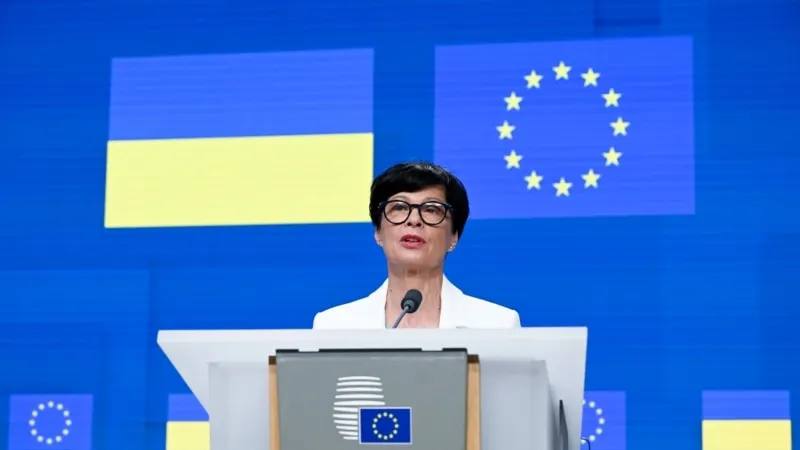
BRUSSELS — The European Commission and Ukraine agreed on Sunday, November 15, to accelerate Ukraine's EU accession reforms and set out a concrete path for Kyiv to meet the interim benchmarks on democracy and the rule of law in the first half of 2027, after a meeting of their high-level working group in Brussels co-chaired by EU Enlargement Commissioner Marta Kos and Ukrainian Prime Minister Serhii Koretskyi.
Source: Hromadske
"We agreed on concrete steps on reforms and set out a path for Ukraine to meet the interim benchmarks in the first half of 2027. Together, we can seize this historic opportunity to bring Ukraine's integration into the European Union closer," Kos wrote after the meeting, according to Kyiv24's report of her announcement.
Source: Kyiv24
Verkhovna Rada Speaker Ruslan Stefanchuk also took part. According to Stefanchuk, Kos noted that "the Ukrainian parliament is demonstrating exceptional effectiveness under conditions in which no other European parliament has to work," and he said that over the past two plenary weeks the Rada had supported 12 bills aimed at European integration and at fulfilling commitments under the Ukraine Facility programme — four adopted in full and another eight passed at first reading.
Why the benchmarks decide everything
The meeting focused on the interim benchmarks for negotiating chapters 23 (judiciary and fundamental rights) and 24 (justice, freedom and security), the heart of Cluster 1, 'Fundamentals'. Without meeting the interim benchmarks on democracy and the rule of law, Ukraine cannot move to the next stage of the accession negotiations — provisionally closing negotiating chapters.
The high-level working group was established in October, on the initiative of President Volodymyr Zelenskyy and Commission President Ursula von der Leyen, to help Ukraine deliver the benchmarks and prepare for the Interim Benchmark Assessment Report (IBAR) expected in early 2027.
Sunday's agreement builds on the Commission's annual enlargement report of November 4, which set roadmaps for Ukraine and its fellow candidates and stated that democracy, the rule of law and fundamental rights "remain the foundation of the accession process and determine the overall pace of negotiations." Read the November 4 enlargement package story
How far Ukraine still has to go
Independent monitoring of Ukraine's progress under chapters 23 and 24, published by the Ukrainian Centre for European Policy, put overall implementation of the interim benchmarks at 20.9% at the end of the first half of 2026, with the hardest test being a sustained track record in investigations, court proceedings and enforcement of judgments.
Source: KAS / Ukrainian Centre for European Policy
Ukraine is also racing a neighbour: Moldova, which began accession negotiations at the same time as Kyiv, is further ahead, and the Commission's roadmap envisages Moldova provisionally closing far more chapters in 2027. Ukraine's ambassador to the EU, Taras Kachka, has told Radio Liberty that the success of the negotiations depends 90% on "the speed and pro-European stance of parliament."
What happens next
Under the Commission's roadmap, Ukraine could provisionally close seven chapters during 2027 — education and culture in the first half, and intellectual property, social policy and employment, enterprise and industrial policy, science and research, external relations, and foreign, security and defence policy in the second half — but only if the rule-of-law benchmarks are met first. Kyiv's ambition is to conclude accession negotiations by the end of 2028; the Commission has set no date for membership itself.