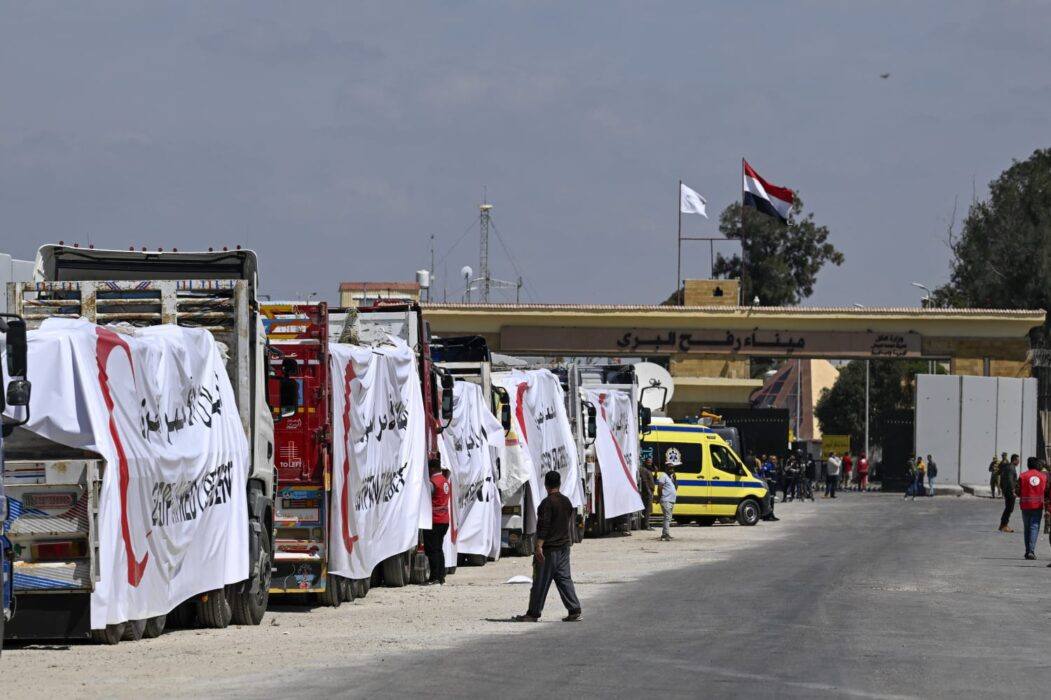
Aid entering Gaza has run at roughly half the volume promised under the ceasefire for most of the past eight months, according to monthly figures published by Haaretz on Sunday, November 15, drawn from data supplied by COGAT, the Israeli military body that coordinates aid entry, to the United States-run Civil-Military Coordination Center in Kiryat Gat and verified by the United Nations.
Source: Haaretz, via Magna Bureau
The ceasefire deal, which took effect on October 10, 2025 under United States President Donald Trump's plan, sealed in the Sharm El-Sheikh Agreement and endorsed by UN Security Council Resolution 2803, provides for 4,200 trucks of aid and commercial goods a week — about 600 a day. The COGAT-origin totals published by Haaretz list about 4,700 trucks in March, 5,300 in April, more than 9,600 in May, over 12,000 in June, about 10,000 in each of July and August, more than 13,000 in September and just over 6,500 in October — in most months roughly half the agreed target or less. About 4,000 trucks had entered so far in November, Haaretz reported.
COGAT disputes the figures
COGAT has publicly disputed Haaretz's presentation as inaccurate and says Israel has met or exceeded its humanitarian commitments. The agency has stopped publishing truck totals since the ceasefire began, which makes the full scale of the gap harder to establish independently. COGAT also says more than 93,000 tents and 8,600 trucks of winter supplies have entered since its winterisation plan began — a figure the aid agencies' counts do not match, according to the reporting.
What is solid
- The ceasefire deal provides for 4,200 trucks a week, about 600 a day
- Haaretz published COGAT-origin monthly totals, supplied to the US-run coordination centre and verified by the UN, showing most months at roughly half that rate or less
- COGAT has stopped publishing its own truck totals since the ceasefire began
What is only claimed
- Whether Israel has met its commitments — COGAT says it has met or exceeded them and calls Haaretz's presentation inaccurate
- The total shortfall — Gaza's Government Media Office counts 77,657 of 232,800 expected trucks, 33.3 percent, a lower figure than the COGAT-origin data implies
Winter makes the gap a deadline
The argument is no longer abstract. The World Health Organization warned on Friday, November 13 that acute respiratory infections in Gaza are running 33,000 cases higher than at the same time last year, and UN OCHA reported roughly 46,000 households — about 226,000 people — affected by flooding, with more than 40,000 shelters damaged and over 9,000 destroyed. About 950,000 displaced people live in flood-risk areas, the WHO says, as heavy rain floods tens of thousands of tents.
On Saturday, the foreign ministers of eighteen Arab and Islamic countries condemned the November 12 strike on Nasser Hospital and called on Israel to fulfil its obligations under the Sharm El-Sheikh Agreement, the Trump plan and Resolution 2803, and on the United States and the Board of Peace to intensify their efforts. Read: Eighteen nations condemn the Nasser Hospital strike
On Sunday, Al Jazeera's Inside Story asked the question the figures raise: who can force Israel to implement the deal? The agreement's guarantors are the United States, Egypt, Qatar and Türkiye, but neither they nor the Board of Peace the plan created holds enforcement powers in the text of the deal, and Resolution 2803 endorses the plan without creating any. Gaza's health officials count at least 1,600 Palestinians killed since the ceasefire began; Israel says four of its soldiers have been killed.
What happens next
The next test is arithmetical: the ministers demand the full volume flow without further delay, and whether the daily truck count rises in the coming week will show whether their statement carried weight. The Rafah crossing is the second test — Gaza's authorities count 14,821 travellers crossed against 40,000 expected since the deal began. Until Washington decides to treat implementation as a condition rather than a hope, the daily count remains the measure.