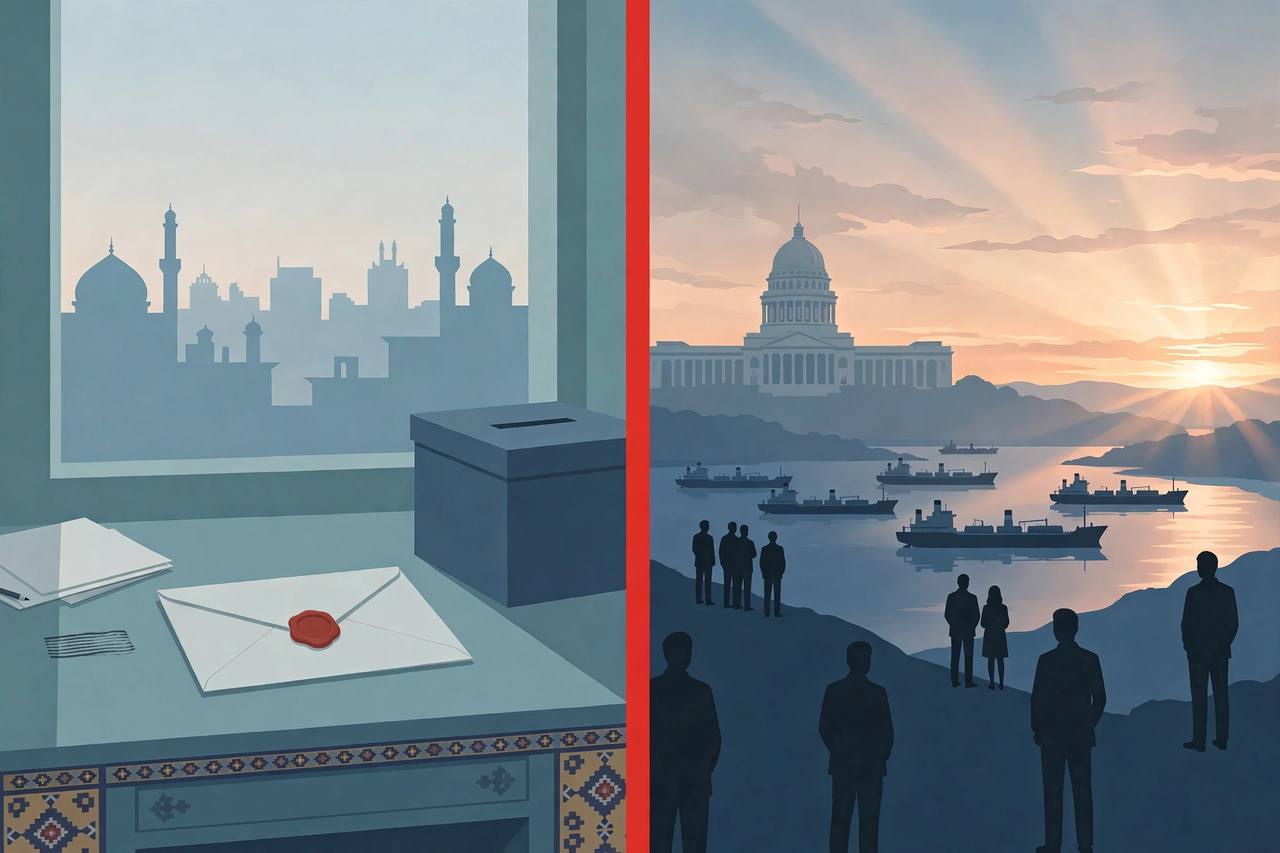
Iran's Supreme Leader Mojtaba Khamenei said on Wednesday, November 4, that anyone expecting a shift in United States policy towards Iran after the US midterm elections is "seriously mistaken" — and warned that any renewed American aggression would be answered on a much greater scale, Reuters reported from Dubai.
Source: Reuters
The warning came in a written message published on Khamenei's website to mark November 4, Iran's National Day of Fighting Global Arrogance. "Those who still harbour even the slightest hope that the behaviour of the hegemonic system might change through partisan or factional shifts, or who imagine that making concessions to the United States can dissuade it from hostility towards the Iranian nation, are seriously mistaken," the statement said, according to AFP and Reuters.
Source: AFP via Pakistan TV
A warning of a much wider response
Khamenei warned that Iran's response to any renewed US aggression would be on a much greater scale, Reuters reported. In the fuller message carried by Press TV, he said that in the event of a repetition of the aggressions, "their dimensions will become much wider." He presented Iran's control of the Strait of Hormuz and what he described as the destruction of America's military bases in regional countries as both a reaction to American aggression and, in his words, "an initial jihad against global arrogance on a regional scale." Those claims about bases are Khamenei's own account — they are attributed to him here, not stated as independently verified fact.
Source: Press TV (Khamenei message)
He added that the confrontation had shown, in his view, "the falsity of the myth of America's invincibility" and exposed what he called the weakness of governments that rely on a force other than their own people. "The US sees the end of its hegemony as distant; we see it as near," Reuters quoted him as saying.
Source: Reuters
'Ever stronger Iran' is the path, he said
The message's central theme was deterrence through strength at home. "The only way to reach the point of absolute deterrence is to continue the strategy of 'Iran ever stronger' along the path of comprehensive progress," Khamenei said, adding that national unity, solidarity and social cohesion "must govern every individual and collective word and action of the nation and officials." He said the ultimate desire of the "Great Satan" — his term for the United States — is the unconditional surrender of the Iranian nation, and that even the slightest submission would squander what he called the great capital acquired through the sacrifices of the nation.
Source: Press TV (Khamenei message)
Why now: the midterms changed the politics, not the war
The message landed hours after the US midterm elections handed Democrats control of Congress from President Donald Trump's Republicans — a result Trump himself has linked to the Iran war, which has driven up gasoline prices for American voters. Trump told the Financial Times on Tuesday that the US appeared to be getting everything it wanted, that it was "ready" and "locked and loaded" if it needed to act, but that there might be no reason to strike — while also saying he was in no hurry. On Monday night, US forces carried out limited strikes on Iran's Qeshm Island, described by a US official as defensive strikes on surface-to-air missiles used against US assets.
Source: Reuters
Trump later confirmed the Qeshm operation himself, calling it a minor attack that was over quickly — read that earlier report here. US strikes on Qeshm Island: Trump confirms 'minor attack'
The talks: still far apart, Hormuz still shut
A senior Iranian official told Reuters on Tuesday that Iran and the United States remain far from a deal to end the war, which began on February 28. Tehran insists the Strait of Hormuz — through which about one-fifth of the world's oil passed in peacetime — will stay closed to the United States until its conditions are met, including waiving oil sanctions, ending the US naval blockade of Iranian ports and releasing frozen Iranian funds. Mohsen Rezaei, secretary of Iran's Supreme National Security Council, said on X that Washington's reply to Iran's seven conditions was "not convincing" and must be fully and explicitly addressed. Qatar's mediators, who travelled to Tehran on Monday night, say both sides are still reviewing proposals, with feedback expected within about 36 hours — though a senior Iranian official later said there is no fixed deadline.
Source: Reuters
Oil: volatile, and still far above pre-war levels
Oil prices rose on Wednesday in a volatile session as investors waited for Washington's next move after the midterms, Reuters reported: Brent futures rose 76 cents, or 0.7%, to $104.36 a barrel at 0730 GMT, and US West Texas Intermediate gained 63 cents, or 0.7%, to $96.72, reversing earlier declines. The move came despite industry data showing an unexpected fall in US crude stocks of 5.27 million barrels in the week ended October 30. Traders cited the unresolved Hormuz risk as the reason the war premium has not come out of prices, even as diplomacy continues.
Source: Reuters
What it means for Gulf-based Punjabi and Indian workers
For the lakhs of Punjabi and Indian workers living in the Gulf, Khamenei's message matters because it lowers the chance of a quick reopening of Hormuz: as long as Tehran ties reopening to sanctions relief, an end to the blockade and the release of frozen funds, shipping, flights and remittance routes through the Gulf stay exposed to disruption, and oil-driven inflation stays a risk for families back home. No new evacuation or travel advisory accompanied Wednesday's message, and the Gulf states themselves continued to push de-escalation through Qatar and Saudi channels — a point to watch alongside any US response.
Source: Reuters
What is solid
- Khamenei's written message was published on Wednesday, November 4, and its key lines — 'seriously mistaken' on a US policy shift, and a much wider response to any renewed aggression — are reported by both Reuters and AFP
- Democrats won control of Congress in the November 3 midterms, and Trump told the Financial Times the US is ready but may have no reason to strike
- A senior Iranian official told Reuters on Tuesday that Iran and the US remain far from a deal, and Qatar's mediators say both sides are reviewing proposals
What is only claimed
- Khamenei's claims about the destruction of US bases in the region are his account of the war, not independently verified here
- Whether the US will strike again after the midterms is unconfirmed — Trump has said both that he is ready and that he is in no hurry, and US officials described the Qeshm strikes as limited and defensive
What happens next
Three things to watch in the next 36 hours and beyond: first, whether Washington and Tehran give Qatar the feedback mediators are waiting for on the draft deal; second, whether any new US military move follows the midterms, as some US media reports have suggested a post-election operation was prepared; and third, the official US inventory data due at 10:30 a.m. EST on Wednesday, which will test whether the API's 5.27-million-barrel draw is confirmed. If the talks break down, Khamenei's message is now on the record as the warning that Iran's answer would be wider than before.
Source: Reuters
Hours after Trump's Republicans lost Congress, Iran's Supreme Leader Mojtaba Khamenei said anyone hoping a US policy shift or concessions would end American hostility is 'seriously mistaken', warned any new US attack would be met on a much greater scale, and tied Hormuz reopening to sanctions relief, an end to the blockade and frozen funds — while oil held above $104 a barrel.