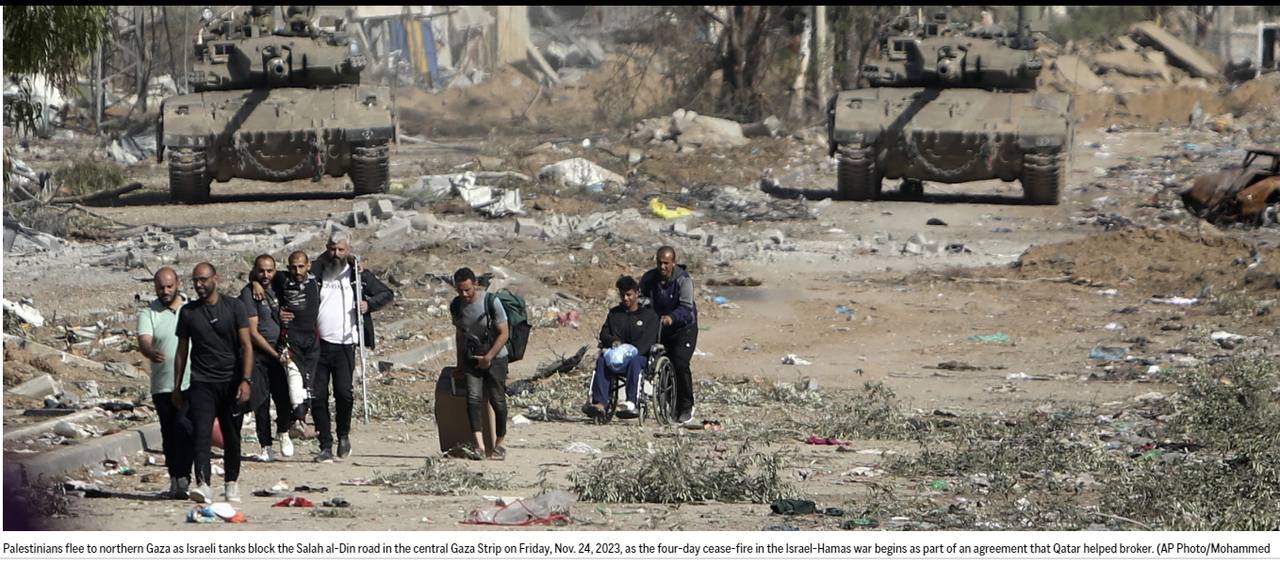
In October, the BBC reported that Israel moved the yellow blocks marking the ceasefire line west into the centre of the Salah al-Din road, displacing families — Hamas called that a violation of the October deal too. Read the earlier story
Israeli tanks crossed the Yellow Line into Hamas-controlled central Gaza on Wednesday, launching the first ground operation beyond the ceasefire boundary since the US-brokered truce took effect in October 2025, the Israeli military confirmed.
Source: BBC News
The Israel Defense Forces (IDF) said the operation, carried out jointly with the Shin Bet security service, was a targeted effort to dismantle a Hamas tunnel west of the line, near the Bureij and Nuseirat refugee camps, that it described as a direct and immediate threat to its troops. Witnesses told Reuters that tanks moved onto the Salah al-Din road, the Strip's main north-south route, in blocks 660, 661 and 666.
Source: Reuters
Ahead of the advance, COGAT, the Israeli military body that handles civilian affairs in the Palestinian territories, ordered residents in the affected blocks to leave and closed a stretch of the Salah al-Din road, warning aid agencies and civilians to stay clear. Gaza's civil defence agency said more than 5,200 people fled their tents and shelters as armoured vehicles rolled in. More than 18,000 people live in the area between Al Bureij and Nuseirat.
What each side says
Hamas called the incursion a flagrant violation of the ceasefire and appealed to the mediators to intervene. The US-backed Board of Peace, which monitors the truce, accused both Israel and Hamas of failing to honour their commitments to end hostilities, as artillery shelling and airstrikes continued around the operation.
The Israeli military said the raid was limited and precise, and Israeli Army Radio reported that it had been coordinated with the United States in advance, would extend only 300 to 400 metres beyond the Yellow Line, and could last several days. It extends a tunnel-clearing campaign the military has run for more than a year east of the line — on November 16 it said troops had demolished a roughly 980-foot tunnel on the Israeli-held side.
Source: AFP
The toll so far
Palestinian medics said three people were killed on Wednesday — one in an Israeli airstrike near the site of the raid, and two others in separate incidents in Deir al-Balah and Gaza City. Al Jazeera, citing hospital officials, reported the same toll, though it was not clear whether all three deaths were connected to the ground operation. Gaza's health authorities say at least 1,600 Palestinians have been killed since the ceasefire came into effect.
What is solid
- Israeli tanks crossed the Yellow Line westward on Wednesday, the first ground operation beyond the line since the October 2025 truce.
- The military says the aim is to destroy a Hamas tunnel it calls an immediate threat to its troops.
- COGAT ordered residents to leave the affected blocks and closed part of the Salah al-Din road.
What is only claimed
- Whether the operation breaches the ceasefire — Hamas calls it a flagrant violation; Israel calls it a limited, targeted tunnel operation.
- How many of the three people killed on Wednesday died as part of the ground operation itself.
- How far the operation will go and how long it will last — Israeli Army Radio reports 300–400 metres and several days; the military has not confirmed a timeline.
What happens next
An Israeli military spokesperson said on Wednesday evening that the operation was still under way, and no response from the mediators had been reported by Wednesday night. The crossing comes as the wider regional war grinds on — the United States struck an Iranian missile site on Qeshm Island on Tuesday, and Iran answered with attacks on American facilities in Kuwait and Bahrain. For the Gaza truce, the question now is whether the first ground crossing of the Yellow Line stays a limited raid or becomes the moment the ceasefire unravels.
The Yellow Line was the ceasefire's core bargain: Israel holds roughly two-thirds of Gaza east of it, Hamas the rest. A ground crossing — however limited Israel says it is — is the first time Israeli armour has gone back into Hamas-held territory since the truce, and it puts the deal under its severest strain yet.