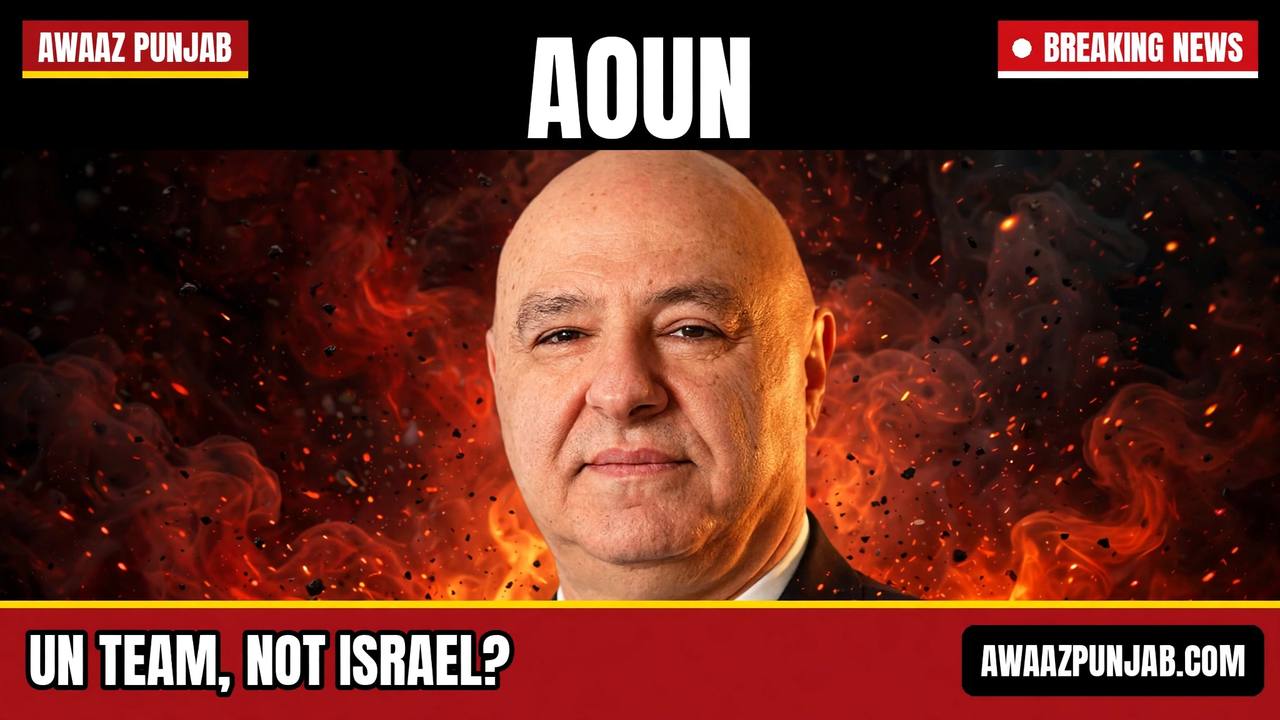
Lebanon's President Joseph Aoun has said he would accept an international team — drawn from Arab or European countries — to verify Hezbollah's disarmament, but he ruled out Israeli inspectors, saying Israel cannot be both 'adversary and judge at the same time.'
Source: IIME Morning Brief
Aoun made the remarks in a wide-ranging interview with Iraq's Dijlah TV, conducted by channel director Nabil Jassim and published on November 17. He said 'whoever wishes to verify can resort to an international team (Arab or European), but it cannot be Israeli,' and stressed that no one should be allowed to undermine Lebanese sovereignty or the role of the Lebanese Army.
Source: Info Plus News
The president said he expects second, third and fourth rounds of negotiations with Israel, but only once Israel forms a new government. The last round was a technical one, he said, in which the Lebanese Army delegation presented a detailed technical case while the Israeli delegation said the matter had to go back to its political leadership. No round has been scheduled since August.
Message to Hezbollah
Aoun repeated his direct appeal to Hezbollah to hand over its weapons. 'You are Lebanese and part of the state,' he said. 'Hand over your weapons so that we can have a strong central state that takes care of protecting its citizens at home and abroad.' He said the state has already taken decisions on the exclusivity of weapons and of war-and-peace decisions in 2025 and 2026, and that the Army and security forces are confiscating weapons shipments — including seizures in warehouses in the Bekaa and in Beirut in recent days.
He said contacts with Hezbollah continue, directly and indirectly, to reach a peaceful solution for its weapons, and that the state 'never thinks of reaching internal clash' as an option. But he warned the group against opening a new front, saying any rocket launched from the south 'will be met with more destruction and displacement' — and pointed to a message from Iraq's senior Shiite cleric, Grand Ayatollah Ali al-Sistani, warning against dragging Lebanon into wars serving outside agendas.
Withdrawal first
Aoun said Israeli withdrawal from southern Lebanon is the government's first and basic step, alongside reconstruction, the return of displaced people and the release of prisoners. He noted that Article 10 of the June 26 framework agreement — signed by Lebanon, Israel and the United States — provides for support to the Lebanese state in reconstruction, and said a reconstruction conference may be held even before withdrawal, though a census of destroyed homes cannot be done until Israeli forces leave.
He put the human cost of the war in stark terms: 'In 2026 alone, we have more than 4,400 martyrs, apart from total destruction that affected entire villages.' After the 2023 war, he said, about five hills were occupied by Israel and a small number of border villages were destroyed; today, he said, a large part of the south is occupied and the villages under occupation have been completely destroyed.
On the economy, Aoun said Lebanon recorded growth of around 4% in 2025 and, for the first time, a surplus at the Finance Ministry of around $1.3 billion — yaani 1 arab 30 crore dollar — while hard-currency deposits at the central bank rose by around $2 billion, yaani 2 arab dollar. Growth in 2026 had been expected at around 6%, he said, but the war caused a contraction. About 84% of Lebanese depositors hold less than $100,000, he added, and the state is determined to return depositors' funds through a financial-gap law.
What happens next
The verification question now sits at the centre of the post-war arrangements. The UN peacekeeping force UNIFIL's mandate expires on December 31, 2026, and no successor arrangement has been agreed. US Ambassador to the United Nations Mike Waltz visited Beirut on November 16, called on Hezbollah to disarm voluntarily and said negotiations on a replacement are under way, with France expected to draft a UN Security Council resolution. Washington favours a small, non-UN verification mission, while the UN secretary-general has proposed scaled-down monitoring options. Israel says its army will stay in southern Lebanon until Hezbollah is disarmed; Hezbollah has warned that implementing the agreement risks internal conflict.
Source: UPI
Who verifies disarmament has been the key disagreement since the June framework agreement: Israel wants direct monitoring, Lebanon insists on a third party. Aoun's public acceptance of an Arab or European UN team — and his flat rejection of Israeli inspectors — is the clearest statement yet of Beirut's red line, and it will shape the talks once Israel's new government is in place.
Aoun also used the interview to pitch Iraq on an old energy route: reviving the 1950s-era oil pipeline from Iraq to the Lebanese port of Tripoli as an alternative to the Strait of Hormuz, which remains disrupted by the US–Iran war. He said he had raised it with Iraqi Prime Minister Ali al-Zaidi and offered Lebanon's ports to receive Iraqi tankers while the line is repaired, adding that Beirut would cooperate fully on recovering Iraqi funds held in Lebanon.
On the wider US–Iran war, Aoun said he relies on Hezbollah's awareness of its own community's suffering not to enter the war, warning that every rocket from Lebanon would bring more displacement and destruction without achieving anything. He said Lebanon must be at the negotiating table on Iran — 'not on it' — and wants the best relations with Tehran, but built on mutual respect and non-interference, state to state.