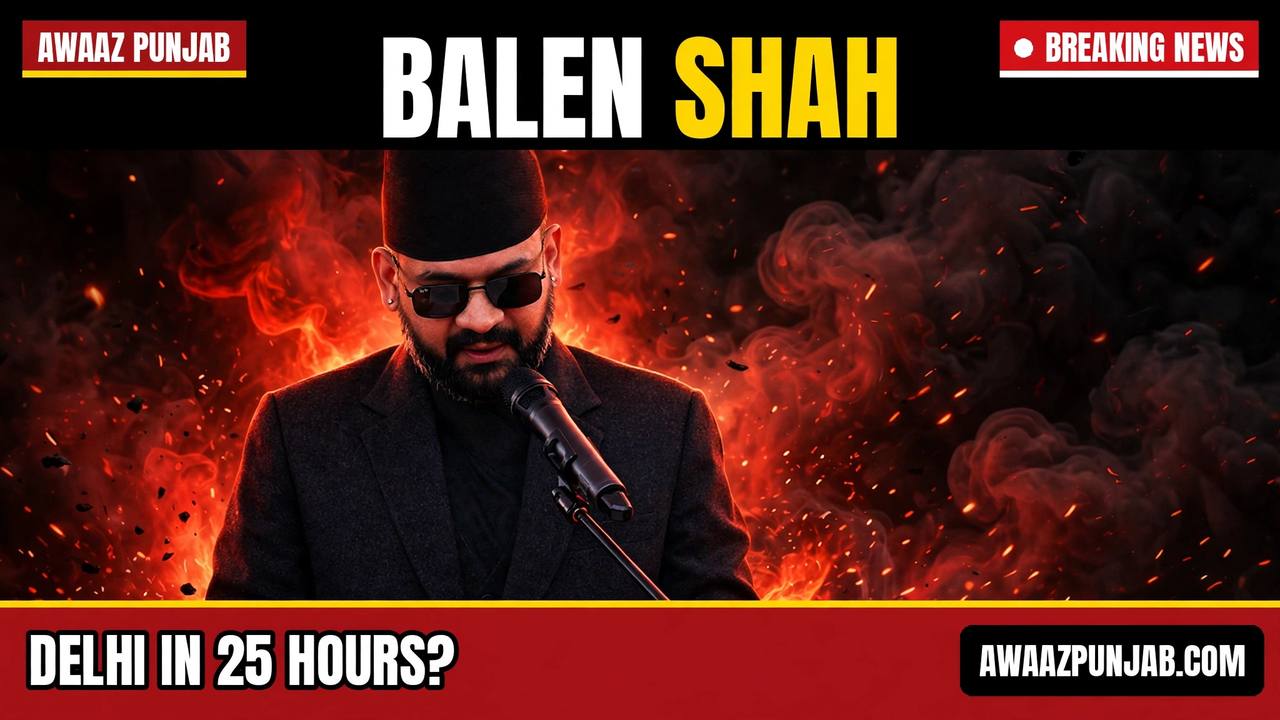
Nepal Prime Minister Balendra Shah's first official bilateral visit to India will be a sharply shortened trip, lasting about 25 hours, with the Nepali leader due to arrive in New Delhi on November 22 and return to Kathmandu on November 23. The visit, at the invitation of Prime Minister Narendra Modi, was originally planned to run for three days, from November 22 to 25.
Source: NICA News
According to the revised programme, Shah will depart Kathmandu at 1:25 pm on November 22 and hold formal bilateral discussions with Modi the following day, before flying back. The two prime ministers are expected to hold a 30-minute one-on-one meeting, followed by delegation-level talks. Meetings with President Droupadi Murmu and External Affairs Minister S. Jaishankar are also part of the proposed programme, though officials say the final schedule remains subject to confirmation.
Source: Defence Aviation Post
At the top of Kathmandu's agenda is a request for about $2 billion in Indian assistance - $1 billion in concessional loans, $500 million in grants and another $500 million for reconstruction after the August 26 floods in the Bhotekoshi corridor. The package has not been agreed, and the amount and conditions remain a matter for the bilateral discussions rather than a confirmed Indian commitment.
Air connectivity is emerging as one of the most significant potential outcomes. Nepal has been seeking additional air entry routes through Indian airspace to improve international access to Pokhara International Airport and Gautam Buddha International Airport in Bhairahawa, both of which have struggled to attract regular international flights.
Energy and trade will also feature heavily. Nepal is pushing to expand electricity exports to India, extend petroleum and gas pipelines - including a proposed LPG line from Motihari to Sarlahi - and review the Nepal-India trade treaty to tackle technical barriers, including delays in Bureau of Indian Standards certifications for Nepali exports such as cement, plywood and tea. Kathmandu is also seeking access to the Dhamra and Mundra seaports.
Source: Ajako Taja
Longstanding bilateral issues are on the table too, including the Pancheshwar Multipurpose Project on the Mahakali River, the Kalapani, Limpiyadhura and Susta territorial disputes, and cross-border rail and road connectivity. One expected deliverable is the joint inauguration on November 23 of a 604-kilometre weekly passenger train linking Ayodhya Cantt in Uttar Pradesh with Janakpurdham in Nepal.
Source: NewsPoint
Shah, 35, leads the Rastriya Swatantra Party and took office on March 27, 2026, about six months after the youth-led Gen-Z uprising brought down the government of K.P. Sharma Oli. He travelled to New York in September for the United Nations General Assembly; choosing New Delhi for his first bilateral trip restores a longstanding diplomatic convention between the two neighbours.
Preparations are already under way. India's newly appointed ambassador to Nepal, Sudhakar Dalela, called on Shah in Kathmandu on November 18 to discuss the visit, and The Kathmandu Post reports that Nepal and India will unveil a 10-point vision for partnership during the trip.
With only about 25 hours on the ground, the visit is designed as a compact, outcome-driven engagement. What it delivers will depend on the November 23 talks - the aid package, the air routes and the train launch are all proposals on the table, not done deals.