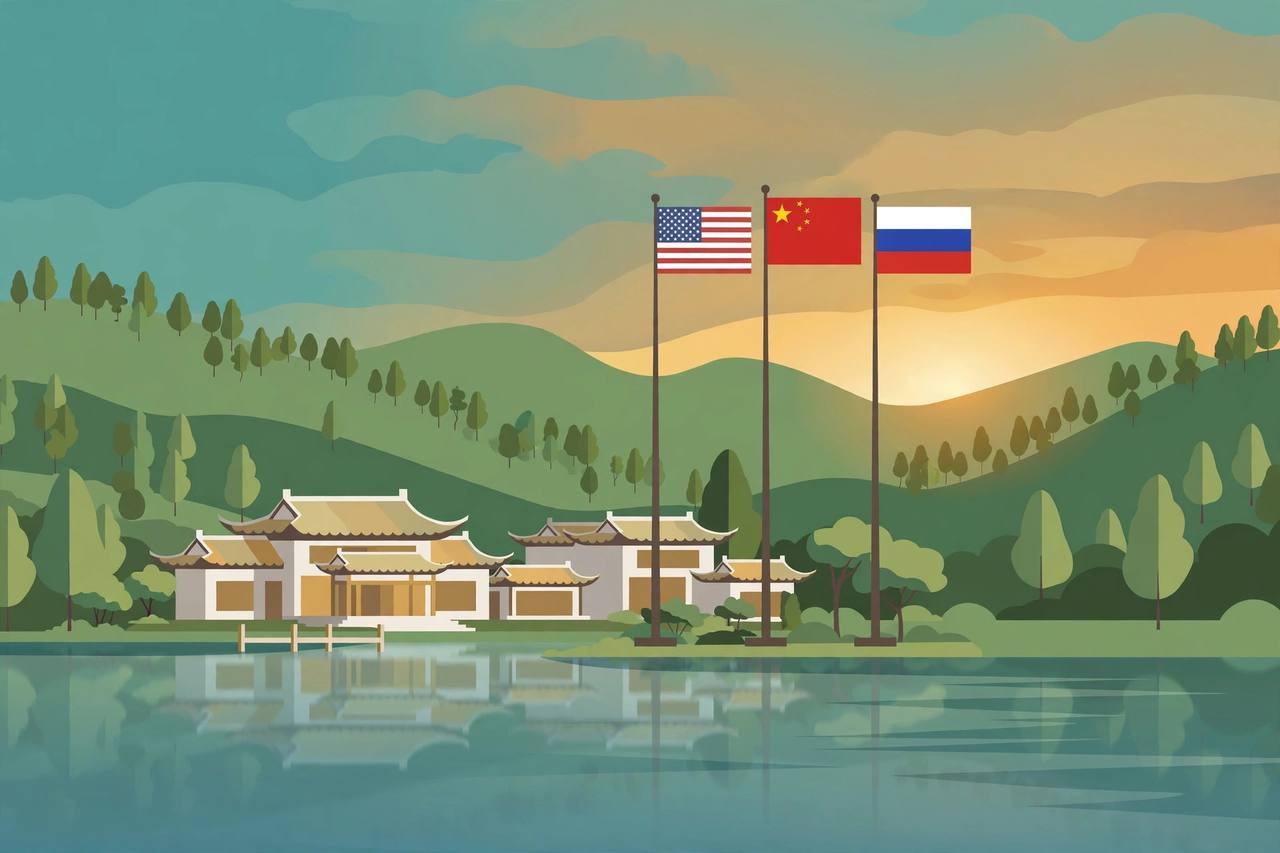
Earlier on Thursday, Donald Trump, Xi Jinping and Vladimir Putin sat down together in Shenzhen for the first-ever trilateral meeting of the sitting leaders of the United States, China and Russia. This story carries what happened after that meeting ended. Read the earlier story
China and Russia released a 'peace declaration' after the first-ever trilateral meeting of Donald Trump, Xi Jinping and Vladimir Putin in Shenzhen on Thursday, in which the three leaders reaffirmed that a nuclear war should never be fought, according to reports by Reuters. The document was released by Chinese state news agency Xinhua and by the Kremlin. None of the three presidents made immediate public statements after the meeting, and Trump departed on his flight back to the United States.
Source: Devdiscourse / Reuters
The meeting, held at the lakeside Kylin Villa on the sidelines of the Asia-Pacific Economic Cooperation (APEC) summit, was the first three-way gathering of the leaders of the world's three largest nuclear powers. Before the trilateral session, Trump held separate closed-door talks with each leader: about 40 minutes with Putin and about an hour with Xi. The trilateral group session itself lasted about an hour and a half. A senior US official had said beforehand that no agreement was expected from the first encounter, describing it instead as an entry point that could in time lead to negotiations on a new arms-control framework.
Source: Zark News / Reuters, AP
Xi's Taiwan warning
In his separate bilateral meeting with Trump on Thursday afternoon, Xi told the US president that on the Taiwan question the United States should 'do the right thing' to avoid major setbacks in China-US relations, according to Xinhua. Trump replied that the United States does not support 'Taiwan independence' — a restatement of Washington's existing position that stops short of the stronger language Beijing wants, which is that the United States opposes Taiwan independence.
Source: Reuters
Xinhua described the Xi–Trump meeting as 'positive and constructive' and said the two leaders agreed to formulate an action plan for their 'constructive, strategically stable relationship'. The report did not say what the action plan would specifically contain. China is concerned that a delayed $14 billion arms sale to Taiwan — yaani lagbhag ₹1.24 lakh crore — could gain momentum, according to reporting on the talks.
Source: SE Daily
Ukraine and the wider agenda
Nuclear arms sat at the top of the known agenda: the New START treaty between Russia and the United States expired in February 2026, removing caps on the two largest atomic arsenals for the first time in more than half a century. Trump said the three countries were 'uniquely positioned to discuss how to reduce the number of nuclear weapons on Earth', and Beijing described the meeting as having 'groundbreaking significance'.
Source: Dimsum Daily
On Ukraine, the accounts differed: Russia's Tass news agency reported that Putin said considerable attention had been paid to Ukraine at Trump's initiative and that all three countries shared an interest in resolving the conflict, while US officials had said the war in Ukraine would not be discussed in the three-way forum itself. Trade, artificial intelligence, critical minerals and semiconductor export controls were also on the table.
Source: Dimsum Daily
What is solid
- Trump, Xi and Putin held their first-ever trilateral meeting in Shenzhen on 19 November 2026, at the Kylin Villa on the APEC sidelines.
- China and Russia released a 'peace declaration' afterwards, via Xinhua and the Kremlin, reaffirming that a nuclear war should never be fought.
- Xi told Trump the US must 'do the right thing' on Taiwan, and Trump said the US does not support 'Taiwan independence', according to the Xinhua readout reported by Reuters.
- New START, the last US–Russia nuclear arms treaty, expired in February 2026.
What is only claimed
- Whether the 'peace declaration' carries any binding commitments — no agreement was announced, and a senior US official said none was expected from this first meeting.
- What was actually agreed, if anything, inside the closed-door sessions — no joint statement from the three leaders had been reported, and the contents of the talks are not public.
What happens next
Trump has left Shenzhen, and it remained uncertain whether the three leaders would issue a joint statement. The test now is whether the declaration and the agreed US–China action plan turn into real arms-control talks — or whether, as analysts quoted in the coverage suggested, the summit stays heavy in symbolism and light in substance. Xi greeted Trump at the airport on arrival, the first time he has done so with any visiting leader since becoming president, in a gesture read as a mark of the importance Beijing attached to the visit.
Source: Devdiscourse / Reuters
For Taiwan, the warning and the reply leave the underlying tension untouched: Beijing wants Washington to say it opposes Taiwan independence and to hold back the arms package, while Washington has repeated only that it does not support independence. The next signal will be whether the delayed arms sale moves forward in the weeks after the summit.