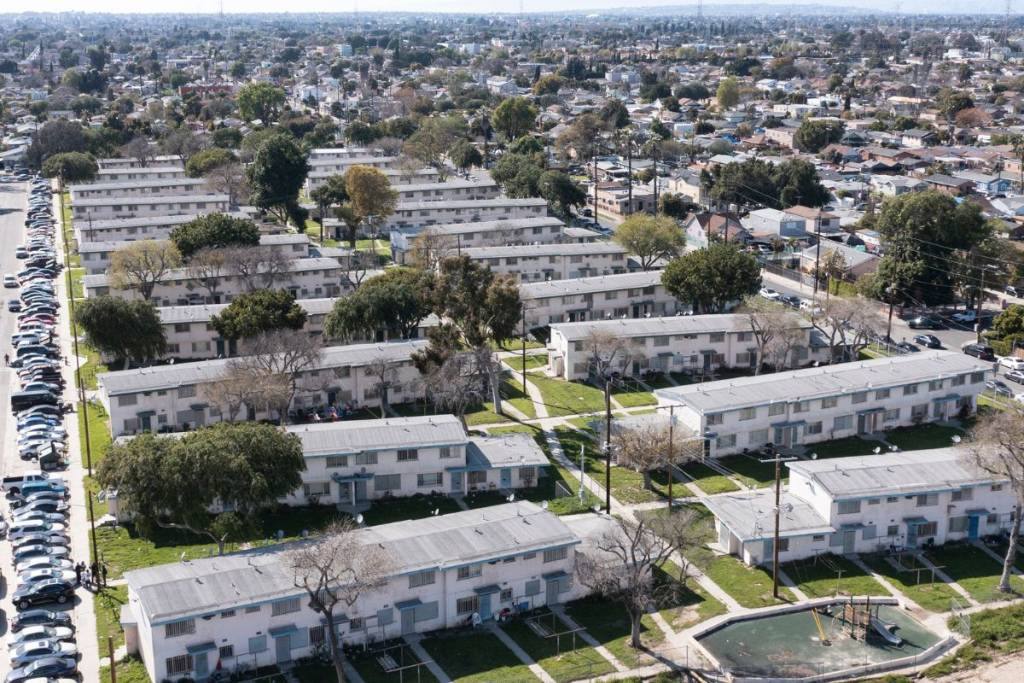
Los Angeles families and tenant organisations have gone to federal court to stop a new U.S. Department of Housing and Urban Development rule that would end three decades of protection for mixed-status families in public housing and Section 8 homes. The lawsuit, filed on Monday, November 16 in the U.S. District Court for the Central District of California, asks a judge to postpone the rule's December 14 effective date and to block its enforcement while the case proceeds.
Source: Public Counsel announcement of the November 16 filing
The case is the first court challenge to the rule HUD finalised on November 12 — the rule Awaaz Punjab reported that day, which requires every member of a household receiving federal housing assistance to prove U.S. citizenship or eligible immigration status, and which takes effect on December 14 unless a court intervenes. The plaintiffs are People Organized for Westside Renewal (POWER), Union de Vecinos, and three Los Angeles County residents whose households receive HUD assistance. They are represented by Public Counsel, Kendall Brill & Kelly LLP and Bird Marella LLP.
A mixed-status family is a household in which at least one member has citizenship or eligible immigration status and at least one does not. For more than 30 years, such families have been able to live together in federally assisted housing, with their assistance prorated so that only eligible members — very often U.S. citizen children — are counted, and no ineligible person receives help. The new rule ends that approach: it requires every family member to verify eligible status and makes prorated assistance only temporary, so a family that cannot document every member's status will lose its assistance unless the household separates.
What HUD's own analysis conceded
The lawsuit leans heavily on the government's own numbers. According to the plaintiffs, HUD's analysis found that the rule would reduce the number of households served at current funding levels, and that keeping the same number of people housed would require an additional $311 million to $385 million from Congress. HUD also found that the rule puts the roughly 36,000 currently eligible children in these families at risk of losing their housing. And, the complaint says, HUD admitted it considered less harmful options — protecting families already in their homes, and exempting families with children — but rejected both, while acknowledging that families with children are likely to leave assisted housing together rather than separate.
“No family should have to choose between staying together and keeping a roof over their heads. Yet HUD's rule would force precisely that choice on families across the country, including U.S. citizen children who could lose their homes because of their parents' immigration status. Congress did not require this. HUD chose it,” said Amanda Mangaser Savage, Strategic Litigation Counsel at Public Counsel. Kendall Brill & Kelly attorney David Alpert described two of the individual plaintiffs: a 26-year-old with cerebral palsy who has lived in his family's home and relied on his parents and sister for care since he was a toddler, and a woman who has lived in public housing since she was in second grade.
The legal argument, and HUD's answer
The lawsuit argues that the rule violates the Administrative Procedure Act, the Fair Housing Act and the U.S. Constitution, and that it overrides the framework Congress created — Section 214 of the Housing and Community Development Act of 1980 — to keep mixed-status families together. As final relief, the plaintiffs ask the court to declare the rule unlawful and set it aside. The final rule was published on November 12 at 91 Federal Register 72978, and it also removes age exemptions for verification and eliminates the option for a family member simply to decline to claim a status.
Source: Multifamily Dive report on the finalised HUD rule and the Central District lawsuit
HUD's position is that the rule simply enforces the law as written. In a statement reported by KABC in Los Angeles, HUD Secretary Scott Turner said the rule fully implements federal law and “guarantees only American citizens and certain eligible noncitizens will reside in HUD-funded housing.” The agency has said an audit of HUD-assisted households found around 200,000 tenants with incomplete or unknown eligibility verification. Housing organisations dispute the rule's legality and its costings, and the National Low Income Housing Coalition has estimated that as many as 80,000 people could be affected.
Why Los Angeles is the front line
California held the largest number of HUD-assisted mixed-status households of any state as of 2024, about 36 percent of the national total, and an outsized share of those families are in Los Angeles, most of them citizen children living with at least one adult who has not claimed eligibility for federal assistance, according to the plaintiffs' data. Los Angeles already counts roughly 73,000 people experiencing homelessness, and the plaintiffs note that without a subsidy, a household must earn more than $55 an hour to afford a two-bedroom apartment in the city. The Housing Authority of the City of Los Angeles, which oversees assistance for tens of thousands of households, has said it is reviewing the regulation and its compliance timelines.
The court has been asked to postpone the December 14 effective date before it arrives; no hearing date has been announced. If the rule proceeds on schedule, housing agencies and owners must notify affected tenants by January 13, 2027. A ruling against HUD in the Central District would, as the plaintiffs frame their request, block enforcement there while the case proceeds — and would immediately invite similar challenges elsewhere.
For immigrant families in assisted housing — including Punjabi families in Los Angeles and the Central Valley who hold a mix of citizenship, permanent residence and pending statuses under one roof — the case decides a practical question with a December deadline: whether a family's rent help survives when one member cannot prove an eligible status. Until a judge rules, the advice from tenant groups is consistent: do not move out or split the household on the basis of the rule alone, and watch for the court's decision on postponement in the coming weeks.