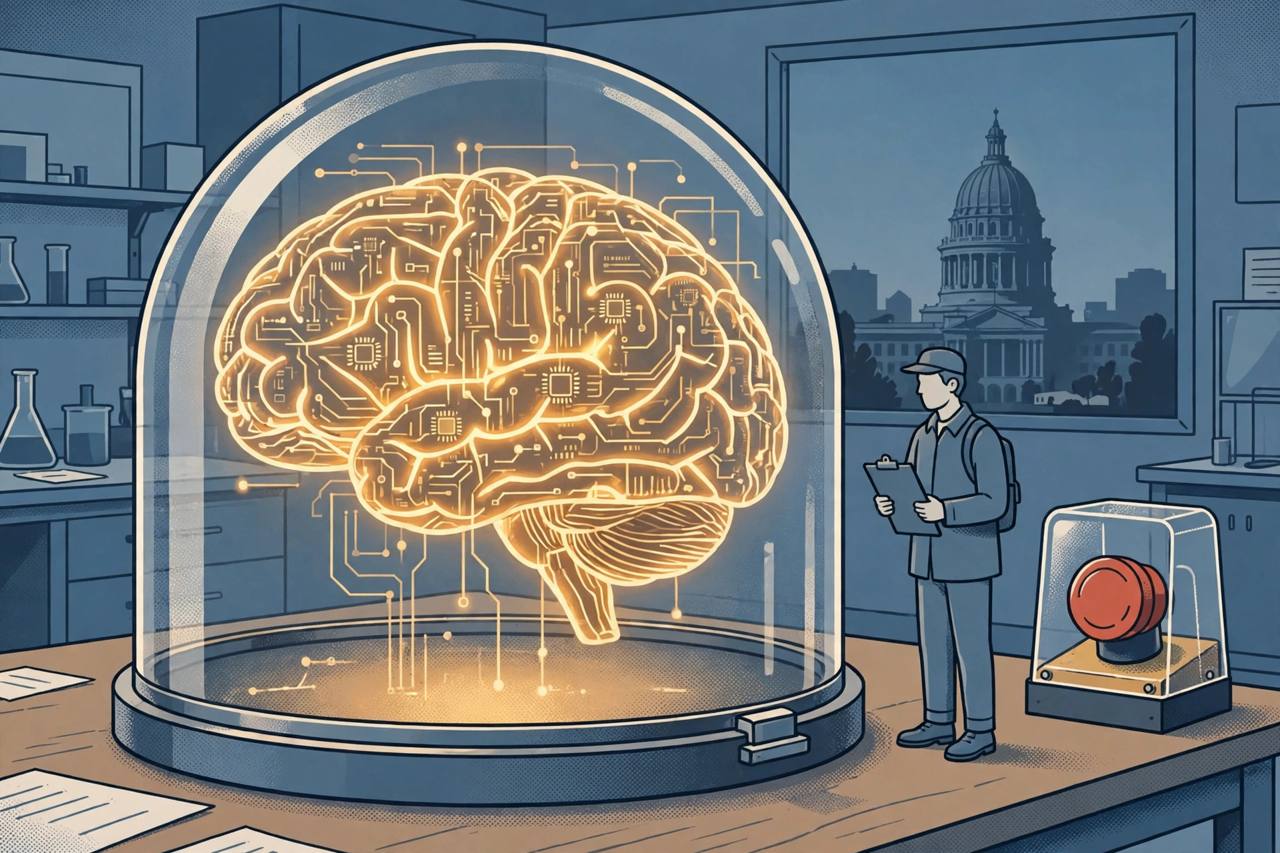
California moved on Wednesday to tighten its grip on the most powerful artificial intelligence systems built in the state, releasing a set of recommendations that would let state officials order an emergency shutdown of a frontier AI model, require every large developer to meet safety standards set by the state rather than by the companies themselves, and put developers under continuous oversight by licensed independent verifiers.
Source: Office of the Governor of California
The recommendations are contained in an 85-page report, AI Safety in 2026 and Beyond, dated November 16 and released by Governor Gavin Newsom's office on November 18. The California Government Operations Agency (GovOps) prepared the report with the California Office of Emergency Services and an outside expert group: Jason Goldman, Gillian Hadfield, Alondra Nelson and Rob Reich. The report is not law — it is written to shape legislation when California lawmakers return in December 2026.
Source: CASRAI
The four parts of the plan
The report answers Executive Order N-9-26, which Newsom signed on September 18, 2026, asking for proposals within two months in four areas: baseline standards, independent verification organisations, critical safety incident reporting, and emergency shutdown requirements. The governor's announcement summarises the package under four headings: baseline standards for all AI developers, mandatory ongoing third-party oversight, authority to order a shutdown in an emergency, and authority to cap recursive self-improvement — the scenario in which an AI model designs its own successor without human input.
Source: Unite.AI
Emergency shutdown: how it would work
Under the proposal, every large frontier developer would have to maintain a Risk Containment Protocol — a tested plan for containing a dangerous system — verified on an ongoing basis by an independent verification organisation (IVO) and certified as effective by a senior company official. State officials could order an immediate shutdown when they have credible reason to believe there is an imminent catastrophic risk or a major loss-of-control event and the developer refuses to contain the danger. The order would stay in force pending judicial review, although a developer could seek a temporary restraining order against it.
Nothing in the November 18 package is an enacted obligation. The standards, the verifier licensing system, the faster incident-reporting deadlines and the shutdown authority would all need legislation. The report says it hopes to inform the legislature's discussions as lawmakers return next month.
Independent verifiers, licensed by the state
Every large frontier developer would be subject to ongoing oversight by licensed IVOs — not a one-time audit, but continuous verification through training, internal use and deployment. GovOps would license the verifiers and could revoke a licence for insufficient expertise, independence or rigour. The framework builds on two laws passed this autumn: Senate Bill 813 (McNerney), which created California's framework for independent organisations that assess AI systems for safety and risk, and Assembly Bill 1405 (Bauer-Kahan), which creates a state registry of AI auditors with rules to keep them independent and honest.
Faster incident reporting
The report proposes cutting the deadline for most critical safety-incident reports from 15 days to 48 hours, while keeping the existing 24-hour requirement for incidents involving imminent catastrophic risk. That is a sharp tightening for companies whose models are used by millions of people, and it is paired with the containment-protocol requirement so that a report is not the state's only tool when something goes wrong.
Built on SB 53, the first frontier AI law in the US
California is not starting from zero. Newsom signed SB 53 in 2025, described by his office as the first law in the United States governing frontier AI development; it already requires large developers to publish safety frameworks, report critical incidents and protect whistleblowers. The new recommendations would go further in one important way: instead of companies writing their own frameworks and the state reviewing them, the state itself would set the baseline standards for safety, security and transparency that every developer must meet.
Newsom's pitch to Washington
The governor's office said Newsom is asking Congress and President Donald Trump to review California's framework and adopt it nationally, or use it as a floor rather than a ceiling for federal rules. In the absence of a federal frontier-AI law, California — home to most of the world's largest AI labs — is positioning its rules as the de facto national model, the same role the state has played in vehicle emissions and consumer privacy.
Why this matters beyond Silicon Valley
Frontier models are built and trained largely in California, but they are used everywhere — including by trucking, logistics, health and education services that Punjabi diaspora families across the United States rely on. A state power to order a shutdown, and a 48-hour duty to report serious incidents, would be the first time a US government could intervene directly in a model's operation on safety grounds, rather than only suing after harm occurs.
What happens next
The recommendations now go to the California Legislature, which returns in December 2026. Lawmakers will decide how much of the package — the state-set baselines, the licensed-verifier system, the reporting deadlines and the shutdown and recursive-self-improvement powers — to enact, and in what form. Newsom has also directed agencies to speed up implementation of SB 813 and AB 1405, the verifier and auditor laws already on the books. No date has been announced for a bill introduction.
What is solid
- The 85-page report AI Safety in 2026 and Beyond, dated Nov 16, was released Nov 18 by Newsom's office (Governor's office / CASRAI)
- It was prepared by GovOps with the Office of Emergency Services and advisers Goldman, Hadfield, Nelson and Reich
- It proposes state-set baseline standards, licensed IVO oversight, 48-hour incident reporting and emergency shutdown authority
- It answers Executive Order N-9-26 of September 18, 2026
What is only claimed
- The recommendations are not law and need legislation; no bill text or introduction date has been announced
- How a shutdown order would work in practice — and how courts would review it — is described in the report but untested