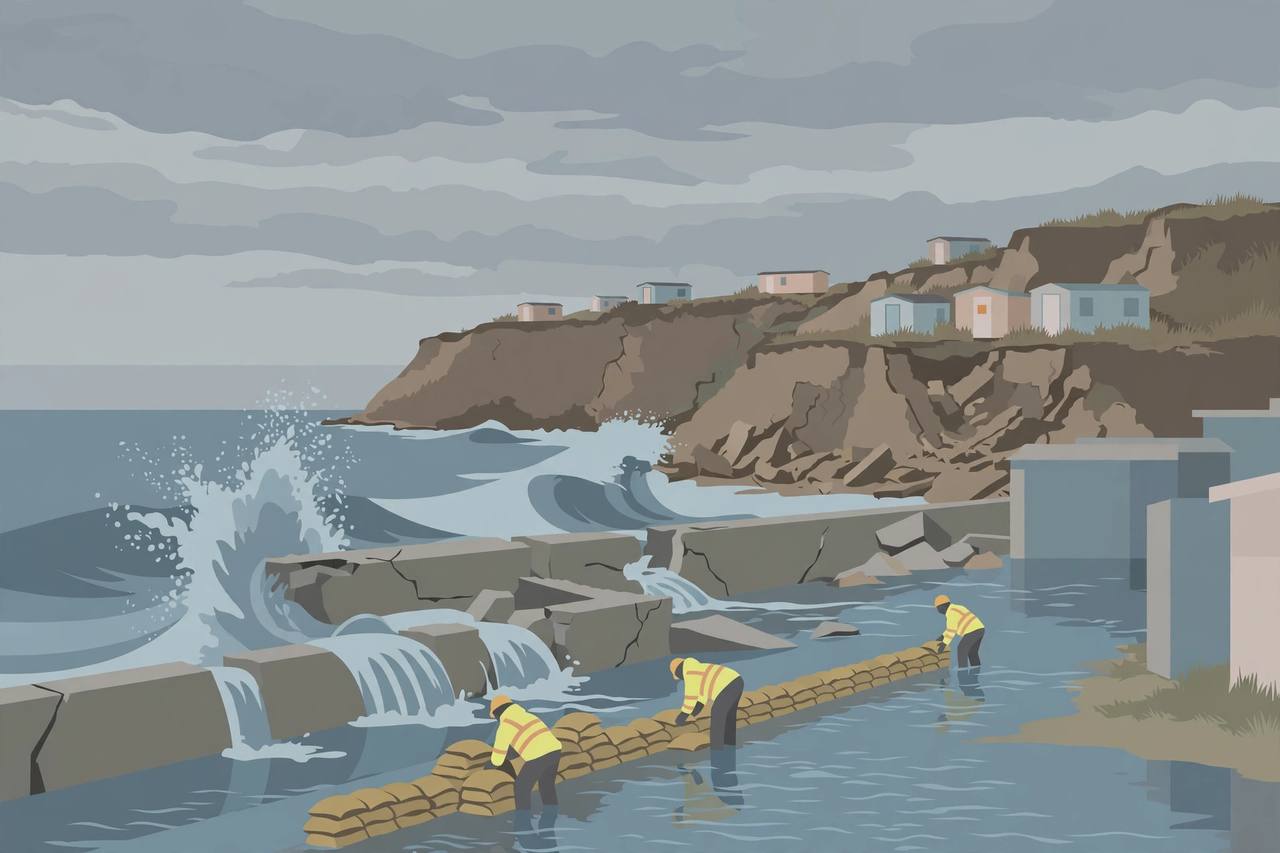
PACIFICA, California — City officials red-tagged 14 manufactured homes and ordered their residents out on Friday evening, giving people just 30 minutes to pack as the bluff beneath their homes crumbled into the Pacific Ocean. Mayor Christine Boles said on Saturday that she did not expect the homes to be habitable again.
Source: NBC Bay Area
This evacuation is the second blow of a week that began with Wednesday's king-tide surge, when waves 20 to 30 feet high tore away the outer end of Pacifica's 1,140-foot Municipal Pier and opened three holes in the Beach Boulevard seawall. We reported that collapse on November 25. Read the earlier report
What happened on Friday
The order came at dusk on Friday. City officials walked the oceanfront path on 4th Street at ViewPointe at the Seaside, a manufactured-home community on the bluff above the Pacific, and told residents to leave within half an hour, the San Francisco Chronicle reported. The waves had been eating away at the cliff below the community since Wednesday, undermining a retaining wall of boulders and dirt until part of the path collapsed in front of one home. Cracks spread along the entire ocean-facing section, and a city inspector said it was likely all the homes along that path would need to be evacuated.
"We loved to sit on the couch and watch the whales go by, watch the dolphins go by," said Lynn, a resident of the park. Morgan Saunders, one of the residents forced to leave on Friday, told the Chronicle: "This was the affordable housing we could find. It was a very unique home." Saunders later said she had moved her belongings to another unit and was staying with friends while awaiting hotel accommodation.
Three days of flooding
Seawater has breached the city's compromised barriers with every high tide since Wednesday, flooding crawl spaces, yards and ground-floor rooms blocks inland. "There was just too much water coming over the wall and we just had this massive river coming down Beach Boulevard," said David Chamberlin, who has lived along the Pacifica coast for nearly 20 years. He said he had hundreds of sandbags in place and several pumps running, but the precautions were not enough to keep water out of his first floor.
Source: NBC Palm Springs
"All of the water that came into my yard ended up underneath my house, so I had about four feet of standing water under my house in the crawl space," Jen Bender told NBC Bay Area. On Paloma Avenue, Heather Carpagna described bailing water from behind a sandbag levee across her driveway for 15-hour days, only to be flooded again. On Palmetto Avenue, Nav Gill said her property had flooded several times since cement beach barriers fell, and that calls to the City Council, Public Works and firefighters had produced no action to repair the barrier.
Repair crews have been racing the tides. Three voids opened in the Beach Boulevard seawall: one was filled completely and a second was about 90 percent filled by Thursday, but the third widened overnight and was still under repair on Friday, NBC Bay Area reported. City workers also placed stones and super sacks of gravel and sand north of the pier, with cement planned to reinforce the seawall. Crews were still working late into Saturday night ahead of a new storm expected on Sunday, and more big waves are forecast for Monday.
Why the coast gave way
The damage is the product of several forces arriving together: record king tides, a strong El Niño pattern and heavy Pacific swell. Buoy data from six miles west of San Francisco show November waves running 2.3 times the seasonal average in power, with three of the decade's largest swells hitting on November 14, 16 and 25, the Chronicle reported. Pacifica's shoreline takes the full force of that wave energy, unlike more sheltered Bay Area cities.
The city's defences were already weakened. About 300 boulders were removed from Beach Boulevard in June to shore up the pier, leaving stretches of seawall without that protective armour. The San Francisco Regional Water Quality Control Board granted emergency approval on November 16 to replace the rocks, with work authorised to begin that day, but board officials had warned that the pier stabilisation increased "the potential for wave overtopping, erosion, and flooding." It remains unclear whether any boulders were replaced before Wednesday's onslaught, the Chronicle noted.
Pacifica is in emergency mode. An El Niño Active Response Local Assistance Center opens on Tuesday, December 1, from 2 p.m. to 7 p.m. at Pacifica City Hall, with the Red Cross assisting displaced residents, City Manager Sean Charpentier said in a Saturday statement. The state has announced $2.25 million in funding to stabilise the pier. Officials warn the next king tides arrive around Christmas, and they are urging everyone to stay off the beaches, the seawall and the closed pier.
The flooding stretched far beyond Pacifica. Marin County issued an evacuation notice for beachside homes at Stinson Beach, then rescinded it; Santa Cruz County issued a stay-put notice for the Pajaro Dunes resort area; a small seaside community in Humboldt County was ordered to evacuate; and Huntington Beach reported household flooding around its Sunset Beach area. San Mateo County Supervisor Ray Mueller, whose district includes Pacifica, called this week a "dress rehearsal" for potentially worse conditions in December and January, and said the city had sought help from the county and the state Office of Emergency Management.
Local businesses are counting the cost. "We're calling them trauma tourists," said Ed Ochi, a 30-year resident, describing visitors who come to look at the damage but spend little. Rita Prichard Anderson, owner of In The Attic on Palmetto Avenue, told CBS News her trade has fallen 30 percent since the pier closed and streets were restricted. On Small Business Saturday, vendors set up along Palmetto Avenue hoping for local support. The city had warned on Thursday: "Residents and visitors should STAY AWAY FROM OUR BEACHES during this storm event. Large waves, powerful currents and rising water levels pose a serious safety risk."