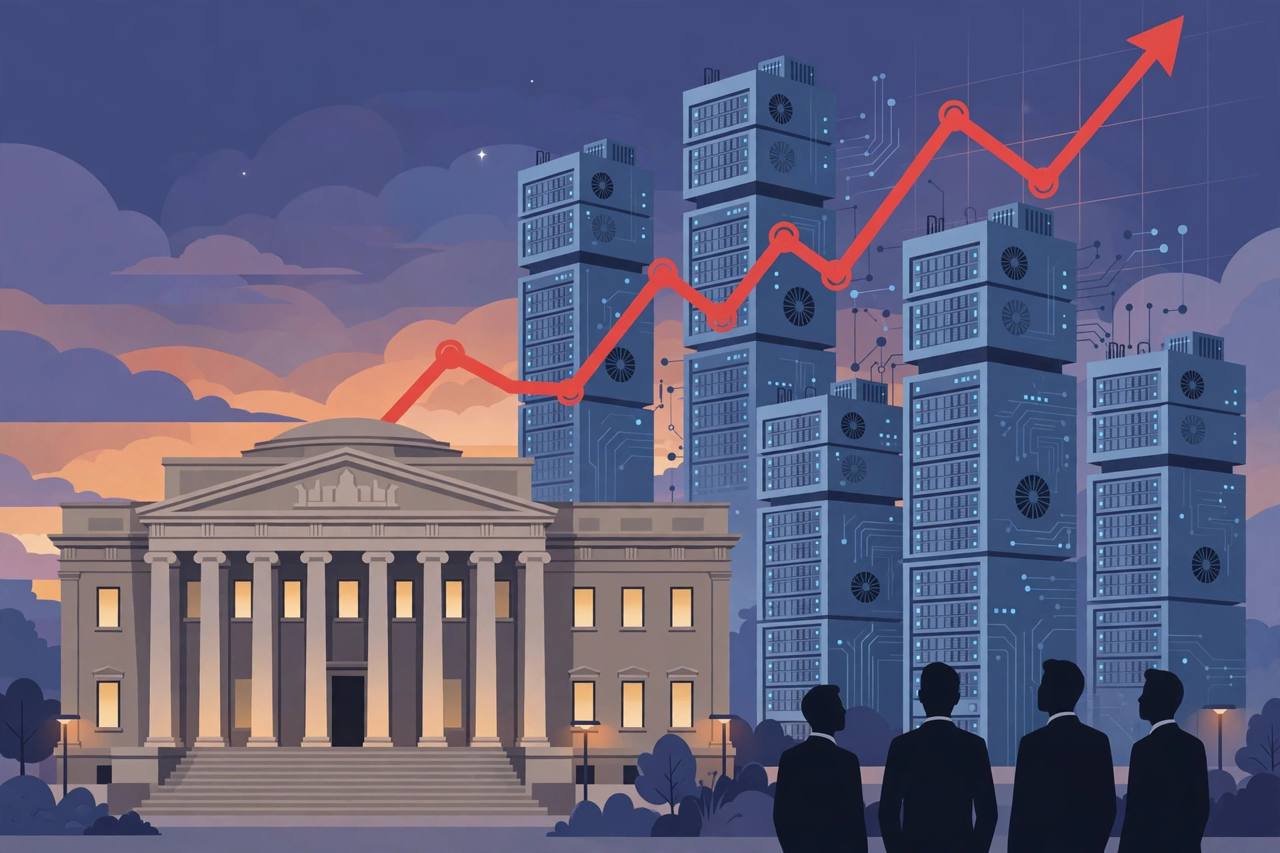
Artificial intelligence is now the risk that Wall Street worries about most, according to the Federal Reserve. In its twice-yearly Financial Stability Report, released on Friday, November 13, the Fed said 87 percent of the market contacts it surveyed in September and October named AI as a salient risk to U.S. financial stability — up sharply from 50 percent in the spring survey.
Source: Reuters, November 13, 2026
The survey is run by staff at the Federal Reserve Bank of New York, who collect views from broker-dealers, banks, investment funds and advisory firms. This round drew responses from 23 contacts, and the report covers information available through October 28. The Fed stresses that the survey summarizes respondents' views and does not represent the views of the Board of Governors or the New York Fed itself. Reuters noted that the survey had already closed before Nvidia chief executive Jensen Huang stepped down on Thursday, November 12, and before this month's midterm elections, in which public concern about AI was a central issue.
Three AI worries, in the contacts' own framing
Respondents described three separate dangers bundled under the AI heading. In the report's words, they were: (1) elevated equity valuations and the possibility that lower-than-expected earnings could result in lower valuations and a market correction; (2) cybersecurity risk, stemming from either a malicious attack by sophisticated state actors or damage caused by frontier AI models themselves; and (3) risks associated with complex forms of AI-related financing.
The other top risks lean on the same theme. Contacts who cited a risk-asset correction pointed specifically to AI-related stocks, driven by uncertain returns on large capital expenditures, and said circular financing and heavy debt could amplify losses that spill over into business investment and household spending. Those who cited cyberattacks said advances in AI are lowering the barrier to sophisticated attacks.
The debt behind the data centre buildout
The report goes well beyond sentiment. In a section titled 'Leverage in the Data Center Buildout,' Fed staff say debt issuance tied to advanced computing infrastructure rose to more than $680 billion by October 2026 — about five times the $130 billion issued in all of 2023. Investment-grade technology companies issued most of it. As a share of nonfinancial investment-grade corporate debt issuance, AI-related borrowing climbed from under 6 percent in 2023 to about 31 percent this year. Outstanding public debt related to advanced computing is estimated at more than $1.1 trillion, and the Fed says private credit deals make the true total harder to measure.
Source: Federal Reserve Financial Stability Report, November 2026, via DailyMech
Fed staff compare the cycle with the broadband telecom boom that began in 1995. Measured against GDP, the cumulative capital spending of five hyperscalers — Amazon, Alphabet, Meta Platforms, Microsoft and Oracle — since 2020 has tracked the telecom industry's closely, but the report says AI investment has been accelerating and may surpass that of the 1990s telecom cycle relatively soon. The mix of financing is also shifting, from mostly corporate bonds toward a blend of public and private debt, structured credit and project finance.
More than $3 trillion sits off the balance sheet
The faster growth is in obligations that are not counted as debt. For a group of seven companies — Amazon, Alphabet, Broadcom, Meta Platforms, Microsoft, Nvidia and Oracle — the Fed tallies leases that have been signed but not yet started, with undiscounted values above $1 trillion, and other commitments such as take-or-pay contracts and residual value guarantees above $2 trillion. The report cautions that these undiscounted figures are not directly comparable with on-balance-sheet debt. Reuters summarized the combined picture as debt, guarantees and leases that could exceed $3 trillion.
The report explains how these tools work. A hyperscaler signs a long-term lease with a data centre developer, and the developer uses that lease to borrow for construction. Chip makers often guarantee the resale value of the chips used as collateral when AI companies buy them. Equity stakes from hyperscalers and chip designers on top create what the Fed calls a 'circular financing' dynamic. The largest U.S. bank holding companies have close to $1 trillion of exposure to large tech firms, data centre developers, related special purpose vehicles, private credit funds and utilities, and those exposures are covered in the annual stress test. Riskier slices of these deals sit with high-yield bond funds, life insurers, business development companies and other private debt vehicles.
"The complex interlinkages among firms engaged in the data center buildout, public credit markets, private lenders, and special purpose financing vehicles create vulnerabilities that necessitate close monitoring." — Financial Stability Report overview, November 2026
The rest of the system — and what this report is not
Outside AI, the Fed's overall picture is steadier. It describes the banking sector as sound and resilient overall, with capital near historically high levels, and household debt relative to GDP continued to fall. The sore spot it flags is leverage at hedge funds, which reached the highest level since that data series began in 2013 and is concentrated in a small number of large funds. The Financial Stability Report is not a forecast, and a survey of 23 market contacts is a measure of sentiment, not proof of danger — the report's weight is in the central bank's own numbers on how the AI boom is being financed, including the large share of commitments that conventional debt measures miss.
For readers — including Punjabi diaspora families in the United States with retirement savings, pensions and brokerage accounts tied to big technology stocks — the practical point is concentration: the same AI names that dominate market gains now also dominate the Fed's risk map. Data centre costs and electricity use have also become a local political issue in many states; CNBC, cited in coverage of the report, pointed to exit polling in which 56 percent of midterm voters called data centres of crucial or major importance to their choices. What happens next is measured, not immediate: the Fed's next Financial Stability Report is due in about six months, and it will show whether the 87 percent figure keeps climbing or eases as AI earnings catch up with expectations.