This story follows our November 19 report that the Tallahassee City Commission voted to start the process of exiting its 287(g) agreement with ICE, and that Florida Governor-elect Byron Donalds warned the state would step in. Since then, immigrant rights groups have taken to the streets in Tallahassee, and the fight over who can suspend a city official has moved to the centre of the dispute. Read the earlier report
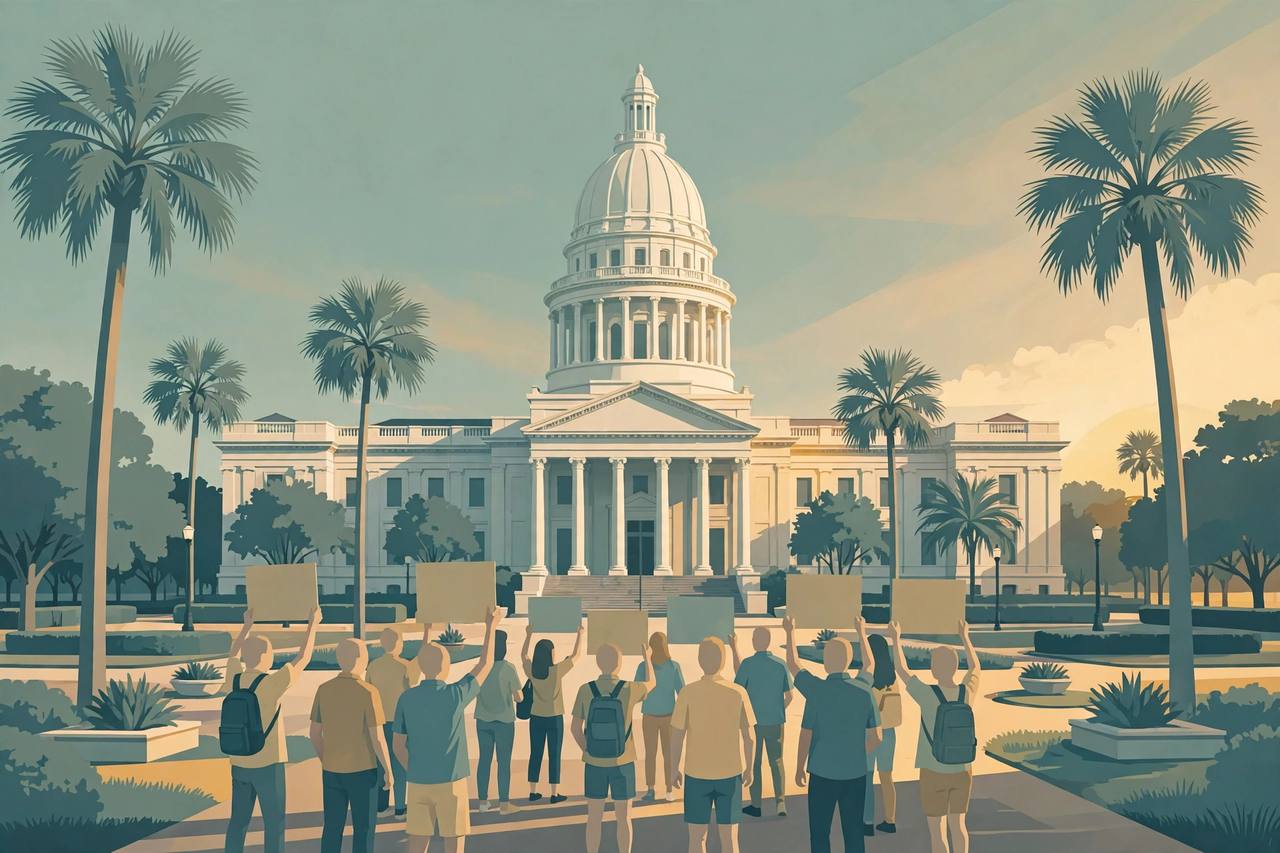
TALLAHASSEE, Florida — Immigrant rights groups rallied in Florida's capital on Tuesday, November 24, to protest the possibility that the state's governor could suspend Tallahassee city officials for ending the city's immigration enforcement agreement with U.S. Immigration and Customs Enforcement (ICE). The protest came six days after the Tallahassee City Commission voted unanimously to begin the process of leaving the agreement, setting up a direct confrontation between the city's new leadership and the incoming Republican governor.
The demonstrators argued that the commission should go to court to protect itself before the governor acts, according to local television station WCTV. Their message was aimed at two men: Governor-elect Byron Donalds, who takes office on January 5, 2027, and Attorney General James Uthmeier, whose office has said that ending a 287(g) agreement without good reason could violate Florida's ban on sanctuary policies — and that the governor holds the power to suspend a city commissioner who breaks the law.
What the city voted to do
On November 18, the Tallahassee City Commission voted 5-0 to bring back an agenda item at a future meeting laying out a process to pull out of the 287(g) agreement between the Tallahassee Police Department and ICE. The vote did not end the agreement on the spot. It set in motion a formal process, with the commission expected to take up the question again in December 2026.
Commissioner Jack Porter made the motion after more than an hour of public speakers argued against the agreement. "I'm ready to move forward to exit the 287(g) agreement," Porter said, according to the Tallahassee Democrat. Commissioner Dianne Williams-Cox, who had pushed for the item, asked the commission to weigh the legal risks of cancelling the deal before it acts.
The vote was the first major act of the city's new progressive majority. Mayor Jeremy Matlow, newly elected Commissioner P.J. Perez and re-elected Commissioner Dianne Williams-Cox were sworn in on November 16, joining Porter and Curtis Richardson on the five-member commission. Matlow had campaigned on ending the agreement, and the commission's move was reported by local media as the first step toward doing so.
What the 287(g) agreement does
Under Section 287(g) of federal immigration law, ICE can authorise trained state and local officers to carry out certain federal immigration enforcement duties under ICE supervision. The Tallahassee Police Department entered into such an agreement last year. In practice, it means local officers can be drawn into federal immigration enforcement work that would otherwise be done only by federal agents.
Critics of the agreements say they turn routine local policing — traffic stops, minor arrests, jail bookings — into a pipeline to federal detention and deportation, and that fear of that pipeline keeps immigrant families from calling the police or reporting crimes. Supporters, including the state attorney general's office, say the agreements are part of cooperating with federal partners and protecting public safety, and that Florida law requires local governments to make their "best efforts" to support federal immigration enforcement.
The governor-elect's warning
A day after the commission's vote, Governor-elect Byron Donalds issued a public warning on X. "Florida is not a sanctuary state, and as Governor, I will never let it become one," he wrote. "Florida cities must comply with federal and state laws — full stop." Donalds, a Republican, defeated Democrat David Jolly in the November 3 general election and will be sworn in as Florida's 47th governor on January 5, 2027.
Attorney General James Uthmeier, who was also re-elected this month, backed the warning the same day. His office had sent a letter to the City of Doral on November 18, written by Deputy Attorney General Greg Slemp, saying that a city's "failure to execute a 287(g) agreement does not by itself violate Florida law but may provide evidence of an unlawful sanctuary policy," and that choosing to "rescind or terminate an executed 287(g) agreement, without sufficient justification, likely demonstrates a sanctuary policy and lack of 'best efforts.'"
Uthmeier repeated the point on X: "As we told the Doral City Council yesterday, walking back from a 287(g) agreement would demonstrate forbidden sanctuary policies and a lack of best efforts to support federal immigration enforcement. Supporting our federal partners and protecting our sovereignty isn't optional. It's the law."
Why the protesters say the city should sue first
The groups that rallied on Tuesday want the commission to act before the governor does. Their argument, as reported by WCTV, is that the city should file a lawsuit challenging the governor's power to suspend officials over the agreement, rather than waiting for a suspension order to land. Whatever happens next, the station reported, the issue is likely headed to court.
The legal question is not settled. Florida law does not necessarily require local governments to sign a 287(g) agreement in the first place. The attorney general's office argues that cancelling one that is already signed is different — that it can amount to a sanctuary policy, which state law does forbid. The commission, for its part, has said it wants to weigh the legal peril before it takes a final vote, which is why Williams-Cox asked for the risks to be laid out first.
Doral is watching the same fight
Tallahassee is not the only Florida city in this position. The Doral City Council, in Miami-Dade County, held a public discussion about its own 287(g) agreement on November 23, with residents speaking both about fear in immigrant families and about the attorney general's letter. Doral's council decided to wait for an updated legal opinion from the attorney general's office, which was sent to the city on November 18. Doral generates the most calls to Florida's immigrant hotline in Miami-Dade County, according to advocates who spoke at the meeting, and the city has a large Venezuelan community affected by the end of Temporary Protected Status for Venezuela.
Tallahassee has been here before. On October 22, 2025, the commission voted 3-2 against withdrawing from the agreement. The difference now is the election: the new majority was sworn in on November 16, and within two days it had voted to move toward an exit.
A wider post-election wave
The Tallahassee fight is part of a wider shift since the November 3 elections, in which Democrats won the governor's office and other statewide posts in Texas and made gains in Florida cities. In Houston, Mayor John Whitmire signed an executive order limiting police contact with ICE to arrests for jailable offences and cases with an ICE warrant. In Austin, Mayor Kirk Watson asked the police chief to revise the department's rules on ICE warrants, and San Antonio council members have sought similar changes. In Texas, a 2025 state law sets a December 1, 2026 deadline for sheriffs to sign 287(g) agreements — a deadline that is now colliding with the new political landscape.
For immigrant families in Florida, the stakes are immediate. Advocates say that when local police are seen as an arm of federal immigration enforcement, families avoid public spaces, keep children home from school activities and hesitate to report crimes. The Tallahassee protesters' demand was simple: that the city be allowed to decide for itself how its own police department works with federal agents — and that no governor should be able to remove elected local officials for making that choice.
The commission is expected to consider ending the 287(g) agreement in December 2026. Governor-elect Donalds takes office on January 5, 2027. The attorney general's office has warned that cancelling the agreement could be treated as a sanctuary policy, and immigrant rights groups are urging the city to file a lawsuit before any suspension is attempted. The dispute is likely to be decided in court.
What is solid
- The Tallahassee City Commission voted 5-0 on November 18 to start a process to exit its 287(g) agreement with ICE.
- Governor-elect Byron Donalds warned on November 19 that Florida cities must comply with federal and state law and that he will not let Florida become a sanctuary state.
- Immigrant rights groups protested in Tallahassee on Tuesday, November 24, against the possible suspension of city officials over the agreement.
- The attorney general's office wrote to Doral on November 18 that rescinding a 287(g) agreement without sufficient justification likely demonstrates a sanctuary policy.
What is only claimed
- Whether cancelling a signed 287(g) agreement amounts to an unlawful sanctuary policy under Florida law — the attorney general's office says it likely does; the city and immigrant advocates dispute that reading.
- Whether the governor can suspend a city commissioner over the agreement — the attorney general's office says the governor holds that authority; the question has not been tested in court on these facts.