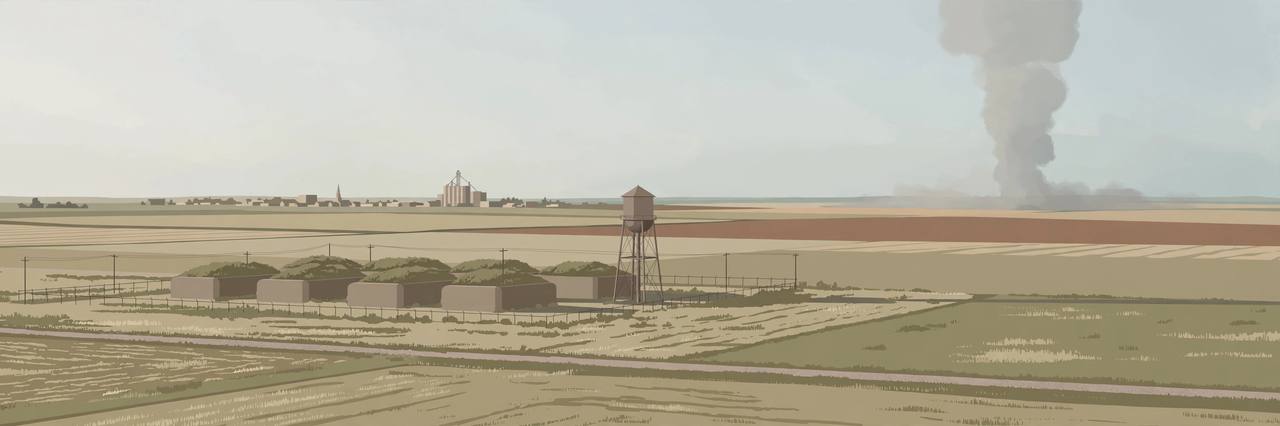
The U.S. Army will set off two controlled detonations at the Iowa Army Ammunition Plant near Middletown, Iowa, around noon on Friday, November 20, to destroy nearly five tons of degraded lead azide — an explosive so unstable that the Army says it is too dangerous to move — and residents across southeast Iowa and into Illinois are bracing for a dust plume that could carry lead particles for miles.
Source: Associated Press
What will happen on Friday
The Army will detonate the material where it sits, in two blasts around noon on Friday. The lead azide is held in an ethanol-and-water solution in two underground concrete storage containers at the plant. Army spokesperson Justine Barati said investigations early this year found those tanks had dried out too much and the lead azide was forming crystals, making it dangerously sensitive to friction and shock.
Moving the material is not an option, the Army says: transporting it now carries an unacceptable risk of setting it off by accident, which could kill the explosives technicians handling it. Detonating it in place, the Army says, is the safest option. The operation is governed by an emergency permit issued by the U.S. Environmental Protection Agency on November 13 under the Resource Conservation and Recovery Act, the federal hazardous-waste law.
Where the lead dust could go
The blasts will send up a dust plume containing lead. The Army's own modelling shows airborne lead particles travelling up to about 100 miles to the northeast, with dust settling on surfaces for about 40 miles downwind — a corridor running from Burlington through the Quad Cities area toward Maquoketa, taking in Muscatine, Wilton, Durant and Tipton, and reaching across the Mississippi River into Illinois, including the area around New Boston.
The Army released its first plume map on Sunday, November 15, and says the maps will change with the weather forecast. Updated maps are due 48 hours before the detonation, then six hours before, and every hour after until the blast. The Army expects airborne dust to linger for no more than about an hour, depending on wind speed, and will issue a final estimate of the affected areas after the detonation is complete. The Army also warns residents not to assume they are outside the impact zone based on the maps, because the projected area changes as forecasts are updated.
What residents are being told to do
Residents in the Middletown City Park neighbourhood are being asked to temporarily leave their homes from 8 a.m. to 2 p.m. on Friday, because the detonations could cause ground vibrations strong enough to damage windows. Those who need a place to stay are invited to the Armed Forces Reserve Center at 16815 DMC Highway 34 in Middletown, where the Army will also host media to view the detonation. Schools in Mediapolis, West Burlington and Danville have cancelled classes for Friday. People remaining in the affected zone are advised to stay inside with doors and windows closed until the Army announces an all-clear, and to set ventilation systems to recirculate air until the plume passes.
Stay indoors with windows and doors closed until the all-clear, set ventilation to recirculate, and avoid touching dust that settles on soil, vehicles, play equipment and outdoor surfaces until authorities advise it is safe.
Why lead worries health officials
The Centers for Disease Control and Prevention says there is no known safe blood lead level in children. Even low levels can harm learning, attention and development, and children under six are at greatest risk because their brains and nervous systems are still developing. The CDC's blood lead reference value for children is 3.5 micrograms per deciliter — a screening benchmark, not a safety threshold. Iowa already carries a heavy lead burden. In 2023, 1,032 Iowa children under age six who were tested had a confirmed elevated blood lead level of 3.5 or more, and 287 of them had levels of 10 or more — but only about 8 percent of Iowa children under six were tested that year, so the true number is likely higher. Iowa health officials say more than 1,200 children under age six are affected by lead poisoning in the state each year, and a University of Iowa study published in June 2025, following 305,000 Iowa children born between 1989 and 2010, found that even small increases in blood lead levels were linked to lower maths and reading scores from second grade through eleventh grade, including at levels below the CDC's reference value.
A plant with a long contamination history
The Iowa Army Ammunition Plant covers about 19,000 acres roughly four miles west of Burlington. Built in November 1940, it began production in 1941 and is government-owned and contractor-operated. The Environmental Protection Agency placed the site on the Superfund programme's National Priorities List in 1990: historical operations released hazardous substances into soil, surface water and groundwater, and lead is listed among the site's contaminants of concern, along with explosives, metals, volatile organic compounds and depleted uranium. About 10,000 people live within three miles of the site, and cleanup work continues under federal oversight. The Army says it has taken extraordinary measures to mitigate the plume, including earthworks, soil wetting and air sampling, with air monitors set up for perimeter monitoring during the event and environmental sampling of the blast radius to follow. Soil sampling is due to start within 24 hours of the blast. The Iowa Environmental Council has called on federal and state leaders to provide immediate transparency about the health risks, and Illinois officials have said the EPA office that approved the detonation never told Illinois — even though the Army's own maps show lead dust crossing the river. What happens next will be decided by what the post-blast sampling finds, and by whether the Army's final plume estimate matches what residents on the ground actually experience on Friday.