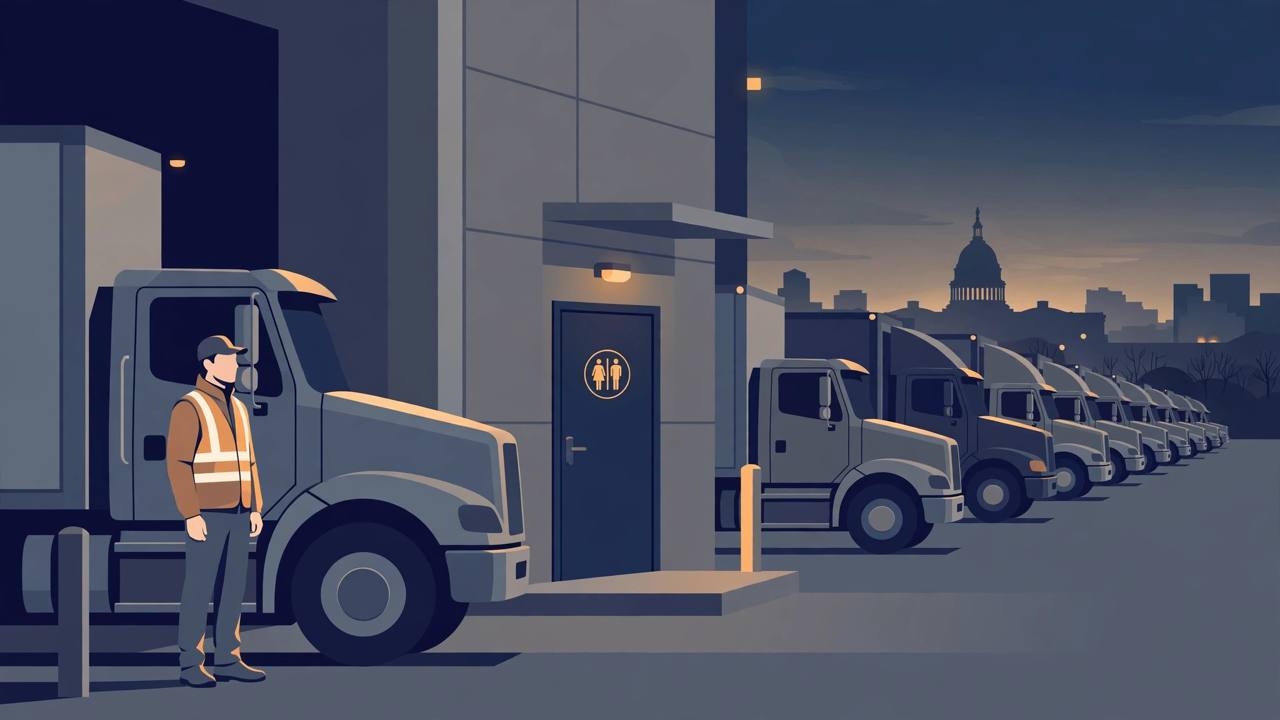
The Trucker Bathroom Access Act cleared the Senate Committee on Commerce, Science, and Transportation on Wednesday, November 18 — advanced by voice vote, as amended — just five days after it was introduced in the Senate for the first time, the furthest this long-running drivers' campaign has ever reached in Congress.
Source: U.S. Senate Committee on Commerce, Science, and Transportation
This is a follow-up development: Awaaz Punjab reported on November 13, when Senators Lisa Blunt Rochester, a Delaware Democrat, and Deb Fischer, a Nebraska Republican, introduced the bill, S. 5718. Wednesday's markup was the next step the November 13 report pointed to — the committee vote that decides whether a bill goes to the full Senate — and the bill passed it.
What happened in the markup
The committee's official release lists S. 5718, the Trucker Bathroom Access Act, among the legislation advanced by voice vote, “as amended by the Blunt Rochester substitute, as modified.” It was part of a larger executive session that advanced twelve bills, four of President Trump's nominations and multiple Coast Guard promotions. Committee Democrats boycotted the markup — for the second time in the 119th Congress, the committee said — in protest over the nomination of Danielle Thumann Severs to the Federal Communications Commission. Republican members advanced the bill without objection, Land Line Media, the Owner-Operator Independent Drivers Association's news outlet, reported.
Source: Land Line Media
What the bill would require
The act is deliberately narrow. It would ensure that truck drivers have access to a restroom while they are picking up or delivering cargo and waiting at shipper and receiver facilities — the same access the business already gives its own customers or employees. It does not require any business to construct new facilities. Transport Topics reported that the bill covers commercial motor vehicle operators who are subject to federal hours-of-service rules, and that the access duty applies where providing it poses no safety or security risk.
Source: Transport Topics
The American Trucking Associations praised the committee vote as a major legislative milestone. ATA's Chief Advocacy and Public Affairs Officer, Henry Hanscom, described the passage as a breakthrough in efforts to address the basic needs of professional drivers, and the association credited its Women In Motion Council, which had made the measure a central priority.
The bill's backers span the industry: the Owner-Operator Independent Drivers Association, which originated the idea, the American Trucking Associations, the Women in Trucking Association, She Trucking and Trinity Logistics all supported the Senate introduction. Supporters frame restroom access as a basic dignity and retention issue, and one that matters more as more women enter the driving workforce — a point ATA's Women In Motion Council has pressed in Washington.
Why drivers — including Punjabi truckers — care
Drivers routinely wait for hours at warehouses and distribution centres to be loaded or unloaded, and being refused the restroom at the dock is one of the most common everyday grievances in the job. North American trucking depends heavily on immigrant drivers, and Punjabi drivers are a large and visible part of the workforce on both sides of the Canada–U.S. border, including on the cross-border corridors many Awaaz Punjab readers drive. For those readers, this bill is not an abstract Washington story: it is about the conditions at the facilities where they spend their working weeks.
What happens next
Committee passage is not law. The bill now goes to the full Senate. It also has a second route: the House companion, led by Representatives Troy Nehls of Texas and Chrissy Houlahan of Pennsylvania, was approved by the House Transportation and Infrastructure Committee in May for inclusion in the House highway bill, the BUILD America 250 Act. To become law, the measure still needs passage in both chambers and the president's signature — and if Congress does not act before the new Congress begins on January 3, 2027, it would have to be reintroduced and start over. For now, nothing changes at the dock this week: drivers' restroom access remains a matter of each facility's policy until a law says otherwise.