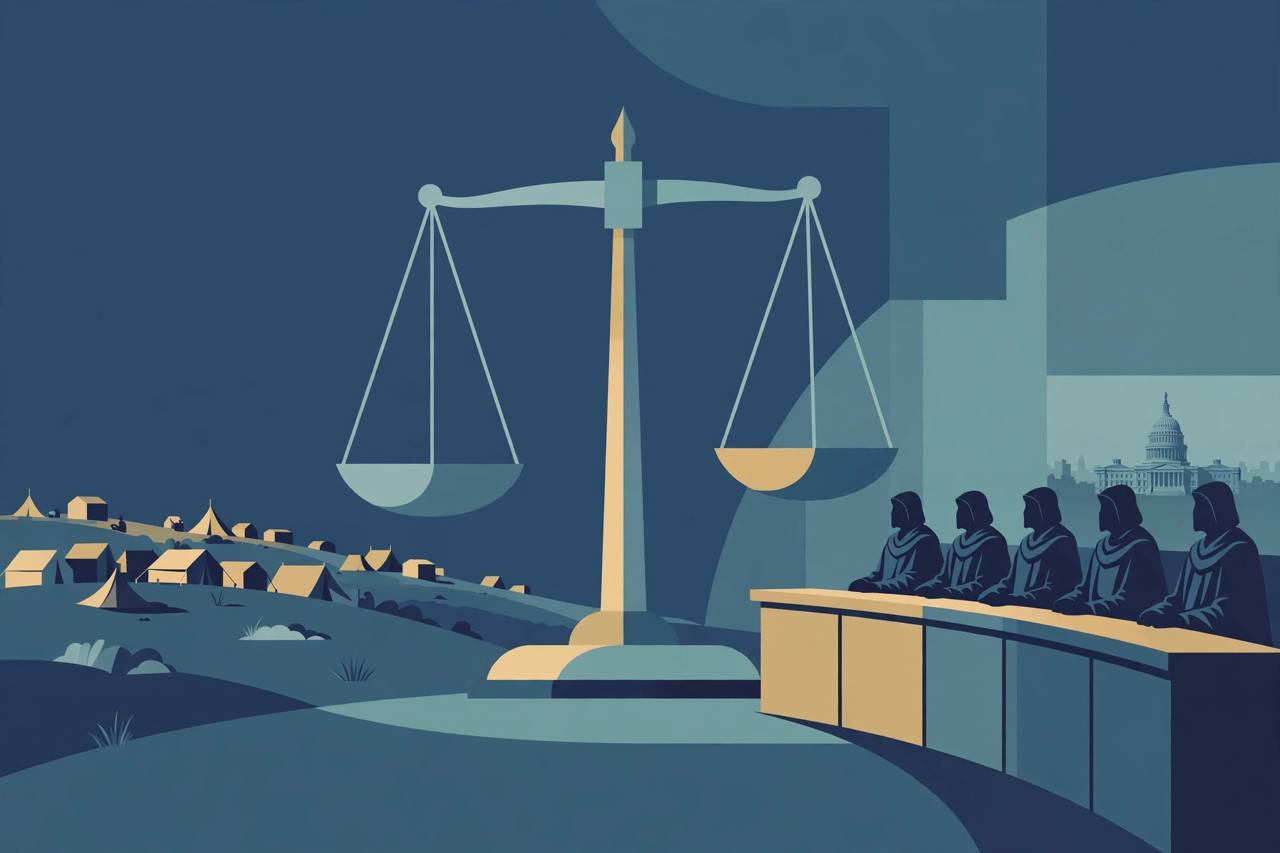
This is a new development on top of the court's November 3 announcement that it will deliver the Rohingya genocide judgment on November 19 — a ruling first reported by Awaaz Punjab when the date was set. Read the earlier report: World Court to rule in Rohingya genocide case on November 19
THE HAGUE — Fears are growing that the United States could impose sanctions on judges of the International Court of Justice (ICJ), including this year's Nobel Peace Prize winner Navi Pillay, if the court rules on Thursday, November 19, that Myanmar's government committed genocide against the Rohingya, The Guardian reported on Wednesday. The ICJ has never before found a state responsible for committing genocide.
Source: The Guardian, Nov 18, 2026, via Bytes Europe
Judges at the court have taken advice on how to protect their assets from possible American sanctions, The Guardian reported, because a genocide ruling could be read in Washington as lowering the legal threshold for the crime. The Foundation for Defense of Democracies, an influential thinktank close to the White House, has predicted that a genocide ruling will lead the United States to impose sanctions on the ICJ itself.
No US sanctions against ICJ judges have been announced. A separate analysis of the pressure on the court noted that the UK Parliament's research service said there was no public indication of Pillay's position in the proceedings and that judicial deliberations are confidential.
Source: Polaris Insights, Nov 18, 2026
Why the word 'intent' is at the centre of the fight
A significant factor in previous genocide cases has been how to prove intent — the crime is defined as acts committed with the intent to destroy, in whole or in part, a national, ethnical, racial or religious group. Lawyers representing Rohingya survivors say patterns of behaviour by Myanmar's military, including killing people as they fled, show clear attempts to destroy the group during assaults on Rakhine State in 2016 and 2017. Myanmar has denied carrying out a genocide and says its actions targeted a military uprising by insurgents.
The United States and Israel fear the final judgment may clarify how a government's intent to commit genocide is established, setting a precedent that makes it more likely the court will later rule that Israel committed genocide in Gaza — a charge Israel denies. In a 24-page submission jointly filed by the United Kingdom and five other mainly European states, governments argued the court should assess intent from a range of facts and circumstances, comprehensively and holistically, and stressed that genocide is not defined solely by killings: the treatment of children, gender-based violence and forced displacement are also relevant.
Washington's warnings, in its own words
Mike Waltz, the US ambassador to the United Nations, has sent what The Guardian called a warning shot to Pillay and the court's 15 judges, saying Washington “will not allow globalist, faux judges to weaponise the law against our troops”. Waltz asserted last month that Pillay was “tipping the scales” in the Myanmar proceedings, intending to lower the legal threshold for proving genocide so a weakened standard could later be used against American and allied soldiers, and told her: “We see your agenda and we'll be watching the ICJ's handling of these proceedings very closely.” Pillay sits as an ad hoc judge chosen by The Gambia, which brought the case; she is required to act as a jurist, not as an advocate for The Gambia, and was awarded the Nobel Peace Prize in October.
In a speech last Friday, US Secretary of State Marco Rubio said: “For this global elite, international law … is an instrument to advance their interests under the pretence of universal principles.” He also warned the separate International Criminal Court (ICC) against quoting laws to “men with swords”, The Guardian reported.
The ICC precedent Washington has already set
The fears rest on a record: the United States has already imposed sanctions on judges at the ICC after that court issued arrest warrants against Israeli Prime Minister Benjamin Netanyahu, and has announced sanctions against the entire ICC as an institution, which it described as a “rogue court”. The ICJ is a different body — it settles disputes between states, while the ICC prosecutes individuals. Rubio has given the ICC until April to respond to his criticisms before he imposes sanctions, and on Friday the ICC formally decided to drop plans to prosecute US soldiers and intelligence agents over potentially unlawful acts in Afghanistan — a move The Guardian said may make Washington more willing to abandon its plan to sanction the ICC. The Guardian also noted that the United States, under former secretary of state Antony Blinken, had itself determined that Myanmar had committed genocide.
What is solid
- The ICJ delivers its judgment in Gambia v. Myanmar on Thursday, November 19; it has never found a state responsible for genocide — The Guardian / ICJ announcement
- ICJ judges have taken advice on protecting their assets from possible US sanctions, and the Foundation for Defense of Democracies has predicted a genocide ruling will trigger US sanctions on the court — The Guardian
- US ambassador Mike Waltz publicly warned ad hoc judge Navi Pillay and the court's 15 judges over the Myanmar proceedings — The Guardian
What is only claimed
- Whether Washington will actually sanction ICJ judges: no such sanctions have been announced, and the prediction comes from a thinktank close to the White House — The Guardian / Polaris Insights
- Whether Myanmar committed genocide: The Gambia and Rohingya survivors' lawyers say the 2016-17 Rakhine assaults show intent to destroy the group; Myanmar denies genocide and says it targeted an insurgent uprising
The judgment is read at The Hague on Thursday, November 19, starting at 8:00 a.m. GMT. The ruling is final for the parties. Any US response — sanctions or otherwise — remains unannounced, and Awaaz Punjab will report the verdict and Washington's reaction as separate, verified developments.