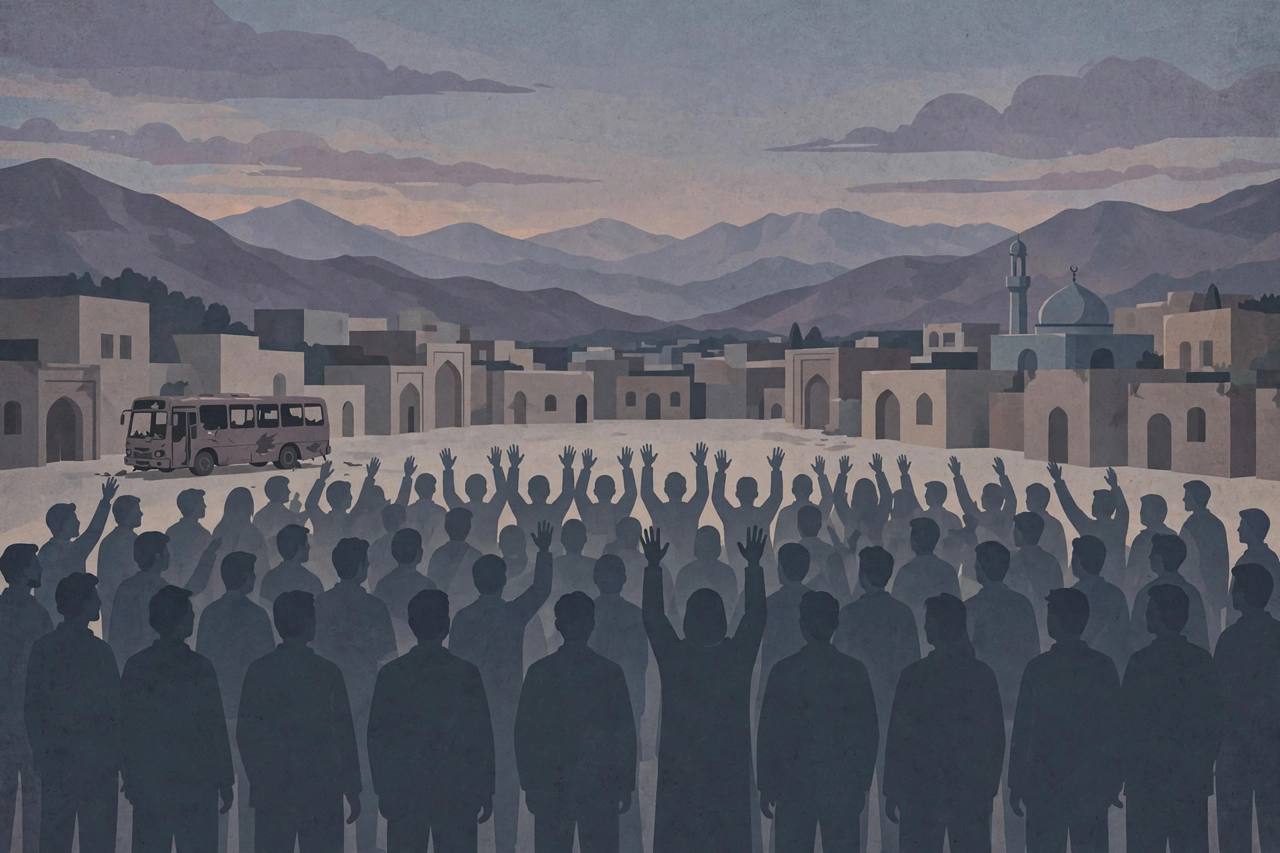
Hundreds of people protested in Abdanan, a city in Iran's western Ilam province near the Iraqi border, on Tuesday, November 17, after a bus crash killed 13 oil and gas workers — and a gathering that began as a demand for accountability over road safety turned into a rare open protest against Iran's rulers, with chants of “Death to the dictator” and “Long live the Shah” reported by eyewitnesses.
Source: CBS News via Bytes Europe
The bus, carrying employees of the Dehloran gas processing project, overturned on Saturday, November 14, on a road in Ilam province, killing 13 workers and injuring 14, according to witness accounts given to Iran International. Iranian media reports put the injured at more than a dozen. Residents first gathered in Abdanan's Vali-e Asr Square to mourn the dead and demand answers over the crash.
Iran's Fars news agency, which is closely affiliated with the Islamic Revolutionary Guard Corps (IRGC), confirmed the protest took place in Vali-e Asr Square and said the crowd grew to about 1,000 people. Fars acknowledged that slogans chanted at the gathering took on a “political tone” after initially focusing on the accident, according to AFP's November 17 report cited by Fox News Digital.
Source: Fox News Digital
“At first, people were mostly angry about the accident, but gradually the slogans became political and against the government,” a shopkeeper named Jamshid, who witnessed the demonstration, told CBS News by phone. He said security forces eventually dispersed the crowd by force, using tear gas and firing warning shots. Witness accounts given to Iran International likewise said security forces fired into the air and used tear gas to disperse demonstrators.
Iran's state broadcaster IRIB portrayed the gathering very differently, calling it “another failure of the counter-revolution plan” and claiming residents had come out to quell the unrest themselves in support of the government. A Tehran resident who spoke to CBS News anonymously, citing safety concerns, disputed that account: “The accident brought people into the streets, but the anger wasn't only about the workers who died. People were chanting against the government, even against the new supreme leader, and some were supporting the exiled crowned prince.”
A city that rose early in January
Abdanan carries particular significance because it was among the first cities to rise during Iran's nationwide anti-government protests in January 2026. Reuters reported on January 9 that it had verified footage of demonstrators marching through the city during that uprising, and reported again on February 18 that witnesses and activists said security forces opened fire on hundreds of mourners at a cemetery in Abdanan during ceremonies for protesters killed in January. Tuesday's protest is another outbreak of public anger in a city with a recent history of confrontation with the authorities, in a predominantly Kurdish province.
Officials have moved on two tracks. Abdanan prosecutor Amrollah Misaie warned, according to the judiciary-affiliated Mizan news agency as quoted by AFP, that “individuals who seek to exploit this incident to disrupt public order or incite public sentiment will be dealt with firmly.” At the same time, prosecutors have announced legal proceedings against the company and provincial transportation officials over the crash itself, although responsibility has not been established in court. Euronews Persian reported on November 17 that provincial traffic police had identified driver negligence, irregularities involving the company's bus contract and inadequate road barriers as factors in the accident.
New reports on Wednesday said security forces had arrested at least seven people during the unrest. The Hengaw Organization for Human Rights said two of the detainees had been released while the whereabouts of five others remained unknown, and the Kurdistan Human Rights Network separately reported that security forces fired tear gas at demonstrators and that internet access was disrupted during the crackdown. These arrest figures come from rights organisations and have not been confirmed by Iranian authorities.
At the United Nations' daily briefing on Tuesday, a UN spokesperson asked about the situation said the organisation was keeping an eye on developments: “We want to make sure that all peaceful protests are allowed to proceed without obstruction and without harassment of protesters,” the spokesperson said, adding that UN human rights colleagues would continue to monitor the situation.
Public anti-government chanting has been rare and dangerous in Iran since the deadly January crackdown, in which thousands were killed according to reporting cited by analysts. That a road accident in a small western city could bring about 1,000 people into a square — with even the IRGC-affiliated Fars agency acknowledging the political slogans — shows how quickly a local grievance over workers' safety can become a challenge to the system itself.
What is solid
- A bus carrying Dehloran gas project workers overturned on November 14 in Ilam province, killing 13 workers (Iranian media; Iran International witness accounts).
- A protest took place in Abdanan's Vali-e Asr Square on November 17 and grew to about 1,000 people, with slogans taking a political tone (Fars news agency, via AFP).
What is only claimed
- State broadcaster IRIB claims residents turned out in support of the government; eyewitnesses speaking to CBS News and Iran International describe an anti-government protest dispersed with tear gas and warning shots.
- Arrest numbers (at least seven detained) come from the Hengaw Organization for Human Rights and have not been confirmed by Iranian authorities.