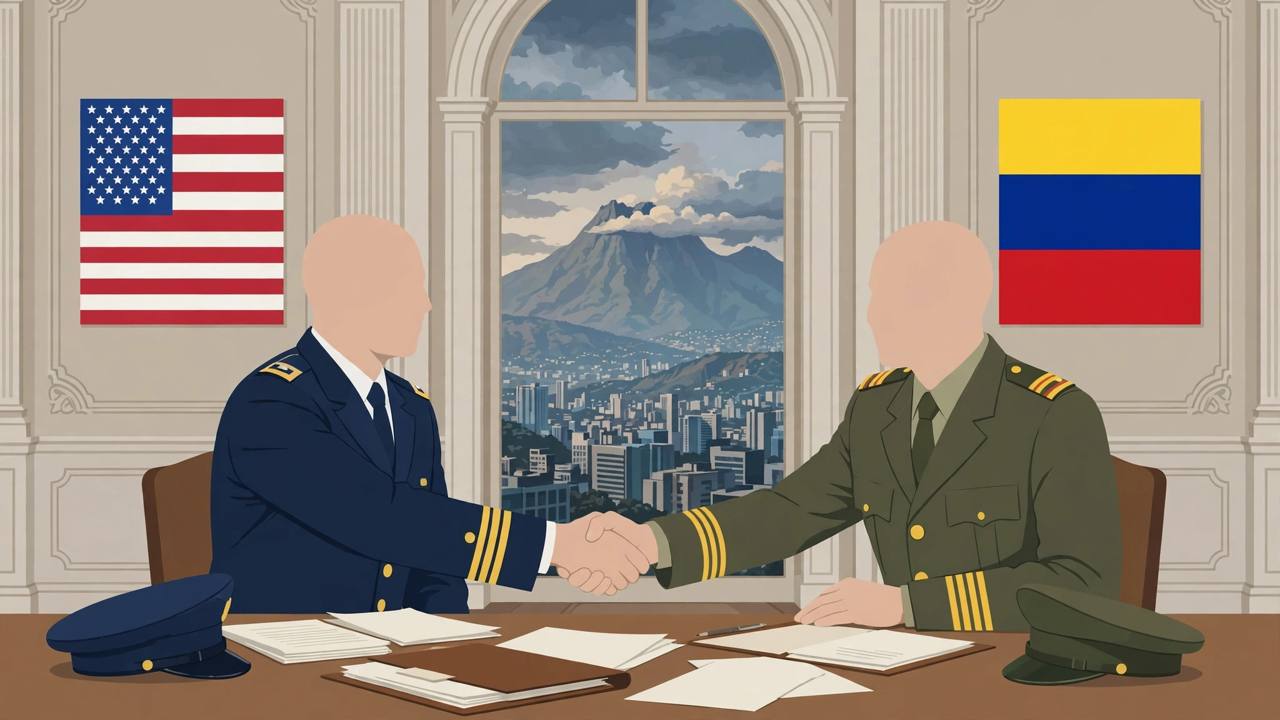
The United States and Venezuela have signed a deal to reestablish military ties, from training to intelligence sharing, U.S. Defense Secretary Pete Hegseth said on Wednesday, November 18, in Caracas, on a visit with the South American nation's interim leaders, the Associated Press reported.
Source: Associated Press via Military.com
Agence France-Presse independently confirmed that an agreement had been announced, reporting that Hegseth described a "military cooperation agreement" and a partnership against narco-terrorist and criminal enterprises. AFP did not describe the agreement as signed or specify training and intelligence sharing as its scope — those details come from Hegseth's own announcement as reported by AP.
Source: AFP confirmation via The Library Estate summary
Hegseth said that following the January capture of Venezuelan President Nicolas Maduro by the U.S. military, the country "has gone from our most aggressive regional threat to a compliant security partner."
He also praised the "close cooperation" with interim President Delcy Rodriguez that allowed officials "to stabilize Venezuela and rid it of narco-terrorists once and for all," AP reported.
Rodriguez separately lauded the opportunity to strengthen the military partnership. "I hope that this technical-military cooperation … can be brought to its highest possible level, so that ... we may address common threats," she said, according to AP.
The Pentagon did not immediately offer further details on the new partnership. No deal name, published text, timeline, named signatories or specific training or intelligence-sharing arrangements have been reported.
The latest Cabinet visit to Caracas
Hegseth's visit underscores efforts by President Donald Trump's administration to deepen its influence in Venezuela since U.S. forces ousted Maduro in January, AP said. Hegseth is the latest member of Trump's Cabinet to travel to Venezuela, following visits this year by the Interior and Energy secretaries, who focused on efforts to tap its oil reserves and critical minerals.
Trump said in August that Hegseth helped broker a sweeping deal for the U.S. to take control of some Venezuelan oil reserves. The head of U.S. military operations in Latin America, Gen. Francis Donovan of U.S. Southern Command, has also met interim authorities in Venezuela at least twice this year, AP reported.
Background: boats, oil and an uncertain transition
The U.S. military has been expanding its attention on the region since Trump returned to the White House last year. To try to stem the flow of narcotics, American forces have been attacking what the Trump administration says are boats smuggling drugs in the Caribbean Sea and the eastern Pacific Ocean. At least 240 people have been killed since the administration began targeting those it calls "narcoterrorists" in September 2025, although U.S. officials have released little public evidence to support claims the vessels were carrying drugs, AP reported — that casualty figure and the drug-smuggling claim are the administration's, attributed here, not independently verified in this report.
Rodriguez, a Maduro ally, took over after Maduro's capture. Her court-allowed term expired in July, but she continues to function as Venezuela's head of state, and no date has been announced for the next presidential election, AP said. The Trump administration says it has returned more than $12 billion — yaani over twelve billion dollars in oil revenue — or almost 99%, of the revenue obtained from sales of Venezuelan oil back to the country under the energy deal reached with Rodriguez's government, according to a report released this month; that figure is the administration's own account.
What happens next
What happens next depends on details neither government has yet published: which units would train together, where any training would take place, what intelligence would be shared, and whether any agreement requires further approval. Until the Pentagon or Caracas releases the text or an implementation timetable, Wednesday's deal is a signed commitment to rebuild military cooperation, not yet a visible joint operation.