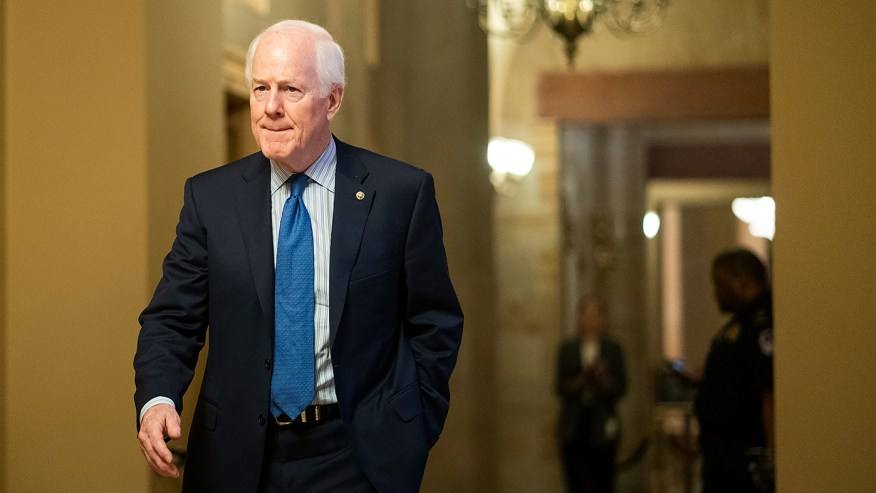
Texas Sen. John Cornyn said on Wednesday that he will block one of President Donald Trump's final judicial picks, telling the Associated Press that he has not returned the “blue slip” for Elliot Gaiser — the Justice Department official nominated to a federal judgeship in Dallas — and does not plan to do so.
Source: Associated Press
The decision is the decisive turn in a standoff Awaaz Punjab first reported on November 15, when Cornyn had declined to commit to Gaiser's nomination and the nomination was stuck ahead of a Senate Judiciary Committee hearing scheduled for Wednesday. On Wednesday, the hearing day itself, Cornyn made the block explicit and on the record, a Senate aide confirmed to Reuters that Gaiser would not appear before the committee.
A blue slip is effectively a permission slip from a nominee's home-state senators. By Senate custom, a senator can veto a trial-court nominee in their own state simply by refusing to return the form, which signals support and allows the confirmation process to advance. Cornyn's refusal therefore stops Gaiser in place, however strongly the White House backs him.
“Not from Texas, hasn't been vetted”
“He's not from Texas. He hasn't been vetted. And this is a lifetime job, and there's better qualified people to hold that job,” Cornyn said in an interview on Wednesday. “This is part, of course, of the constitutional responsibility of senators in the Senate to provide advice and consent. But it's hard to provide advice and consent when there's zero consultation, which happened in that case.” A day earlier, at an event hosted by the Atlantic, he put it more bluntly: “The Senate's not supposed to be a rubber stamp, and what I've said is we have been too often.”
Gaiser, 37, leads the Justice Department's Office of Legal Counsel, a key unit that has frequently signed off on the legality of the administration's actions. He is a former Ohio solicitor general and previously clerked for conservative Supreme Court Justice Samuel Alito. According to his nominee questionnaire sent to the Senate Judiciary Committee, he was first contacted by Texas Sen. Ted Cruz's staff about becoming a federal judge on November 4, the day after the election. Cornyn has repeatedly raised concerns that Gaiser was not vetted by the bipartisan federal judicial evaluation committee traditionally used in Texas, and Trump nominated him to the U.S. District Court for the Northern District of Texas, the Dallas-area court, after the election.
Source: Reuters
Cornyn's alternative: Fort Worth lawyer Steve Fahey
Cornyn stressed that he does not want to leave the seat vacant, and said the White House has requested information about his preferred candidate, Fort Worth lawyer Steve Fahey. Fahey served in the U.S. Attorney's Office for the Northern District of Texas from 2003 until 2021 and was a partner at Kirkland and Ellis until starting his own firm in 2024. Cornyn said he did not know whether Gaiser would be formally withdrawn, and sounded almost apologetic about the nominee himself: “He's a very bright young man, and I think has a very bright future. I kind of feel bad that he's been used basically as a pawn in this process.”
Texas's other senator pushed back hard. Republican Sen. Ted Cruz warned in a statement that if Gaiser does not advance, “the people of Texas will pay the price because it will effectively give the judicial seat to the Democrats, who will keep it vacant in perpetuity.” A White House official, meanwhile, said in a statement that it expects all of Trump's judicial nominees to be confirmed by the end of the year.
The Republican-led Senate is scrambling to fill every remaining federal court vacancy before Democrats assume power in January. Democrats take control of the Senate on January 3, so a Dallas seat left unfilled now is a seat the White House may not get to fill at all.
Part of a wider lame-duck resistance
Cornyn's block is the latest instance of a Republican senator refusing to back a White House judicial nominee from their home state during the lame-duck session. Cornyn, a member of the Senate Judiciary Committee who lost a primary to a Trump-backed challenger and is leaving the Senate, did not address Gaiser's nomination at Wednesday's hearing — even as he expressed support for Trump's separate decision to nominate Texas Supreme Court Justice James Sullivan, who was defeated by a Democrat in the recent election, to serve as a federal judge. Two of Trump's other nominees have run into similar home-state resistance since the midterms: on November 10 the White House rescinded U.S. District Judge Lee Rudofsky's nomination to the 8th U.S. Circuit Court of Appeals and nominated Arkansas Supreme Court Justice Cody Hiland in his place, following opposition from Arkansas's Republican senators; Hiland appeared at Wednesday's hearing alongside other nominees.
What happens next turns on the White House. It can withdraw Gaiser and take up Cornyn's candidate, Fahey; it can try to pressure Cornyn to relent; or it can leave the nomination to expire when the Senate changes hands on January 3 — the outcome Cruz warned would hand the seat to the Democrats. For courts in the Northern District of Texas, which handles cases from Dallas and Fort Worth, the practical effect is immediate: a lifetime seat stays empty while the two sides decide who blinks first.